
10 Days in Morocco: The Perfect First-Timer’s Itinerary
 By TravelSpatial ·
· 11 min read
By TravelSpatial ·
· 11 min read
 31.63°N 7.99°W
The route at a glance
Ten days is the sweet spot for a first trip to Morocco. It’s enough time to see the four places most people dream about without spending every day on a bus: Marrakech, a night under the stars in the Sahara, the medieval medina of Fes and the blue mountain town of Chefchaouen.
The route runs one way, south to north, so you never backtrack. Fly into Marrakech and out of Fes or Tangier. Most airlines let you book this as a multi-city ticket, often for about the same price as a return.
If you’ve seen one photo of Morocco, it was probably taken in one of these four places: the smoky food stalls of Jemaa el-Fna, camels cresting an orange dune, a maze of leather-dyeing vats in Fes, or a blue staircase in Chefchaouen. This itinerary links all four in a single loop, with real prices and travel times, so you can spend less time planning and more time drinking mint tea.
| Days | Where | Sleep | Getting there |
|---|---|---|---|
| 1–3 | Marrakech | Riad in the medina | Fly in |
| 4 | Atlas Mountains, Aït Benhaddou, Dadès Valley | Hotel in the Dadès Gorge | Desert tour, day 1 |
| 5 | Todra Gorge, Merzouga | Desert camp in the Erg Chebbi dunes | Desert tour, day 2, camel ride at sunset |
| 6 | Middle Atlas, Ifrane, Fes | Riad in Fes | Desert tour, day 3 |
| 7–8 | Fes | Riad in Fes | |
| 9–10 | Chefchaouen | Guesthouse in the medina | CTM bus, about 5 hours |
Quick facts
- Currency: Moroccan dirham (MAD). 1 € was about 10.95 MAD in mid-October 2026.
- Visa: US citizens need no visa for stays under 90 days, and most EU, UK, Canadian and Australian travellers are also visa-free. Check your own country’s rules before booking.
- Languages: Arabic and Tamazight (Berber) are official. French is widely spoken, and English is common in tourist areas.
- Best months: March to May and late September to November.
Days 1–3: Marrakech
Give Marrakech three nights. The first day goes to arriving and adjusting to the noise. The other two let you see the big sights without rushing and still get lost in the souks.
Where to stay: a riad inside the medina, a traditional house built around a courtyard. Pick one within a 10-minute walk of Jemaa el-Fna, and ask the riad to arrange your airport pickup. Taxis can’t drive into most medina lanes, and someone from the riad usually meets you at the nearest road.
Day 1: Arrive and find your feet
- Check in, have mint tea on the roof terrace, and get the riad’s map of the lanes around you.
- Walk to Jemaa el-Fna in the late afternoon. The square changes completely at dusk, when the food stalls set up and the storytellers and musicians arrive.
- Eat at the night stalls or on a terrace overlooking the square.
Day 2: Palaces, madrasa and souks
- Start early at Bahia Palace before the tour groups arrive, then walk to the Saadian Tombs and El Badi Palace in the kasbah area.
- After lunch, cross the medina to Ben Youssef Madrasa, a 16th-century Quranic school with some of the finest tilework in Morocco.
- Spend the late afternoon in the souks north of Jemaa el-Fna. Getting lost is part of it.
Entry to each of these sights cost about 70–100 MAD in 2026, and several take cash only (LorenziGo).
Day 3: Gardens and a slower pace
- Visit Jardin Majorelle, the cobalt-blue garden once owned by Yves Saint Laurent. Tickets are sold online only, and there’s no ticket desk at the gate. Adult entry was 170 MAD in 2026 (Third Eye Traveller), and slots can sell out.
- Back in the medina, visit Le Jardin Secret for a quiet hour, then book a hammam.
- Pack a small overnight bag tonight. Desert tours leave early, and basic camps often ask you to leave big luggage in the van.
Jemaa el-Fna at dusk, when the smoke from the food stalls rises over the square.
Days 4–6: Over the Atlas to the Sahara
The easiest way to reach the Sahara and carry on to Fes is a three-day desert tour that starts in Marrakech and ends in Fes. It covers about 1,000 km of mountain roads you’d otherwise have to drive yourself, and the camel ride and desert camp are included.
Go to Merzouga, not Zagora. Shorter two-day tours from Marrakech go to Zagora, which is closer but has much smaller dunes. The tall dunes of Erg Chebbi near Merzouga are the ones in the photos, and you need at least three days to reach them (The Smooth Escape).
Day 4: High Atlas, Aït Benhaddou and the Dadès Valley
Cross the High Atlas on the Tizi n’Tichka pass, then stop at Aït Benhaddou, a UNESCO-listed fortified village built of red earth. You may recognise it from Gladiator and Game of Thrones. The day ends in the Dadès Valley, among palm groves and kasbahs.
Day 5: Todra Gorge and a night in the dunes
Walk through the narrow walls of the Todra Gorge in the morning, then drive to Merzouga. In the late afternoon you ride a camel into the Erg Chebbi dunes for sunset, then spend the night at a desert camp with dinner and drumming around the fire.
Climb a dune before dawn for sunrise. Nights get cold from October to March, so bring a warm layer even if the days are hot.
Day 6: Middle Atlas to Fes
A long drive north through the Ziz Valley, the cedar forests of the Middle Atlas, where Barbary macaques live, and Ifrane, a town of alpine-style chalets. You reach Fes by early evening.
Choosing a tour
| Shared group tour | Private tour | |
|---|---|---|
| Price per person | From about 63 € on a big coach tour. Around 250 € buys a small group in a 4×4. | Up to about 630 € |
| Vehicle | Minibus or coach | 4×4 with your own driver |
| Desert camp | Often shared tents, a shared toilet, no shower | Private tent with a bed, toilet and hot shower |
| Shopping stops | Often required (carpet shops, set-menu restaurants) | Your choice |
Prices from The Smooth Escape.
Before booking, ask four things: is the camp tent private, does it have its own bathroom, what time does pickup start, and are lunches included. Lunches usually aren’t.
The Erg Chebbi dunes near Merzouga. The camel ride to camp starts in the late afternoon, in time for sunset.
Days 7–8: Fes
Fes el-Bali, the old medina, is one of the largest car-free urban areas in the world and a UNESCO World Heritage Site. It feels older and less polished than Marrakech, and many travellers end up liking it more.
Hire a guide for the first morning. The medina has more than 9,000 lanes, and a guide gets you to the big sights in half a day. Book an official, licensed guide through your riad, and turn down anyone who offers to guide you in the street.
Day 7: The old medina
- Enter through Bab Bou Jeloud, the blue-tiled gate, and walk down Tala’a Kebira, the medina’s main street.
- See the courtyard of Bou Inania Madrasa and the tilework of Al-Attarine Madrasa.
- Look into Al-Qarawiyyin, founded in 859 and often called the world’s oldest university still operating. Non-Muslims can’t enter the mosque, but you can look in through the main doors.
- Watch the dyers at the Chouara Tannery from one of the leather shops’ terraces. The shops expect you to browse afterwards, but you don’t have to buy. The sprig of mint they hand you is for the smell.
Day 8: Your choice
- Day trip to Volubilis and Meknes: Roman ruins with well-preserved mosaics, then the imperial city of Meknes. Your riad can book a driver for the day.
- Or stay in Fes: take a cooking class, visit the Merenid Tombs for a sunset view over the medina, or explore the old Jewish quarter (the Mellah) and the Royal Palace gates in Fes el-Jdid.
The dye pits of the Chouara Tannery have been in use for centuries.
Days 9–10: Chefchaouen and home
After a week of big cities, Chefchaouen is the slow ending this trip needs. The medina’s blue-washed walls climb the Rif Mountains, and there’s little to do but wander, take photos and drink tea.
Day 9: Bus to the blue city
Take a morning CTM bus from Fes. The ride takes about 5 hours and costs around 110 MAD (eTravelSIM, Rome2Rio). There are only a few departures a day, so book a seat online a day or two ahead. A private driver takes about 3.5 hours but costs far more.
In the afternoon, wander the lanes around Outa el Hammam, the main square. Before sunset, walk up to the Spanish Mosque on the hill east of town. The climb takes about half an hour and gives the classic view of the whole blue medina.
Day 10: Morning photos, then onward
The lanes are almost empty before 9 am, which is the best time for photos. Then head to Tangier for your flight home. CTM and Supratours buses take about 2.5 hours and cost around 65 MAD, with several departures a day (Rome2Rio).
With an evening flight, you can make it the same day. Otherwise, spend a night in Tangier, or go back to Fes and fly out of Fes airport.
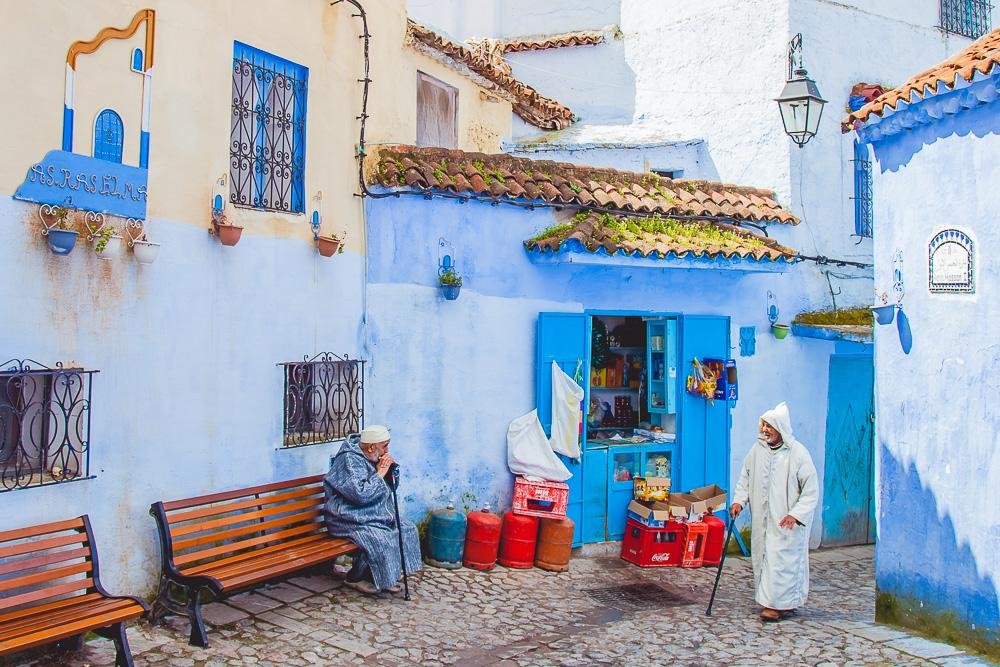
Chefchaouen’s blue lanes are quietest, and best for photos, before 9 am.
How much does 10 days in Morocco cost?
On this route, expect about 500 € per person on a tight budget and about 1,250 € in mid-range comfort, not counting international flights. You pay for only 7 nights of accommodation, because the desert tour covers the other two.
| Per person, 10 days | Budget | Mid-range |
|---|---|---|
| Accommodation, 7 nights | 175 € (budget riad, about 25 € a night) | 525 € (mid-range riad, about 75 € a night) |
| Food and drink | 150 € (about 15 € a day) | 350 € (about 35 € a day) |
| 3-day desert tour | 63–100 € (shared, coach) | 250 € (small group, 4×4, private tent) |
| Buses, Fes → Chefchaouen → Tangier | 16 € | 16 € |
| Sights and guides | 40 € | 80 € |
| Airport transfers | 15 € | 30 € |
| Total | about 460–500 € | about 1,250 € |
These are estimates built from 2026 prices: budget riads at about $20–45 a night, mid-range riads at $60–100, a tagine at a local restaurant for $3–6 and a mid-range meal for $10–20 (eTravelSIM). Tour prices are from The Smooth Escape.
Most of the difference between the two budgets comes from the riads and the desert tour. Food, buses and sights cost little at any travel style, so that’s where you can save the most or upgrade the most.
Getting around: this route needs no car. The desert tour covers the hardest stretch, CTM buses are comfortable and run on time, and inside the cities you walk or take a petit taxi. Insist on the meter, or agree on the fare before you get in.
Tips before you go
- Best time: spring (March to May) and autumn (late September to November) are warm in the cities and bearable in the desert. Summer brings intense heat to Marrakech and the Sahara. Winter days are mild, but desert nights drop close to freezing.
- Ramadan: in 2027 it’s expected to run from about 8 February to 9 March, ending with Eid al-Fitr on 10 March. Exact dates depend on the moon (Calendarific). You can still travel, but some restaurants close during the day and opening hours change.
- Passport: US travellers need a passport valid for at least six months on entry, with one blank page (US State Department).
- Money: cash is king in the medinas. ATMs are easy to find in the cities, but scarce on the desert route. You can’t take dirhams out of the country (US State Department), so spend them or change them back before you fly, and keep your exchange receipts.
- Data: buy a local SIM at the airport (bring your passport to register it) or set up an eSIM before you land. Roaming is expensive.
- What to wear: loose clothes that cover shoulders and knees are respectful everywhere and keep the sun off. Bring a scarf for the desert wind.
- Common scams: someone tells you a street is “closed” and offers to show you the way; a stranger walks with you, then asks for money; or a “guide” steers you into a shop. A polite “la, shukran” (no, thank you) and walking on usually works. Agree on every price before you start: taxis, henna, photos with snake charmers.
- Bargaining: expected in the souks. Start low, stay friendly, and be ready to walk away.
Morocco itinerary FAQ
Is 10 days enough for Morocco? Yes, for the classic loop of Marrakech, the Sahara, Fes and Chefchaouen. With 7 days, drop Chefchaouen. With 14, add the coast at Essaouira after Marrakech, or hike in the High Atlas.
Can I do this route without a tour? Everything except the desert stretch is easy on your own. You can also rent a car for the desert, but the mountain roads are long, and a tour costs little more than a car rental plus fuel.
Is Morocco safe for first-time and solo travellers? Most visits are trouble-free. The common problems are pushy touts and small scams rather than danger. Stay alert in crowds, use riad-arranged transport at night, and check your government’s travel advice before you go.
Should I fly into Marrakech or Fes? Marrakech usually has more flights and cheaper fares. Fly into Marrakech and out of Fes or Tangier so the route never doubles back.
Keep planning
- Solo in Marrakech: what to know before you go (coming soon)
- How to choose a Sahara desert tour (coming soon)
- Morocco on a budget: real costs (coming soon)
- Packing list for Morocco (coming soon)
Turn these into internal links as you publish each post. They keep readers on travelspatial and help Google understand your Morocco section.
Sources
- The Smooth Escape: choosing a Sahara desert tour
- Third Eye Traveller: how to visit Jardin Majorelle (updated 1 January 2026)
- LorenziGo: Marrakech attraction tickets (updated 27 September 2026)
- eTravelSIM: Morocco travel budget 2026
- Rome2Rio: Fes to Chefchaouen and Chefchaouen to Tangier
- US State Department: Morocco travel information
- OFX: EUR to MAD exchange rate (15 October 2026)
- Calendarific: Morocco holidays 2027