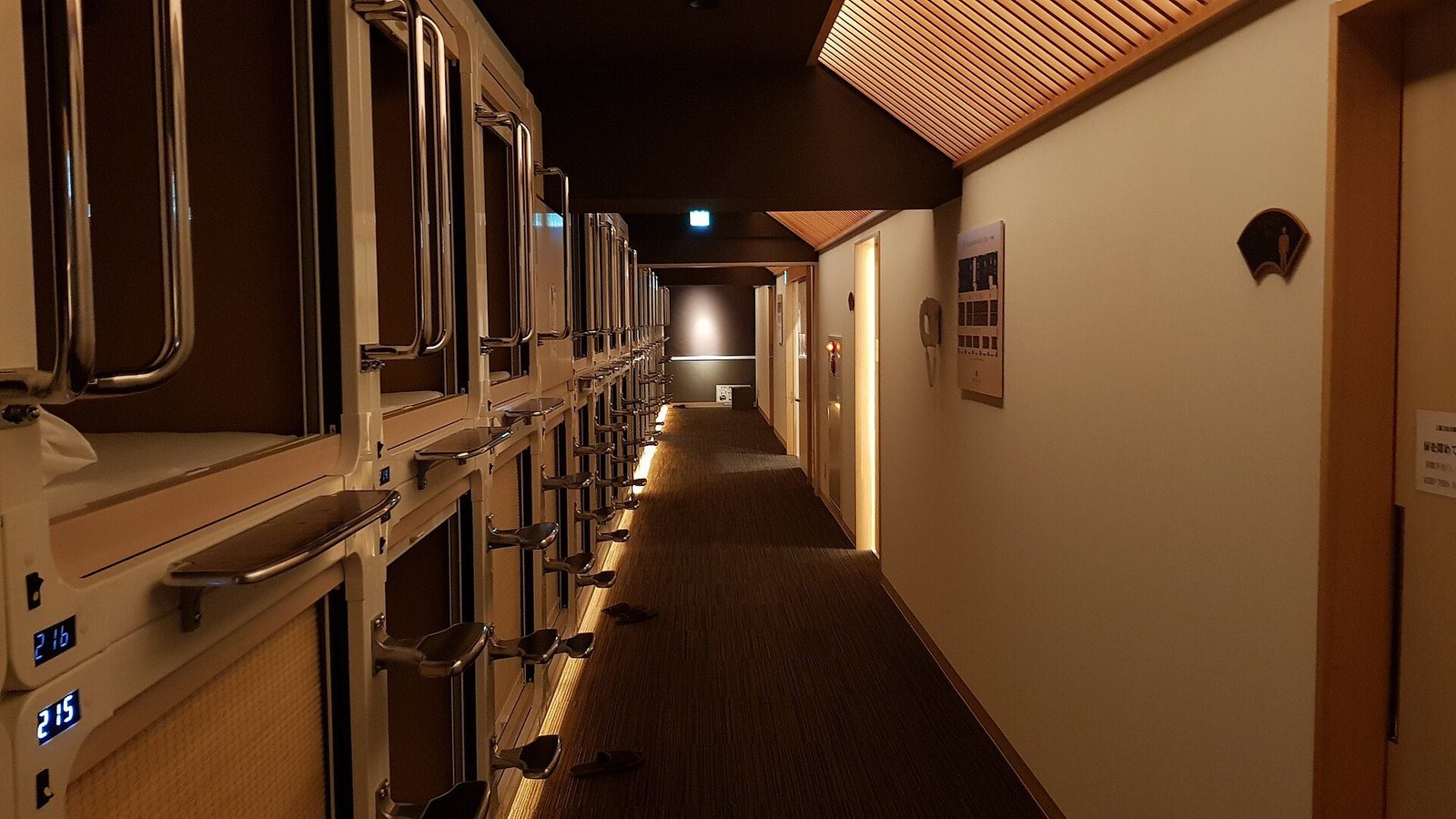
It’s 7:30 in Tokyo and you’re climbing down out of a capsule. That’s not a hardship story; it’s how a lot of people travelling alone in Japan keep their budget, and the bathroom is usually spotless.
This guide follows one realistic budget day for a solo traveller, hour by hour, and prices each step from published sources. Then it gets into the decision that shapes the budget for most people travelling alone in Japan: capsule hotel or business hotel?
The short answer to the money question: ¥10,000 a day is a realistic solo budget in Japan outside the long-distance train days, as long as you sleep in a capsule, hostel or the cheapest business hotels and eat where office workers eat.
A ¥10,000 day, hour by hour

This is a model day in Tokyo, not a diary. Prices are from the sources linked, checked November 2026; anything we couldn’t source to a menu or operator is marked as an estimate.
07:30 · Check out of the capsule. Standard capsules in Tokyo typically run about ¥4,400–8,800 a night, depending on area, brand and day of the week (Tokyo Tourism capsule guide). Book the cheaper end on weekdays: call it ¥5,000. Most capsule hotels have lockers for your bag, because the capsule itself has no room for it.
08:00 · Breakfast from a convenience store. Rice balls, a yoghurt, a coffee. Our estimate: ¥500.
09:00 · Activate a subway pass. The Tokyo Subway Ticket costs ¥1,000 for 24 hours of unlimited rides on Tokyo Metro and Toei lines (Tokyo Metro, adult price, checked November 2026). Some older pages still show ¥800; that’s out of date. If you’ll only ride three or four times, pay per trip with an IC card instead.
12:00 · A set lunch. A teishoku (set meal of a main, rice, miso soup and pickles) at a shokudo or family restaurant costs about ¥1,000–2,000 (japan-guide). Call it ¥1,200. Lunch sets are often cheaper than the same dishes at dinner.
14:00 · Something free, something paid. Shrines, many gardens’ outer grounds, neighbourhood walks and department-store food halls cost nothing. Allow ¥500–1,000 for one paid entry (our estimate; prices vary by sight).
19:00 · Dinner at a counter. A regular gyudon (beef bowl) at Yoshinoya costs ¥498 including tax (Yoshinoya menu). Ramen, soba and curry shops run ¥500–1,500 (japan-guide). Counter seats are made for one; our guide to eating alone in Tokyo explains ticket machines and the etiquette.
Total: roughly ¥8,700–9,200. That leaves a small cushion for a coffee, a bath-house visit or a second paid sight, and lands you near ¥10,000.
Capsule or business hotel?
This is the choice that shapes the budget. A couple sharing a twin pays half each; you pay all of it. That’s why capsules and the smallest business-hotel single rooms are so popular with solo travellers.
| Capsule hotel | Business hotel single | |
|---|---|---|
| Typical price | ~¥4,400–8,800 | ~¥5,500–10,000+ |
| Privacy | A curtain or shutter, shared bathrooms | Your own room and bathroom |
| Luggage | Locker, sometimes small | In your room |
| Noise | Shared space; earplugs help | Quiet |
| Women | Many have women-only floors; some are men-only | Any guest |
| Breakfast | Rarely included | Some chains include a simple breakfast |
| Best for | 1–3 nights, travelling light | Longer stays, work, big luggage |
Price ranges are from secondary guides, not official rate cards (Tokyo Tourism, The Japan Ode, checked November 2026). Prices rise on Friday and Saturday nights and in cherry blossom and autumn leaf seasons, and central Kyoto is often pricier than Tokyo.
Our tip: alternate. A few capsule nights followed by a business-hotel night to do laundry, spread out and sleep properly keeps both your budget and your mood intact. If you’re used to hostels, our comparison of hostel private rooms and budget hotels covers the same trade-off elsewhere.
Before you book a capsule

- Check the gender policy. Some capsule hotels are men-only; others have separate women’s floors. It’s always on the booking page.
- Check the luggage rules. Big suitcases may not fit in lockers. Some hotels store them at reception.
- Check the check-in times. Some capsule hotels ask you to clear out of the capsule area during the day.
- Check the tattoo rules if there’s a bath or sauna.
Don’t forget accommodation tax
Several Japanese cities add a per-person, per-night accommodation tax on top of the room price. Kyoto raised its rates on 1 March 2026: rooms under ¥6,000 per person pay ¥200 a night, ¥6,000–19,999 pay ¥400, and higher bands go up to ¥10,000 (Kyoto City Tourism, checked November 2026). For a budget traveller that’s small, but it’s often paid separately at check-in.
The big variable: getting between cities
The ¥10,000 day doesn’t include long-distance trains, and that’s where solo budgets in Japan rise most. A 7-day ordinary Japan Rail Pass now costs ¥50,000 on the official site (japan-guide, updated October 2026). Whether that beats single tickets depends on your route; our Japan Rail Pass verdict runs the Tokyo–Kyoto–Osaka numbers. Highway buses, including overnight ones, are the low-cost alternative and also save a night’s accommodation.
A realistic solo budget for a week
| Line | Per day | 7 days |
|---|---|---|
| Capsule or cheap business hotel | ¥5,000–7,000 | ¥35,000–49,000 |
| Food (konbini breakfast, set lunch, counter dinner) | ¥2,200–3,500 | ¥15,400–24,500 |
| Local transport | ¥1,000 | ¥7,000 |
| Sights and extras | ¥500–1,500 | ¥3,500–10,500 |
| Total before intercity travel | ~¥61,000–91,000 |
Add your intercity transport and a buffer of about 15% on top.
In short
A solo traveller can keep Japan to about ¥10,000 a day by sleeping in capsules or the cheapest business hotels, eating set lunches and counter dinners, and using a 24-hour subway pass only on busy sightseeing days. The rooms are what push solo costs up, so mix capsule nights with the odd business-hotel night, book weekdays where you can, and price the long-distance trains separately.
More solo budgets, country by country, are in the TravelSpatial newsletter.
Sources
- Tokyo Tourism, capsule hotels in Tokyo (checked November 2026)
- The Japan Ode, Japan hotel prices 2026 (checked November 2026)
- Tokyo Metro, Tokyo Subway Ticket (checked November 2026)
- japan-guide.com, restaurant types and prices (page updated 1 June 2025)
- Yoshinoya, gyudon menu (checked November 2026)
- Kyoto City Tourism, accommodation tax change (checked November 2026)
- japan-guide.com, Japan Rail Pass (page updated 1 October 2026)
Photo credits
- Capsule hotel by Trueshow111, CC BY-SA 4.0, via Wikimedia Commons
- August 2007 capsule hotel in Osaka 3 by Syced, CC0, via Wikimedia Commons
The infographic is original to TravelSpatial. Photos are used under the licences linked above.