Updated 19 November 2026. Thailand’s visa-free stay for tourists is now 30 days, down from 60. The change took effect on 15 September 2026, after Ministry of Interior announcements were published in the Royal Gazette on 31 August (TAT Newsroom, 1 September 2026). Two smaller rules came with it, and they matter more to backpackers than the headline: visa-free entries by land are now generally capped at two per calendar year, and every arrival still needs a Thailand Digital Arrival Card (TDAC).
If your trip is 30 days or less, nothing changes for you except the arithmetic. If it’s longer, read on: you have three options, and one of them is easy.
The new rules at a glance
| Rule | What it says | Source |
|---|---|---|
| Visa-free stay | Up to 30 days, tourism only, for passport holders of 60 countries and territories | TAT, FCDO |
| 15-day stay | Passport holders of Seychelles and Mauritius | TAT |
| Visa on arrival | Azerbaijan, Belarus and Serbia | TAT |
| Land-border entries | Generally no more than 2 visa-free entries per calendar year; flights not affected | TAT, FCDO |
| Land-limit exceptions | Malaysia, Brunei, Indonesia, Singapore, and others the minister designates | TAT |
| Arrival card | TDAC online, within 3 days before arrival, by air, land or sea | FCDO |
| Proof you may be asked for | At least 10,000 baht per person, plus onward or return travel | FCDO |
The 60 countries on the 30-day list include the UK, the US, Canada, Australia, Japan, India and the EU states listed by TAT. Check your own passport against the full list in the TAT announcement. Separate bilateral agreements still give some nationalities 90, 30 or 14 days.
What changed, and why it hits backpackers hardest
For two years, the 60-day exemption meant most travellers never had to think about visas. Two months covered a slow loop of the islands and the north, with time left for a detour into Laos or Malaysia.
Thirty days changes the shape of that trip. And the land-border cap removes the old workaround of hopping across to Laos or Malaysia and coming back for a fresh stamp. According to the UK government’s advice, visa-exempt entries through land checkpoints are “normally limited to 2 entries per calendar year”, while arrivals by air are generally not limited (FCDO, Thailand entry requirements, updated 12 October 2026).
The FCDO also warns that if you enter Thailand often as a tourist, officers may ask for proof of onward travel, accommodation or funds, and “may refuse entry if they believe you are not a genuine visitor”. Frequent flyers aren’t capped, but they are watched.
Already in Thailand? You keep what you were given
If you entered before 15 September 2026, the FCDO says you’ll usually be allowed to stay for the period you were granted on arrival. A 60-day stamp from August stays a 60-day stamp.
What it means for your trip, by length
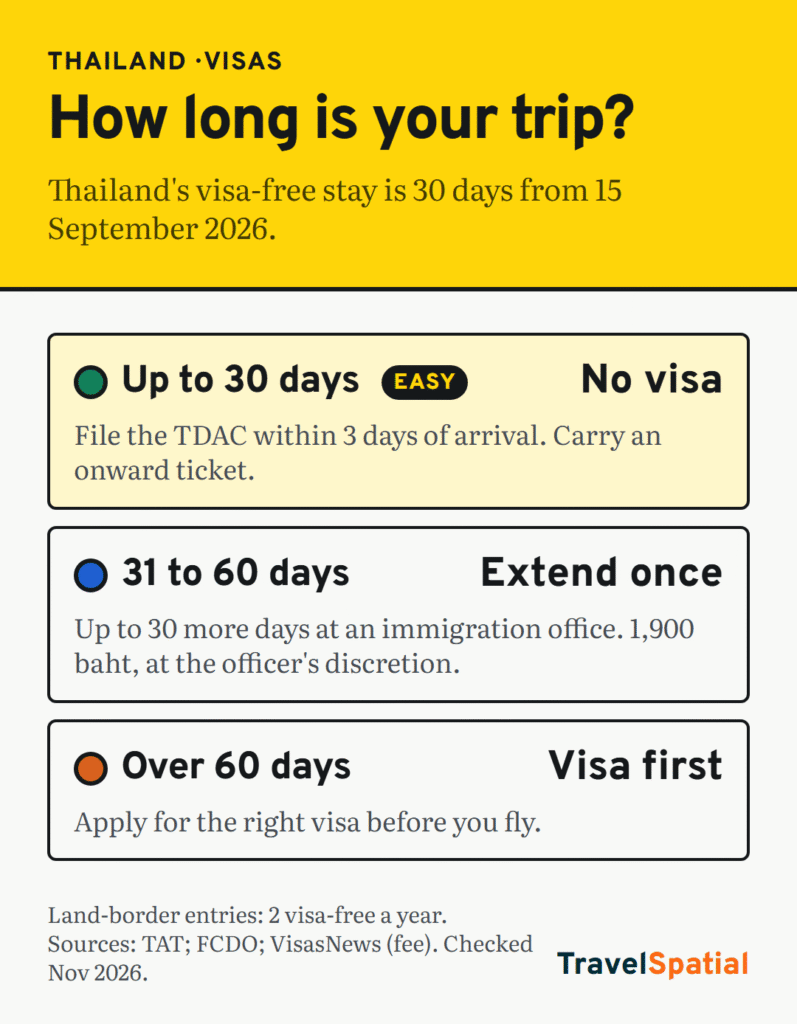
Up to 30 days: no change
Fill in the TDAC within the three days before you arrive, carry proof of your flight out, and you’re done. Our 3-week Thailand route for first-time backpackers fits comfortably.
31 to 60 days: extend once, inside Thailand
The 30 days can be extended by up to 30 more days at a Thai immigration office. The application uses form TM.7 and costs 1,900 baht, according to VisasNews (17 September 2026) and The Thaiger. Both stress that the extension is at the officer’s discretion, not automatic. We couldn’t confirm the fee on the Thai Immigration Bureau’s own site, which blocked our checks, so take cash and a little margin.
Expect to need your passport, the TM.7 form, the fee and a passport-sized photo, and be ready to give the address you’re staying at. VisasNews adds that you should be able to show an onward or return ticket. Go in the second or third week of your stay, not on day 29.
More than 60 days: get a visa before you fly
The FCDO is clear: if you want to stay longer, get the appropriate visa before you travel. For remote workers, that usually means the Destination Thailand Visa, which our digital nomad visa comparison covers alongside seven other programmes.

The land-border cap, explained with a real route
The classic overland loop of Bangkok, the north, Laos and back uses Thailand’s land borders. Under the new rule, here’s how two visa-free land entries get spent:
- Entry 1: you arrive by air in Bangkok. It doesn’t count towards the land cap.
- Entry 2: you cross back from Laos at the Friendship Bridge. First land entry.
- Entry 3: later in the year, you come in by land from Malaysia. Second land entry. Your allowance for that calendar year is used up.
The cap resets on 1 January. Fly in, and it doesn’t apply. And remember that crossings into Cambodia by land are a separate problem this year: our guide to getting to Siem Reap with the land borders closed has the current workarounds.
Our tip: if your route goes in and out of Thailand more than once, make at least one of the returns a flight. Short regional flights are often cheaper than the time lost to a refused crossing.
Don’t skip the arrival card
The TDAC has been required since 1 May 2025, and the September change left it in place. The FCDO says all foreign nationals must complete it online before arrival, whether they come by air, land or sea, and you can only submit it within three days of arriving. It’s free on the official site, tdac.immigration.go.th. Paid lookalike sites exist, so type the address yourself rather than clicking an advert.
What’s still unclear
- Earlier land entries. TAT’s announcement doesn’t say whether visa-free land entries made earlier in 2026, under the old 60-day scheme, count towards this year’s two. If you’ve already crossed by land twice this year, plan on flying.
- The “other nationalities” exception. The land cap doesn’t apply to Malaysia, Brunei, Indonesia and Singapore, or to others “as may be designated by the Minister”. No further list had been published when we checked.
- How strictly the funds rule is applied. The FCDO says British nationals have been refused entry for failing to show funds and onward travel. Most travellers are never asked, but carry the evidence anyway: a bank app screenshot and your onward booking are enough to have ready.
What overstaying costs
The FCDO puts the fine at 500 baht a day, up to 20,000 baht, and warns of detention, deportation and re-entry bans. Count your days from the date stamped in your passport, not from your flight booking.
Key dates
- 31 August 2026: announcements published in the Royal Gazette
- 15 September 2026: 30-day exemption and land-border cap take effect
- 1 January 2027: land-entry count starts again for the new calendar year
The short version
Thailand now gives most tourists 30 days visa-free. You can usually extend once, for up to 30 days, at an immigration office for 1,900 baht, but it’s discretionary. Visa-free land entries are capped at two a year, so loop by air if you’ll be re-entering more than that. File your TDAC in the three days before arrival, and carry proof of your onward trip and funds. Budgeting for the extra fee? Our Thailand ATM fees guide shows how to get baht without paying for it twice.
We update this page when Thailand’s rules change. Sign up for the TravelSpatial newsletter to hear when they do.
Sources
- TAT Newsroom, new 30-day and 15-day visa exemption rules (Royal Gazette date, country lists, land-border limit and exceptions; 1 September 2026, checked November 2026)
- FCDO, Thailand entry requirements (30 days from 15 September 2026, land limit, earlier entrants, funds, TDAC, overstay fines; updated 12 October 2026, checked November 2026)
- VisasNews, 30-day stay can be extended by another 30 days (extension, 1,900 baht, TM.7, discretion; 17 September 2026, checked November 2026)
- The Thaiger, Thailand visa requirements 2026 (extension, TM.7, TDAC; checked November 2026)
Photo credits
- Bangkok Suvarnabhumi Airport – Arrivals – Immigration (for Wikimania 2020) by Exec8, CC BY-SA 4.0, via Wikimedia Commons
- Thai–Lao Friendship Bridge – panoramio by satori.corvus, CC BY 3.0, via Wikimedia Commons
The infographic is original to TravelSpatial. Photos are used under the licences linked above.