Here’s the rule that catches more Central America backpackers than any border guard: Guatemala, Honduras, El Salvador and Nicaragua share one 90-day clock. It starts the day you enter the first of the four and keeps running as you cross between them. Crossing from Guatemala into Honduras doesn’t reset it, and nor does the hop from Honduras into Nicaragua.
The UK government’s advice says it plainly: the 90-day period “starts when you enter any of these countries and does not restart when you cross borders” (FCDO, Guatemala entry requirements, updated 16 November 2026). The arrangement is usually called the CA-4 agreement, and it works much like a smaller Schengen area.
So the useful question isn’t “how long can I stay in Nicaragua?” It’s “how many of my 90 days are left?” This guide teaches you to count them, then walks through a real four-month route so you can see where the clock runs out and what to do about it.
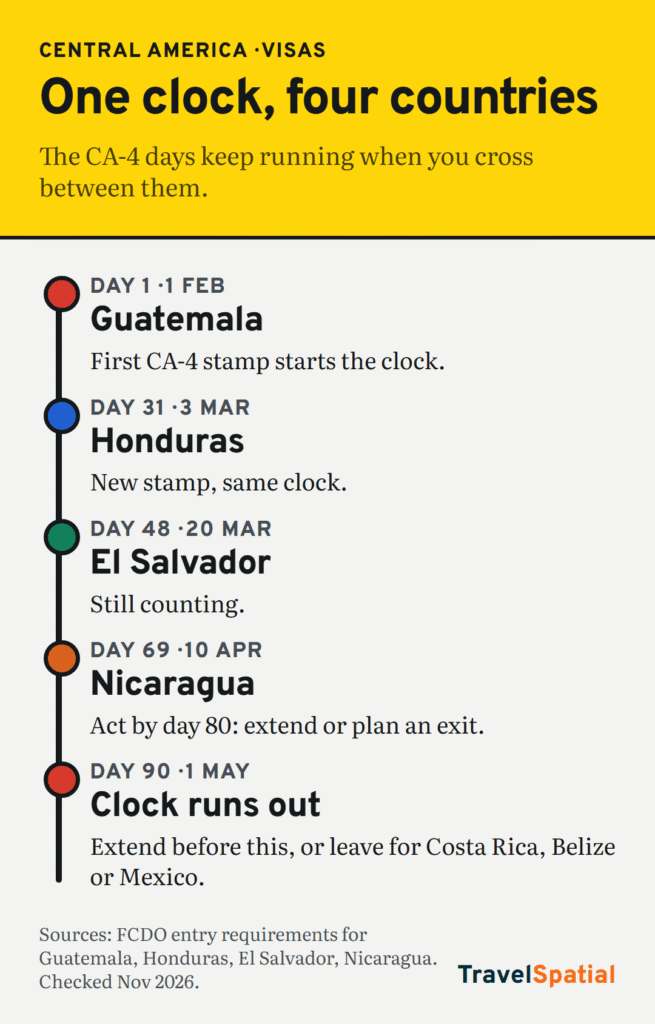
The four rules of the CA-4 clock
Think of it as a lesson in four lines. Learn these and the rest is arithmetic.
- One clock, four countries. Your 90 days cover Guatemala, Honduras, El Salvador and Nicaragua together.
- It starts at your first entry. The day you’re stamped into any of the four is day 1.
- Internal borders don’t reset it. You still queue at immigration and get stamped, but the count carries on.
- Leaving the zone is the only clean break. Belize, Mexico and Costa Rica are outside the CA-4, so time there doesn’t count.
One more rule worth knowing: if you’re expelled from one of the four countries, you’re excluded from the other three as well (FCDO).
What the countries themselves add
The shared clock is the big rule, but each country has a few extras of its own. All of these come from the UK government’s country pages, checked November 2026, and apply to British passport holders.
| Country | Visa-free stay | Extras to know |
|---|---|---|
| Guatemala | 90 days (shared) | Online immigration declaration before you enter or leave; US$30 departure tax, usually in your air ticket |
| Honduras | 90 days (shared) | You may get a 30-day entry stamp; US$3 cash land-border fee, keep the receipt |
| El Salvador | Listed as up to 180 days, but the shared 90 still applies when you cross between the four | Extensions through the immigration directorate (DGME) |
| Nicaragua | 90 days (shared) | You can be refused entry without an onward ticket; US$10 cash arrival tax |
El Salvador’s line looks contradictory, and it is a little. The FCDO lists both a 180-day visa-free stay and the shared 90-day rule on the same page. For planning, treat the shared 90 as the number that binds you whenever you move between the four.
Honduras is the other one to watch. The FCDO says you’ll get a 30-day entry stamp on arrival and can apply to extend at an immigration office. Check the stamp before you walk away from the desk.
Our tip: look at every entry stamp before you leave the counter. Guatemala’s advice is blunt: if your passport isn’t stamped, you’ll be fined and delayed on departure.
A worked example: four months, one clock
Here’s a common route, counted day by day. It’s an illustration, not a recommendation, and the dates are chosen to make the arithmetic easy. Say you fly into Guatemala City on 1 February 2027.
| Date | Where | Clock |
|---|---|---|
| 1 Feb | Land in Guatemala City, head to Antigua | Day 1 |
| 3 Mar | Cross to Copán Ruinas, Honduras | Day 31 |
| 20 Mar | Into El Salvador for the surf coast | Day 48 |
| 10 Apr | Through Honduras into Nicaragua | Day 69 |
| 1 May | Still in Nicaragua | Day 90: the clock runs out |
Notice what happened. You visited four countries and spent three months, and every single day came off the same 90. If you’d planned to spend May on Nicaragua’s beaches and June in Costa Rica, you now have a problem to solve before 1 May, not on it.
You have three ways out.
Option 1: extend before day 90
Both Guatemala and Nicaragua let you extend. The FCDO says you can extend your CA-4 stay “by up to 30 days by paying a fee before the 90 days expires”. In Nicaragua, that would take you from 1 May to around 31 May.
Guatemala’s own immigration institute, the IGM, describes something longer. A February 2025 report in the Guatemalan daily La Hora says the IGM extends a visitor’s stay once, by up to 90 additional days, with a US$25 payment, at its foreigners’ office in Zona 4, Guatemala City (La Hora). That report doesn’t mention the CA-4 at all, and the FCDO figure is 30 days. Ask the IGM what it will grant on your entry before you count on 90.
Two habits make an extension go smoothly:
- Apply early. The FCDO says to pay before the 90 days expire. Leave yourself a week, not a day.
- Carry the paperwork. Expect to need your passport with its last entry stamp and proof that you’ll leave, such as an onward ticket.
Option 2: leave the zone
Step outside the four countries and the CA-4 days stop counting. In our example, the natural exit is south into Costa Rica, which isn’t part of the agreement. The FCDO says Costa Rica gives British visitors up to 180 days, at the officer’s discretion.
From Guatemala, the nearest exits are Belize (30 days visa-free for British visitors, and a departure tax of BZ$40 or US$20 when you leave by land) and Mexico.
Option 3: the border run (and why it’s a gamble)
Backpackers often leave for Belize or Mexico for a few days and come back hoping for a fresh 90. Some do get one. But nothing in the official guidance promises it, and it’s the officer at the border who decides. Treat a border run as a maybe, never as the plan. If you’d be stuck without the new days, extend instead.

How to count your days without an app
You don’t need anything clever. You need three dates, written down.
- Your first CA-4 entry date. Write it on the first page of your notebook or in your phone’s notes, with the border name.
- Your day 90. Count it once, at the start: day 1 plus 89 days. Use a calendar, not mental maths.
- Your “act by” date. Ten days before day 90. That’s when you either book your exit or go to an immigration office.
Then photograph every stamp as you get it. If a stamp is smudged or missing, you’ll have the date anyway.
The mistakes that cost travellers money
- Treating each country as a fresh start. It’s the classic error, and the fix is to count from your first CA-4 stamp.
- Overstaying “just a few days”. Guatemala charges an overstay fine you must pay before leaving, and the FCDO warns that paying at an airport or land border can cause serious delays. Nicaragua and the others may fine you too.
- Arriving in Nicaragua without an onward ticket. The FCDO says you may be refused entry. A bus ticket on to Costa Rica, bought before you reach the border, is often the simplest answer.
- Paying “helpers” at land borders. The FCDO warns that people offering to process your entry into Guatemala may be overcharging you for services you don’t need. Queue at the official window yourself.
Planning your route around the clock
The clock is easier to live with if you plan around it from the start. A few rules of thumb:
- Put Belize or Mexico in the middle, not at the end. A week in Belize splits your CA-4 time naturally, and its days don’t count. Our San Ignacio to Tikal guide covers the crossing.
- Spend the long stays where you can extend. If you want to slow down for a Spanish course in Antigua, Guatemala is where an extension makes sense.
- Keep the CA-4 leg under 80 days if you can. It leaves a buffer for a missed bus, a sick week or a beach you can’t leave.
For the classic route through all four countries, start with our 10-day Guatemala itinerary, then compare chicken buses, Pullmans and shuttles for the border legs. If you’re weighing a slower stop in Nicaragua, our Granada vs León guide helps you choose a base.
If you don’t hold a British passport
The figures above come from the UK government’s advice for British citizens. The CA-4 principle applies to visitors from many countries, but the visa-free stays, fees and extension rules can differ for yours. Check your own government’s travel advice (for example, the US State Department’s country pages) and the immigration authority of the country you’re in.
The rule, in one paragraph
Guatemala, Honduras, El Salvador and Nicaragua share one 90-day visa-free clock that starts at your first entry and doesn’t reset at their internal borders. Write down your day 1 and your day 90, and act ten days before the end: extend at an immigration office before day 90, or leave for Belize, Mexico or Costa Rica. Don’t count on a border run for fresh days. And keep every stamp, receipt and onward ticket until you’re out of the zone.
Planning a slow Central America trip? Get our route and border guides in your inbox. Sign up for the TravelSpatial newsletter.
Sources
- FCDO, Guatemala entry requirements (CA-4 shared 90 days, extension up to 30 days, stamps, declaration form, departure tax, land-border helpers; updated 16 November 2026, checked November 2026)
- FCDO, Honduras entry requirements (90 days from 31 October 2026, 30-day entry stamp, US$3 land-border fee; checked November 2026)
- FCDO, El Salvador entry requirements (180 days listed, CA-4 rule, DGME extensions; checked November 2026)
- FCDO, Nicaragua entry requirements (onward ticket, US$10 arrival tax, extension up to 30 days; checked November 2026)
- FCDO, Belize entry requirements (30 days, land-departure tax; checked November 2026)
- FCDO, Costa Rica entry requirements (up to 180 days at the officer’s discretion; checked November 2026)
- La Hora, extending your stay in Guatemala (one extension of up to 90 additional days, US$25, IGM Zona 4 office; published 12 February 2025, checked November 2026)
Photo credits
- Santa Catalina Arch – Antigua Guatemala Feb 2020 by Chad Davis, CC BY-SA 2.0, via Wikimedia Commons
- Bus and truck in Antigua Guatemala 2020 by Chad Davis, CC BY 2.0, via Wikimedia Commons
The infographic is original to TravelSpatial. Photos are used under the licences linked above.