Before every dive, an instructor runs through a briefing: the plan, the kit, the hazards, what to do if something goes wrong, and the signals you’ll use. Nobody gives that briefing for the insurance side of learning to dive. That’s a gap, because diving is one of the activities ordinary travel insurance is most likely to exclude, and a decompression injury is one of the most expensive things that can happen on a trip.
So here’s that briefing, in the same order. Read it before you pay for an Open Water course in Utila, Koh Tao, Dahab or anywhere else.
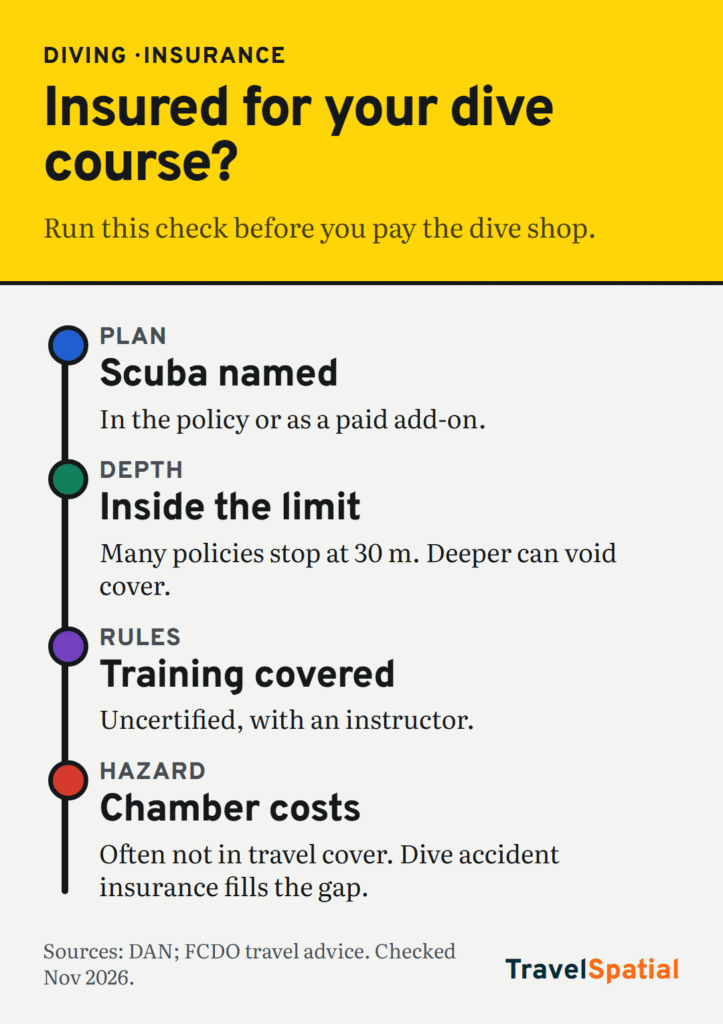
Do you need dive insurance? Not by law, but you need cover that clearly includes diving. The Divers Alert Network (DAN), a not-for-profit dive safety organisation that also sells insurance, says “very few travel protection plans cover scuba diving incidents” and that hyperbaric chamber treatment isn’t typically covered by medical or travel insurance (DAN, checked November 2026).
1. The dive plan: what you’re actually doing
An Open Water course is a few days of training dives with an instructor, ending in a certification. To an insurer, three facts about it matter:
- You’re diving. Many standard policies treat scuba as an excluded or add-on activity. Our travel insurance guide explains how activity cover works.
- You’re not yet certified. Some policies only cover certified divers, or divers with a divemaster or instructor. DAN notes that a policy “may require you to dive with a divemaster or hold a scuba certification from a particular agency.”
- There’s a depth. Your course has depth limits, and so does your policy. They need to fit together.
2. The kit check: the paperwork
Before you get in the water, check you have:
- A policy wording that names scuba diving, either in the base cover or as an add-on you’ve paid for. Look for the words, not a general “adventure” tick box.
- The depth limit, written down. DAN says most travel policies that do cover diving exclude dives deeper than 30 metres (100 feet). Some set a lower limit. The UK Foreign Office’s Egypt advice is direct about it: don’t dive below your insurance policy’s depth limit, because doing so will invalidate it (FCDO Egypt, checked November 2026).
- Any instructor or operator conditions. The FCDO’s Thailand advice notes that some policies require dive instructors to hold certain qualifications (FCDO Thailand).
- Your insurer’s 24-hour assistance number, saved where the dive shop can find it if you can’t.
3. The hazards: where travel cover runs out
These are the gaps DAN describes in ordinary travel or medical insurance:
| Risk | Typical travel insurance | Dive accident insurance |
|---|---|---|
| Hyperbaric chamber treatment | “not typically covered” | Designed to cover it |
| Dives below the policy’s depth limit | Excluded (often 30 m) | Check that policy’s limits |
| Diving without the required supervision or certification | May be excluded | Check that policy’s terms |
| Getting to a chamber by ground, air or sea | Not stated for diving | Listed as a benefit by DAN |
DAN describes its own dive accident insurance as secondary accident medical cover of up to US$500,000. Secondary means it pays after any other insurance you hold. You need a DAN membership to buy it, but DAN says membership alone doesn’t cover a dive accident: the insurance is bought separately. Membership costs from US$40 a year for an individual (DAN membership, checked November 2026). Other dive insurers exist, so compare.
What this means for a beginner: a travel policy with a scuba add-on may be enough for a course in shallow water, provided its depth limit and supervision rules fit your course. Dive accident insurance mostly closes the chamber gap. For a week of training, ask yourself what happens if you need a chamber. If the answer is “I’d pay”, buy the extra cover.
4. Emergency procedures: what happens if it goes wrong
The FCDO advice for popular dive destinations shows why the chamber question isn’t theoretical:
- Honduras (Bay Islands): there’s a hyperbaric chamber on Roatán and recompression facilities on Utila, but emergency medical facilities on the Bay Islands are “extremely limited” (FCDO Honduras). Our Utila vs Roatán Open Water cost comparison covers where to train.
- Thailand and Indonesia: both advise asking about safety precautions, including whether divers can be transferred to a hyperbaric chamber, and making sure there’s oxygen on the boat. Our Andaman vs Gulf coast guide explains which side suits a course in which season.
- Egypt (Red Sea): the FCDO says safety standards of resort dive operators and boats “vary considerably”, and that some may not provide adequate safety and insurance standards. If you’re choosing a base, our Dahab vs Hurghada vs Marsa Alam guide compares them.
- Belize: injuries and deaths from snorkelling and diving have mostly come from inadequate safety precautions and bad weather, so use registered, licensed operators (FCDO Belize). See Caye Caulker vs Ambergris Caye for where to stay.
If something does go wrong, the order is: oxygen and first aid from the dive team, the emergency number, then your insurer’s assistance line, which can approve and arrange the chamber or evacuation.
5. Signals: what to ask the dive shop
Indonesia’s advice suggests that if you’ve never dived before, you should ask your instructor to explain what cover they offer before you sign up, and how to call for help at sea (FCDO Indonesia). Ask these before you hand over a deposit:
- Can I see your operator credentials and the instructor’s certification?
- Is there oxygen on every boat?
- Where’s the nearest chamber, and how would I get there?
- Does the shop carry its own insurance, and what does it cover for students?
- What’s the deepest dive on this course?
A good shop answers all five without hesitating.
The buddy check: sixty seconds before you pay
- [ ] My policy names scuba diving, or I’ve added it
- [ ] The policy’s depth limit is deeper than my course’s deepest dive
- [ ] Training dives with an instructor are covered while I’m uncertified
- [ ] I know what happens with chamber costs, or I’ve bought dive accident cover
- [ ] The dive shop answered the five questions above
If every box is ticked, enjoy the course.
More dive and adventure planning lands in the TravelSpatial newsletter.
Sources
- DAN, Dive accident insurance versus travel protection: do you need both? (very few travel plans cover scuba; most exclude below 30 m; may require divemaster or certification; chamber not typically covered; up to US$500,000 secondary accident medical; transport to chamber; checked November 2026)
- DAN, Membership (from US$40 a year; membership alone doesn’t cover dive accidents; checked November 2026)
- FCDO, Egypt safety and security (Red Sea dive standards vary; don’t dive below your policy’s depth limit; checked November 2026)
- FCDO, Thailand safety and security (dive operator credentials; some policies require instructor qualifications; oxygen; chamber transfer; checked November 2026)
- FCDO, Indonesia safety and security (credentials, insurance, oxygen, chamber; ask instructors about cover; checked November 2026)
- FCDO, Honduras safety and security (chamber on Roatán, recompression on Utila, limited facilities; checked November 2026)
- FCDO, Belize safety and security (diving injuries and deaths; licensed operators; checked November 2026)
Photo credits
- Utila At Dusk – panoramio by ogwen, CC BY-SA 3.0, via Wikimedia Commons
- Scuba Diver by Dr. Ondřej Havelka (cestovatel), CC BY-SA 4.0, via Wikimedia Commons
The infographic is original to TravelSpatial. Photos are used under the licences linked above.