

Four coverage zones, one patch of fine print, and the 14-day window most travelers miss. Here is what travel insurance actually does, mapped from your front door and back.
A twisted ankle in Lisbon costs you an afternoon and a few hundred euros. A fall in northern Thailand that needs a medical flight home is another story: air ambulance transfers from Southeast Asia to the US are estimated at $200,000 to $300,000. The policy that would have paid for it averages about $20 a day.
Most travelers know they “should” buy insurance. Far fewer know what it covers, when to buy it, or which small habits quietly cancel it. This guide is the simple version. It maps what a typical policy pays for at each stage of a trip, what it costs, the deadline that unlocks the best benefits, and the fine print that sinks claims. Read it once and you can scan any policy in ten minutes.
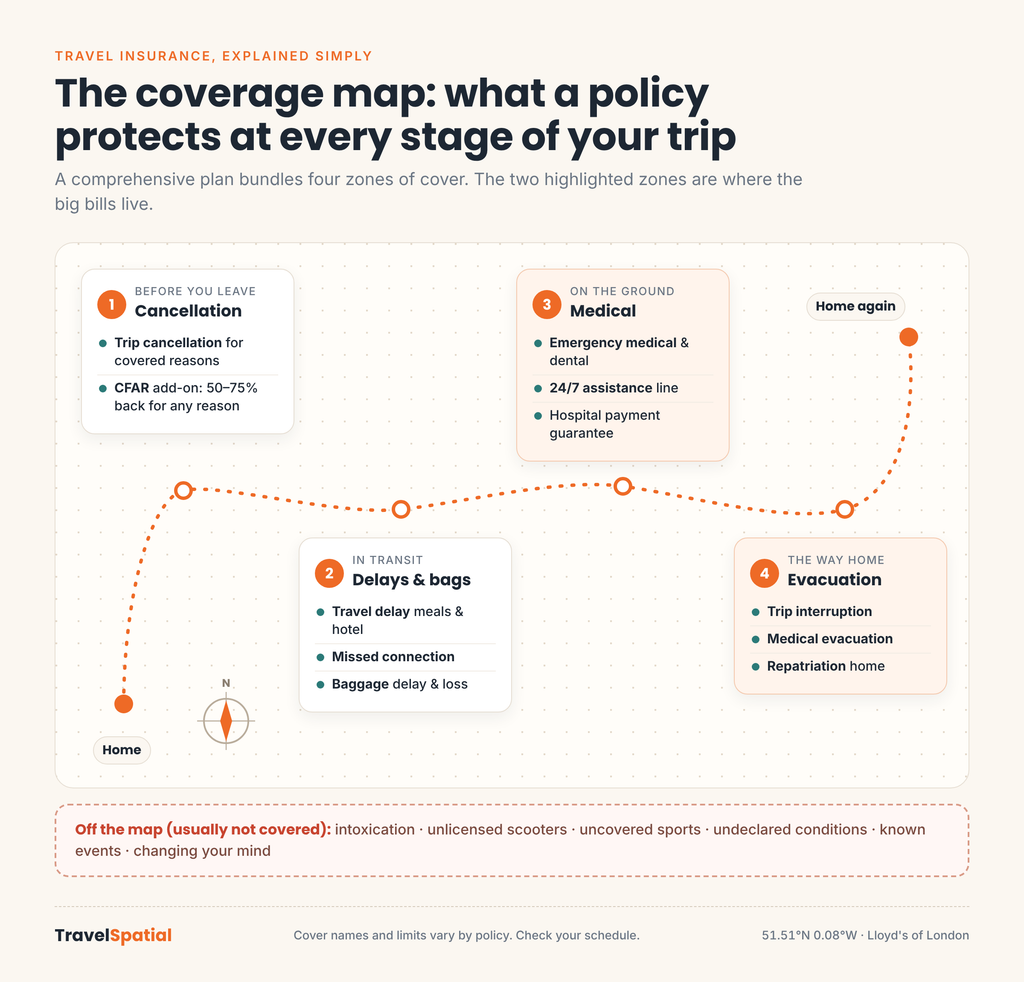
The four zones of a travel insurance policy
A comprehensive travel insurance policy is really a bundle of smaller covers, each one guarding a different stretch of your trip. Think of it as a route map with four zones:
- Before you leave: trip cancellation.
- In transit: delays, missed connections and bags.
- On the ground: emergency medical care and a 24/7 assistance line.
- The way home: trip interruption, medical evacuation and repatriation.
Everything outside those zones is “off the map,” and we will get to that below.
| Zone | Cover | What it pays for | Typical trigger |
|---|---|---|---|
| 1. Before you leave | Trip cancellation | Prepaid, nonrefundable flights, tours and stays | You, a travel partner or close family fall ill; a hurricane hits; jury duty |
| 1. Before you leave | Cancel for any reason (optional) | 50–75% of nonrefundable costs | You simply change your mind |
| 2. In transit | Travel delay | Meals, a hotel and taxis while you wait | A delay past the policy’s threshold, often 6–12 hours |
| 2. In transit | Missed connection | Catch-up costs to rejoin a cruise or tour | A covered delay makes you miss it |
| 2. In transit | Baggage delay and loss | Essentials while you wait; the value of lost items | The airline loses or delays your bag |
| 3. On the ground | Emergency medical | Doctor, hospital, prescriptions, emergency dental | Sudden illness or injury abroad |
| 3. On the ground | 24/7 assistance | Finding a hospital, guaranteeing payment, translation | Any emergency |
| 4. The way home | Trip interruption | Unused trip costs plus a last-minute flight home | You must cut the trip short for a covered reason |
| 4. The way home | Medical evacuation and repatriation | Transport to adequate care or home; return of remains | Local care can’t treat you safely |
The one to care about most is zone 3 and zone 4 together. Losing a $600 flight hurts. An uninsured hospital stay plus a medical flight can be a life-changing debt. If you only buy one thing, buy strong medical and evacuation cover.
How much travel insurance costs (and what it saves)
A comprehensive policy usually costs 4–10% of your prepaid, nonrefundable trip cost. Squaremouth’s 2026 sales data puts the average policy at $307 for a 15-day trip, or roughly $20 a day, and about 6% of insured trip costs.
What moves the price:
- Your age. It is the single biggest factor. Travelers in their 20s and 30s pay the least; over-65s can pay double.
- The trip cost you insure. Cancellation cover is priced on what you could lose, so a $9,000 safari costs more to insure than a $900 hostel run.
- Coverage level. For a $5,000 trip, MoneyGeek found basic plans average $125, comprehensive $227 and premium $345.
- Add-ons. Cancel for any reason, adventure sports and higher medical limits all raise the premium.
Now compare that to what a bad day abroad can cost. Estimated air-ambulance costs to the US run $30,000–80,000 from the Caribbean, $120,000–200,000 from Europe and $200,000–300,000 from Southeast Asia.
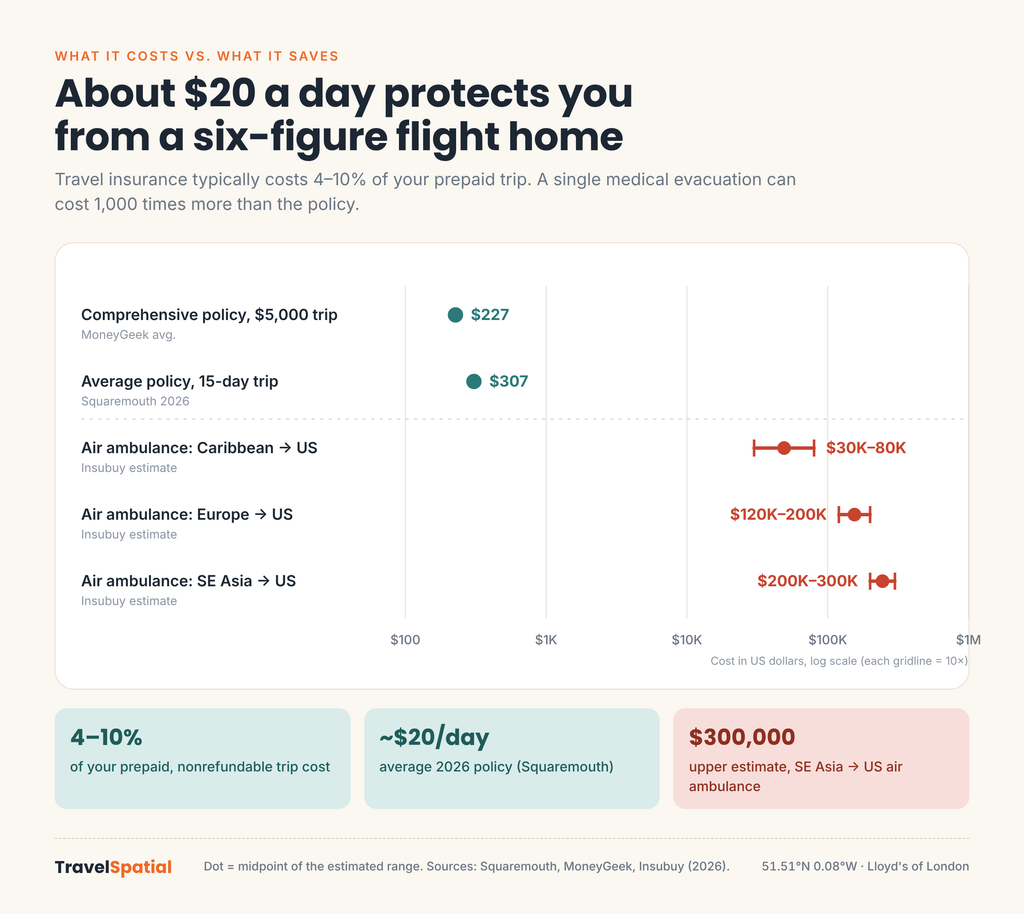
On a log scale, the policy and the evacuation bill sit about three gridlines (1,000×) apart.
Budget backpacker tip: if your flights and beds are cheap or refundable, you have little to cancel. Skip the big comprehensive plan and buy travel medical insurance instead. It covers zones 3 and 4, the expensive ones, for a fraction of the price.
When to buy: the 14–21 day window
Buy travel insurance the same day you pay your first trip deposit, or within two weeks at the latest. You can buy most policies right up to departure, but waiting quietly locks you out of the three best benefits.
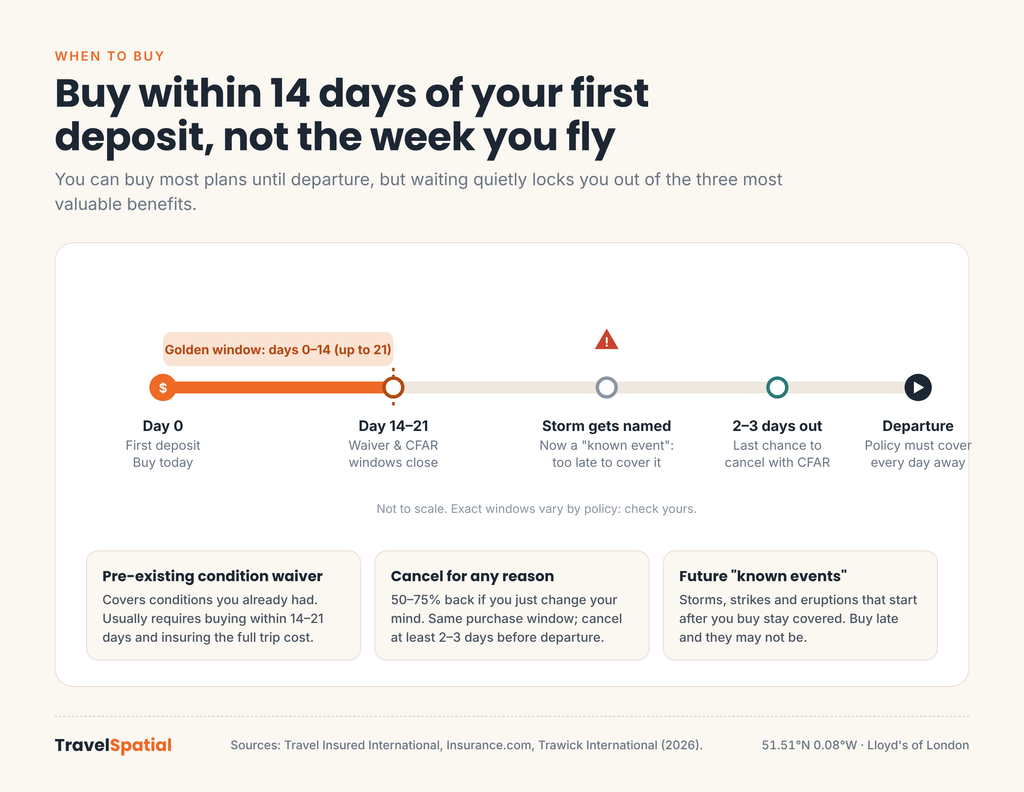
The golden window: buy in the first two weeks after your deposit to unlock the best benefits.
1. The pre-existing condition waiver. Most policies exclude anything you were treated for, or had symptoms of, in the months before you bought. The waiver removes that exclusion, but only if you buy within a set window, typically 14–21 days from your initial trip deposit. One common version also requires that you insure the full nonrefundable trip cost and are medically able to travel on the day you buy.
2. Cancel for any reason (CFAR). This add-on refunds 50–75% of your nonrefundable costs if you cancel for a reason the policy doesn’t list. It must be bought alongside the base plan, usually within 14–21 days of your first payment, and you must cancel at least 2–3 days before departure. It adds real cost: the average CFAR policy sold through Squaremouth in 2026 came to $672. It is not offered to residents of some US states, including New York.
3. Cover for “known events.” Once a hurricane is named, a strike is announced or a volcano starts erupting, it becomes a foreseeable event. Policies bought after that point won’t cover losses from it. Buying early means the storm that forms next month is still covered.
Rule of thumb: book the trip, then book the policy before you close the browser tab.
Off the map: what travel insurance won’t cover
Travel insurance covers a specific list of events, not “anything bad that happens.” Squaremouth calls that belief travelers’ number one misconception. These are the exclusions that catch people most often:
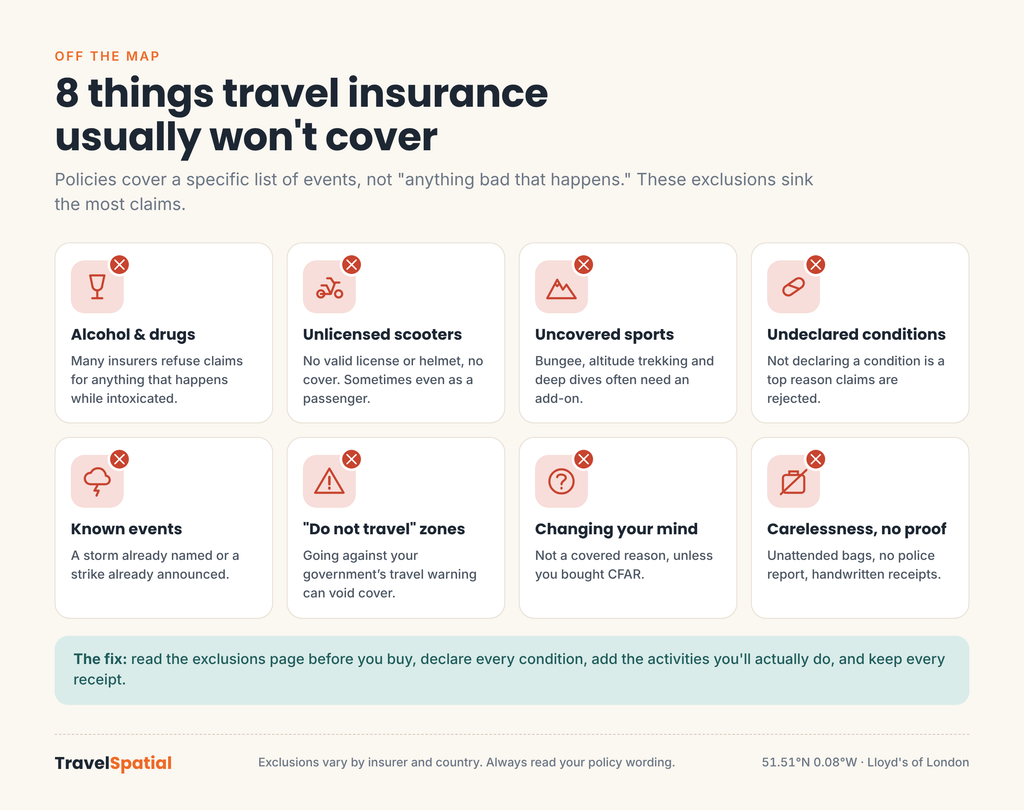
- Alcohol and drugs. Many policies refuse claims for anything that happened while you were intoxicated, and some decline any alcohol-related claim outright. That includes being hit by a car after a few beers.
- Scooters and motorbikes without the right license. Most insurers expect a valid motorcycle license (from home or local permits), a helmet and often an add-on. No license, no cover, even as a passenger if your rider isn’t licensed.
- Adventure sports. Bungee, high-altitude trekking, deep diving and off-piste skiing usually need a sports add-on or a specialist policy.
- Undeclared pre-existing conditions. Not declaring a condition is one of the most common reasons claims are rejected.
- Known events and travel warnings. Storms already named, strikes already announced, and places your government says not to go.
- Changing your mind. Without CFAR, “I don’t feel like going anymore” isn’t a covered reason.
- Carelessness and missing proof. Bags left unattended, no police report for a theft, or handwritten receipts. Insurers reimburse proven financial losses, not inconvenience.
- Elective treatment. Cosmetic surgery or planned dental work abroad, and its complications.
The fix for nearly all of these is boring: read the exclusions page before you buy, declare everything, add the activities you’ll actually do, and keep every receipt.
Is your credit card’s travel insurance enough?
Usually not on its own. Card cover is great for the small stuff in zones 1 and 2, and weak exactly where the big bills live.
An August 2026 Squaremouth survey of 4,700 travelers found 48% didn’t know most travel cards offer little or no emergency medical cover abroad, and 55% didn’t realize card protection generally applies only to bookings paid with that card. Squaremouth’s analysis found just one travel card with emergency medical cover, capped at $2,500.
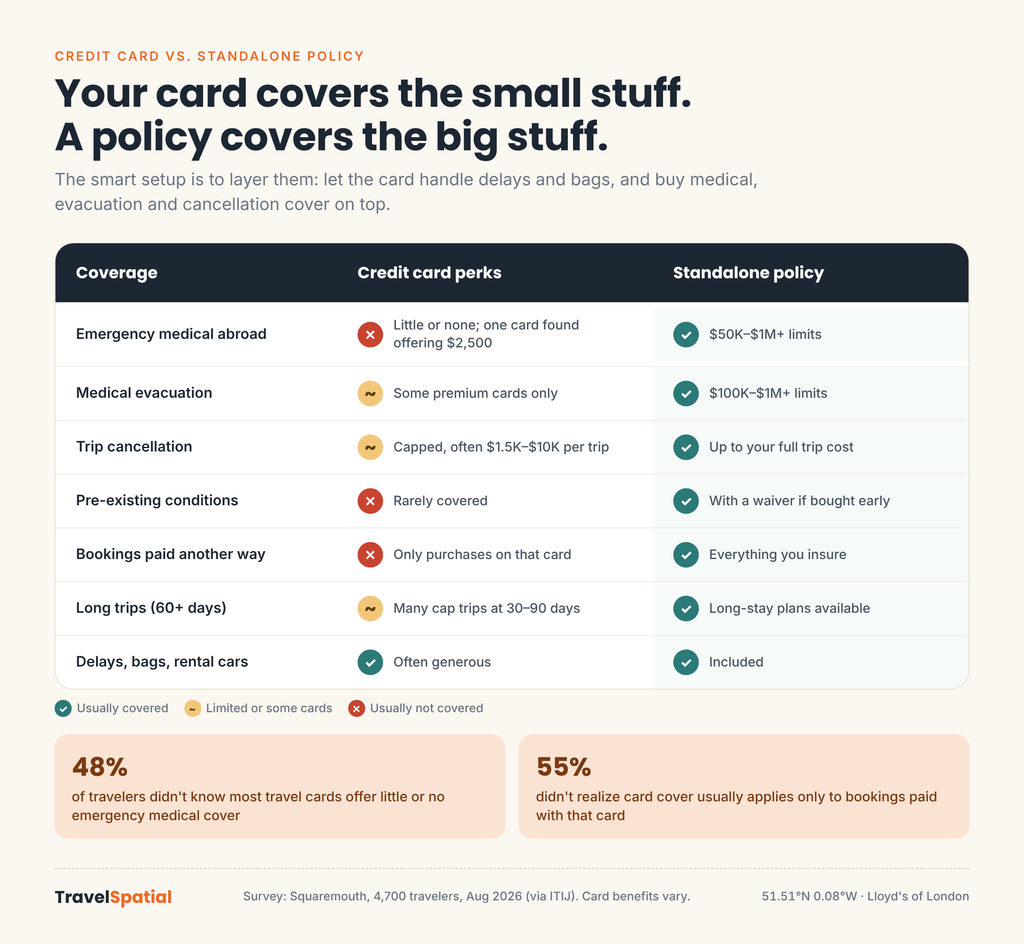
Cards win on delays and bags. Policies win everywhere the costs get serious.
Where cards typically fall short:
- Medical and evacuation: low or no limits.
- Cancellation: capped, with the most generous cards topping out around $10,000 per trip.
- Who’s covered: often just the cardholder and close family, and only for trips charged to the card.
- Trip length: many card benefits stop after 30–90 days, which rules out long backpacking trips and nomad stints.
The smart setup is to layer, not choose. Let the card handle delays, lost bags and rental-car damage. Buy a travel medical or comprehensive policy on top for the medical, evacuation and cancellation gaps.
How much cover you need, and which policy fits your trip
For most international trips, aim for at least $50,000 in emergency medical and $100,000 in medical evacuation. That is Squaremouth’s baseline recommendation, with higher limits for cruises and remote travel. I’d go to $100,000 and $250,000 for long-haul trips to Asia, trekking, cruises or travelers over 60: the price difference is usually small.
Three home-country gaps worth knowing:
- US travelers on Medicare: Medicare usually doesn’t cover health care outside the US. Some Medigap plans add foreign emergency cover, generally with a $250 deductible, 20% coinsurance and a $50,000 lifetime limit, only for the first 60 days of a trip.
- Schengen visa applicants: you need travel medical insurance of at least €30,000, valid across all Schengen states for your whole stay, including repatriation. Get a certificate that shows all three.
- UK and EU travelers: a GHIC or EHIC gets you state healthcare in Europe at local rates. It doesn’t pay for a flight home, private care or a cancelled trip, so it complements insurance rather than replacing it.
Then match the policy type to how you travel:
| Your trip | Policy type | Why |
|---|---|---|
| One-to-three-week holiday with big prepaid costs | Comprehensive single-trip | Covers all four zones, including cancellation |
| Backpacking on cheap or refundable bookings | Travel medical | Little to cancel; covers the expensive zones 3–4 |
| Digital nomad, months abroad | Long-stay or subscription travel medical | Renews monthly; check the trip-length cap |
| Trekking, diving, skiing | Medical + adventure add-on, high evacuation limit | Standard plans exclude many sports |
| Three-plus trips a year | Annual multi-trip | Often cheaper than several single policies |
| Over 60 or with a health condition | Comprehensive, bought within 14 days | Locks in the pre-existing condition waiver |
Your 10-minute travel insurance checklist
- Buy within 14 days of your first deposit to keep the pre-existing waiver and CFAR on the table.
- Insure only nonrefundable costs for cancellation. Refundable bookings don’t need it.
- Check the medical and evacuation limits: $50,000 and $100,000 minimum, more for remote trips.
- Check your home cover first: Medicare, GHIC/EHIC, your credit card. Fill the gaps, don’t double up.
- List your activities (scooter, diving, trekking altitude) and confirm each is covered.
- Declare every pre-existing condition, even well-controlled ones.
- Read the exclusions page, especially alcohol, motorbikes and travel warnings.
- Save the 24/7 assistance number offline and on paper, and call it before a planned hospital visit.
- Keep a claim kit: receipts, boarding passes, police and medical reports, in a cloud folder.
- Know your dates: the policy must cover every day you’re away, including travel days.
Travel insurance FAQ
Is travel insurance worth it?
For international trips, yes, mainly for medical and evacuation cover. Your home health insurance often pays little or nothing abroad, and a single evacuation can cost more than a decade of premiums. Cancellation cover is worth it when you would lose a lot of prepaid money.
What does travel insurance actually cover?
A comprehensive plan covers trip cancellation and interruption, travel delays and missed connections, lost or delayed bags, emergency medical care and medical evacuation. Each cover has its own limit, listed on your policy schedule.
Can I buy travel insurance after booking?
Yes, up to the day you leave. But buying within 14–21 days of your first deposit unlocks the pre-existing condition waiver and CFAR, and protects you against events that develop later.
Does travel insurance cover COVID or other illnesses?
Most current plans treat a sudden illness, including COVID-19, like any other covered medical event. Check the policy wording for your specific plan before you rely on it.
What’s the difference between travel insurance and travel medical insurance?
Travel medical insurance covers health emergencies and evacuation only. Travel insurance usually means a comprehensive plan that also protects your trip costs. Budget travelers and nomads often need only the first.
Travel with a safety net
Travel insurance is simpler than its fine print suggests. Four zones cover your trip from cancellation to the flight home. The big money sits in medical and evacuation, the best benefits sit in the first 14 days, and most denied claims come from a handful of predictable exclusions.
Next, build the rest of your plan: start with how I plan a trip from scratch, set your daily spend with my travel budget template, and stop losing money abroad with a map of every travel money leak.
Want one honest travel guide a week? Subscribe to the TravelSpatial newsletter below. No spam, unsubscribe anytime.
Prices, limits and rules in this guide reflect published figures as of October 2026 and vary by provider, age and country of residence. Always read your own policy wording before you travel. This guide is general information, not insurance or financial advice.
Sources
- Squaremouth: How much does travel insurance cost in 2026?
- MoneyGeek: How much does travel insurance cost?
- Insubuy: Emergency medical evacuation coverage
- Travel Insured International: Time-sensitive travel protection
- Trawick International: Pre-existing condition waiver and CFAR
- Insurance.com: How CFAR travel insurance works
- Squaremouth: Top 5 reasons claims are denied
- Finder: Travel insurance exclusions
- 1Cover: Scooter cover in Bali
- ITIJ: Travel credit cards leave major insurance gaps (Aug 2026)
- InsuranceNewsNet: When your credit card’s travel insurance isn’t enough
- Medicare.gov: Travel outside the U.S.
- Schwab: Traveling? Medicare might not cover you
- Wego: Travel medical insurance for a Schengen visa



15 comments on “Travel Insurance, Explained Simply: A Map of What’s Covered”