


The verdict: choose Annapurna Base Camp if you have less time, want a lower ceiling and don’t want to rely on a mountain flight. Choose Everest Base Camp if standing under the world’s highest mountain is the point, and you can spare extra days for altitude and weather.
ABC tops out at about 4,130 m and starts from Pokhara by road. EBC reaches 5,364 m and nearly everyone starts it with a flight to Lukla, a short sloping runway where flights are regularly delayed by weather. The fixed fees are similar. Both treks now need a licensed guide. The real difference is altitude, and how many spare days you need.
Facts are from the Nepal Tourism Board, GOV.UK travel advice and Wikipedia’s articles on Everest base camps, Lukla airport and the Annapurna Sanctuary, checked November 2026.
The two treks side by side
| Annapurna Base Camp (ABC) | Everest Base Camp (EBC) | |
|---|---|---|
| Highest point | About 4,130 m (the Sanctuary’s high point) | 5,364 m at base camp; Kala Patthar viewpoint about 5,545–5,645 m |
| Gateway | Pokhara, 200 km west of Kathmandu | Lukla (2,846 m), by small plane from Kathmandu or Ramechhap |
| Days | Commonly sold as about 7–10 days from Pokhara (our estimate; it depends on the start point) | About 8 days up from Lukla, including 2 rest days, plus the walk down |
| Park fee (foreigners) | Annapurna Conservation Area NPR 3,000 | Sagarmatha National Park NPR 3,000 |
| TIMS card | NPR 2,000 | NPR 2,000 |
| Licensed guide | Required | Required |
| Main logistics risk | Road time to the trailhead | Lukla flights delayed or cancelled by weather |

Choose ABC if…
You have under two weeks in Nepal. ABC needs no flight into the mountains. You get to Pokhara and start walking. The Sanctuary lies about 40 km north of Pokhara as the crow flies (Wikipedia), and the trek climbs into a ring of peaks that sits above 4,000 m.
You’re worried about altitude. At about 4,130 m, ABC’s high point is more than 1,200 m lower than EBC. GOV.UK warns that altitude sickness is a risk all year round, “especially above 3,000m”. Both treks take you well above that, but ABC spends far less time at extreme height.
You want a cheaper, simpler trip. The fees are almost the same, but ABC has no mountain flight, which is one less ticket and one less thing to go wrong.
The trade-off: you see a mountain amphitheatre rather than Everest itself.
Choose EBC if…
Everest is the reason you’re going. Nothing else replaces it. About 40,000 people a year walk to base camp from Lukla (Wikipedia).
You can give it the days. Wikipedia describes the standard ascent like this:
| Stage | Altitude |
|---|---|
| Lukla → Namche Bazaar, about two days, then a rest day | 3,440 m |
| Namche → Dingboche, about two days, then a rest day | 4,260 m |
| Dingboche → Gorak Shep → Base Camp, about two days | 5,163 m → 5,364 m |
That’s about eight days up before you turn around. Those rest days aren’t optional extras. They’re how your body adjusts to the altitude.
You can absorb a flight delay. Lukla’s runway is just 527 m long with an 11.7% slope. Flights run in daylight, in good weather only, and are scheduled early because winds regularly close the airport from mid to late morning. During the monsoon, visibility problems close it about half the time (Wikipedia: Tenzing-Hillary Airport). GOV.UK says mountain flights are often delayed and “cancellations are common”.
Our tip: build at least two spare days into an EBC trip, one either side of the Lukla flights. A missed international connection costs far more than a night in Kathmandu.
What both treks require
- A licensed guide and an agency-issued TIMS card. Under the revised TIMS rules in force since 31 March 2023, listed protected-area routes, including the Everest Base Camp Trek and the Poon Hill–ABC Trek, need a licensed trekking guide and an agency-issued TIMS card. The TIMS card costs NPR 2,000, or NPR 1,000 for SAARC nationals (NTB: TIMS card).
- The park or conservation area fee, NPR 3,000 per person per entry for foreigners. Children under 10 are free (NTB: park entry fees).
- A visa. Multiple-entry tourist visas cost US$30 for 15 days, US$50 for 30 days or US$125 for 90 days (NTB: tourist visa). For an EBC trip, the 30-day visa leaves room for delays.
- Insurance that covers helicopter rescue. GOV.UK says your policy must include “mountain rescue services and helicopter costs”. It also warns about guides who take inexperienced trekkers up too fast and then call in expensive helicopter evacuations, and says to be wary of very cheap deals. Our travel insurance guide explains what to check.
When to go
GOV.UK warns that travel in the monsoon, normally June to October, can be hazardous. On the Everest side, the monsoon is also when Lukla closures are worst. For both treks, plan around the drier months either side of it, and check the forecast before committing to the high sections.
What the fees add up to
| Fixed cost per person | ABC | EBC |
|---|---|---|
| Park / conservation fee | NPR 3,000 | NPR 3,000 |
| TIMS card | NPR 2,000 | NPR 2,000 |
| 30-day visa | US$50 | US$50 |
| Mountain flights | None | Kathmandu or Ramechhap ⇄ Lukla, extra |
Guide fees, lodges and food make up most of the real cost, and they vary by agency and season. Get two or three quotes, and use our budget template to compare them line by line.
The short version
ABC: about 4,130 m, no mountain flight, roughly a week to ten days from Pokhara. It’s the easier, shorter, more reliable choice. EBC: 5,364 m, about eight days up from Lukla, a flight that weather often delays, and the Everest view itself. Both need a licensed guide, a TIMS card (NPR 2,000), a NPR 3,000 park fee and insurance that covers helicopter rescue. Avoid the June–October monsoon. If altitude is new to you, read our guide to climbing Kilimanjaro for how acclimatisation works.
Want the next route in your inbox? Join the TravelSpatial newsletter for one mapped itinerary a week.
Sources
- Nepal Tourism Board: TIMS card, park entry fees and tourist visa, checked November 2026
- GOV.UK: Nepal safety and security (altitude, guides, insurance, flights, monsoon) and entry requirements
- Wikipedia: Everest base camps, Tenzing-Hillary Airport, Annapurna Sanctuary, Kala Patthar and Pokhara
Photo credits
- Annapurna Base Camp PANO 20180327 074437 by Ermakae, CC0, via Wikimedia Commons
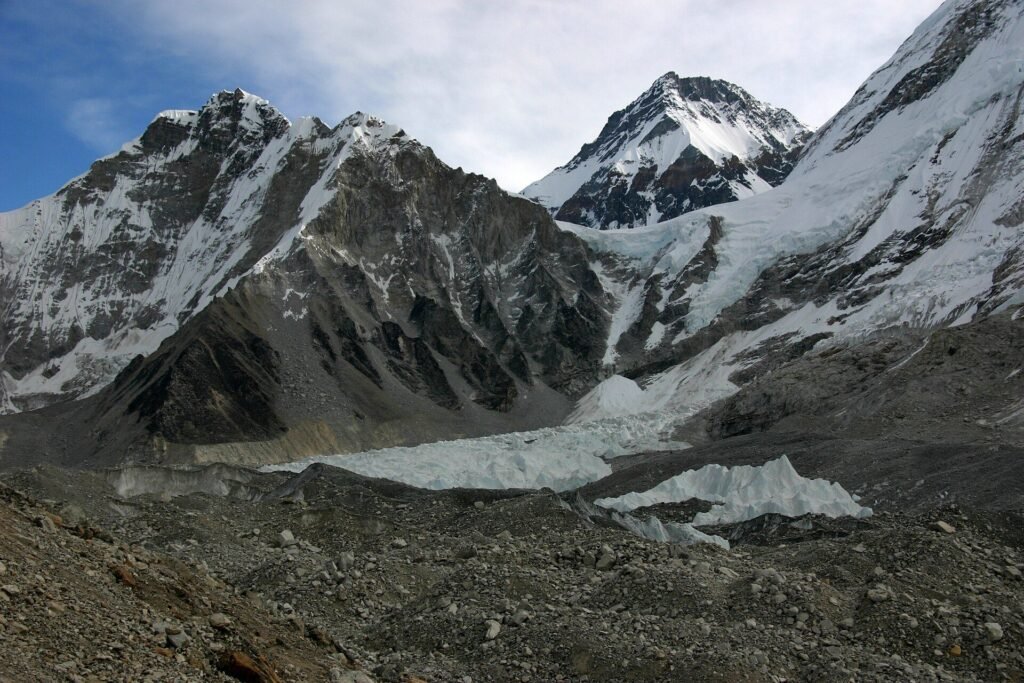
- Gorak Shep to Everest Base Camp-12-Khumbu-Gletscher-2007-gje by Gerd Eichmann, CC BY-SA 4.0, via Wikimedia Commons
The infographic is original to TravelSpatial. Photos are used under the licences linked above.
1 comment on “Annapurna Base Camp vs Everest Base Camp: Which Trek Fits Your Days and Budget?”