

Visa-free, ETA, eVisa or embassy visa: how to tell what your passport needs, where to get it, and the date rules that strand travelers at check-in.
Most travelers who get turned away at the airport aren’t missing a visa. They’re missing a date. A passport that expires in four months. A UK trip booked without the new online permit. A Europe itinerary that quietly runs past 90 days.
The airline checks all of it before you board, and it doesn’t care that you bought a nonrefundable ticket.
This guide maps every kind of border permit you’ll meet in 2026, from “just show your passport” to a full embassy visa. You’ll see which pre-travel permits are live right now, what they cost, and the two passport dates to check before you book anything. It takes about fifteen minutes to work through for any trip, on any continent.
The entry ladder: five ways a border lets you in
Every border on earth sorts visitors into one of five rungs. Your rung depends on two things only: the passport you hold and the country you’re entering. Where you live, where you fly from and how long you’ve saved for the trip don’t change it.
The higher the rung, the earlier you need to start.
- Visa-free. Show a valid passport at the border and walk through. Nothing to apply for.
- Electronic travel authorization (ETA). A short online form, linked to your passport, usually approved in minutes to three days. Technically not a visa, but you can’t board without it.
- eVisa. A real visa you apply for online, often with a photo and documents. Allow days to a few weeks.
- Visa on arrival. You get it at the airport or land border, usually for a fee paid in cash or by card. Quick, but queues can be long and the rules can change with little notice.
- Embassy visa. An application through a consulate or visa center, often with an appointment, biometrics and proof of funds. Allow weeks to months.
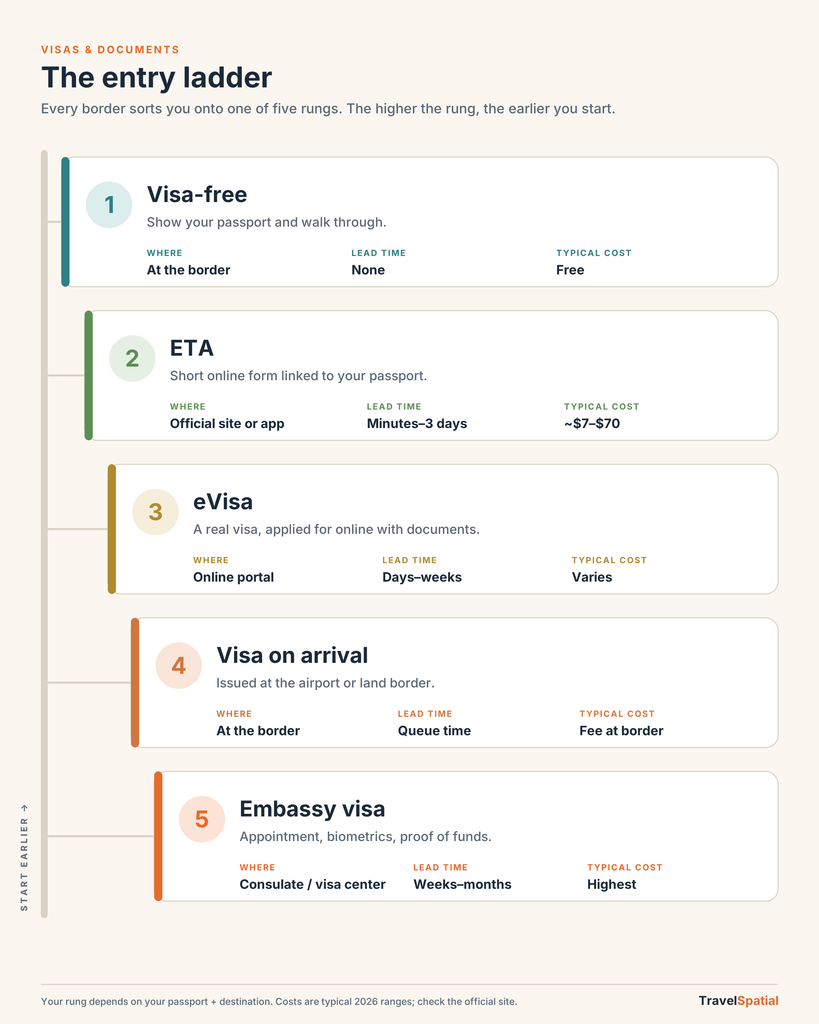
Five rungs, one rule: the higher yours sits, the earlier you start.
The fix: before you book, look up your exact passport and destination on the destination government’s own immigration site. If you hold two passports, check both: one may sit on a much lower rung than the other.
One catch at the bottom of the ladder: visa-free doesn’t mean rule-free. You still need a passport that meets the destination’s date rules, and you can still be asked for an onward ticket or proof of funds.
The pre-travel permits that matter in 2026
Rung two is where most of the change is happening. Country after country now wants visa-free visitors to register online before they fly, and fees have climbed fast. The UK’s ETA has doubled in just over two years, and the US ESTA nearly doubled in a single step in 2025.
Here’s where things stand for most Western passport holders as of October 2026:
| Destination | Permit | Official fee | Valid for |
|---|---|---|---|
| United Kingdom | ETA | £20 | 2 years, stays up to 6 months |
| United States | ESTA | $40.62 (from Oct 16, 2026) | 2 years |
| Canada (by air) | eTA | CA$7 | Up to 5 years |
| Australia | ETA (subclass 601) | A$20 app service fee | 12 months, stays up to 3 months |
| New Zealand | NZeTA + visitor levy | NZ$117 in the app (NZ$17 + NZ$100 levy) | 2 years |
| South Korea | K-ETA | Optional for exempt countries until Dec 31, 2026 | 3 years if you apply |
| Schengen Area | ETIAS | €20 once live | 3 years |
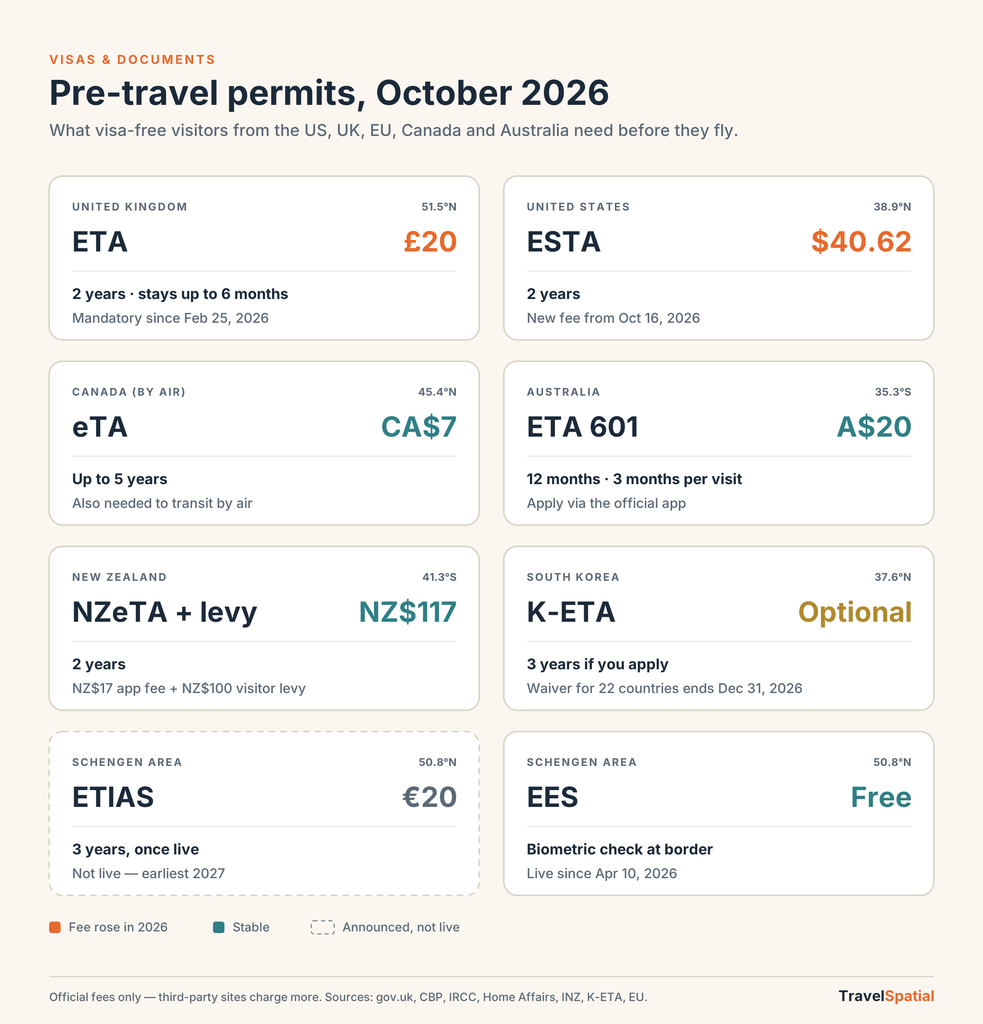
Official fees only. Third-party sites charge more for the same form.
Three things on that list deserve a closer look.
ETIAS isn’t live yet. Europe’s version was meant to start in late 2026, but it has slipped again. The EU pulled the launch date from its official site in summer 2026, and 2027 is now the earliest realistic window. Applications aren’t open, so anyone selling you an ETIAS today is selling nothing.
Europe’s border already changed anyway. The Entry/Exit System (EES) became fully operational on April 10, 2026. Passport stamps are gone for non-EU visitors; instead, the border scans your face and fingerprints on your first entry. There’s nothing to apply for, but the first crossing takes longer, so leave extra time at the airport.
South Korea’s waiver has an end date. The K-ETA exemption for the US, Canada, Australia, Germany, Japan and other countries runs until December 31, 2026. If your trip is in 2027, check the K-ETA site a few weeks before you fly in case the waiver isn’t extended.
Passport validity: the two dates that strand travelers
Your passport has two dates on the photo page, and border rules can use both. The expiry date is the one everyone checks. The issue date is the one that catches people out.
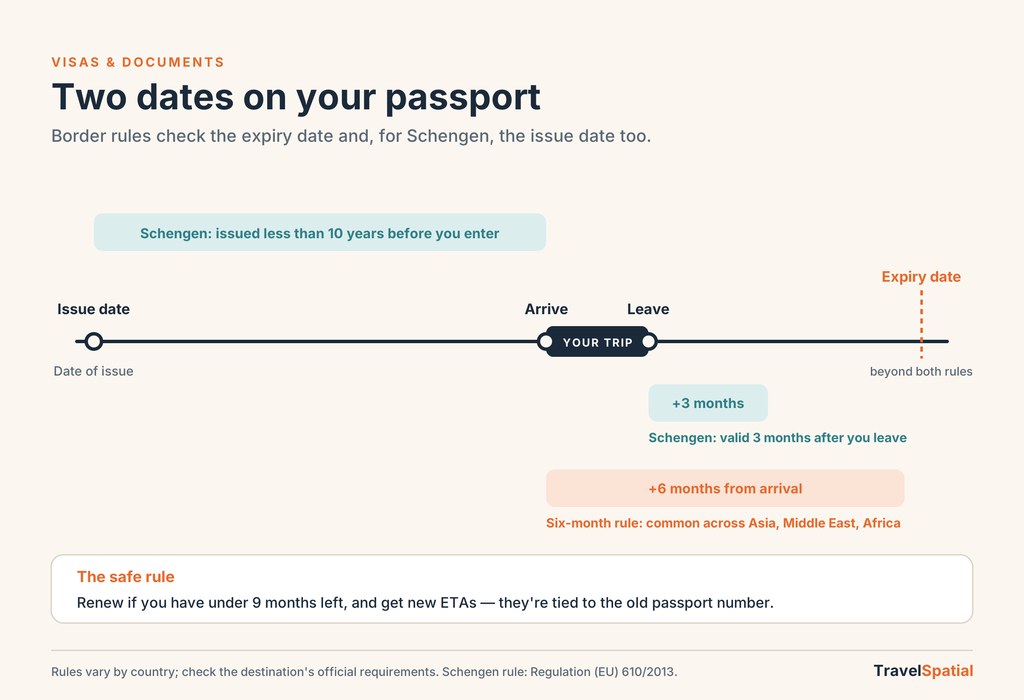
Check both dates on your photo page, not only the expiry.
The six-month rule. Many countries, especially in Asia, the Middle East and Africa, want your passport valid for at least six months from the day you arrive. Some ask for three or four. A passport with five months left can be refused even for a weekend visit.
The Schengen rule. Europe’s 29 Schengen countries use two tests at once. Your passport must be valid for at least three months after the day you plan to leave, and issued within the previous 10 years. That second test matters for older UK passports, some of which were printed with up to nine extra months of validity. Those bonus months don’t count at the Schengen border.
ETAs live on your passport. Every electronic permit in the table above is tied to one passport number. Renew your passport and you need a new ETA, ESTA or eTA, even if the old one had years left.
The fix: renew any passport with less than nine months left before you book a big trip. Nine months covers a six-month rule plus a long stay, and gives you time to reapply for any linked ETAs. Also count your blank pages: some countries want one or two empty pages for stamps or visa stickers.
The Schengen 90/180 rule, mapped
Visa-free visitors to the Schengen Area can stay 90 days in any 180-day period. It’s one allowance for the whole zone, not 90 days per country, so Spain, France and Greece all draw from the same pot.
The tricky part is the “any 180 days.” It isn’t a calendar half-year. It’s a rolling window: on any given day, look back 180 days and count every day you spent inside Schengen. That total must be 90 or fewer.
Here’s a worked example. A traveler spends 30 days in Spain from January 10 to February 8, then 45 days in Italy from April 1 to May 15. On June 20, their 180-day window reaches back to December 23. Inside it sit 75 Schengen days, so they have 15 days left, not the 90 a fresh-start reading might suggest.
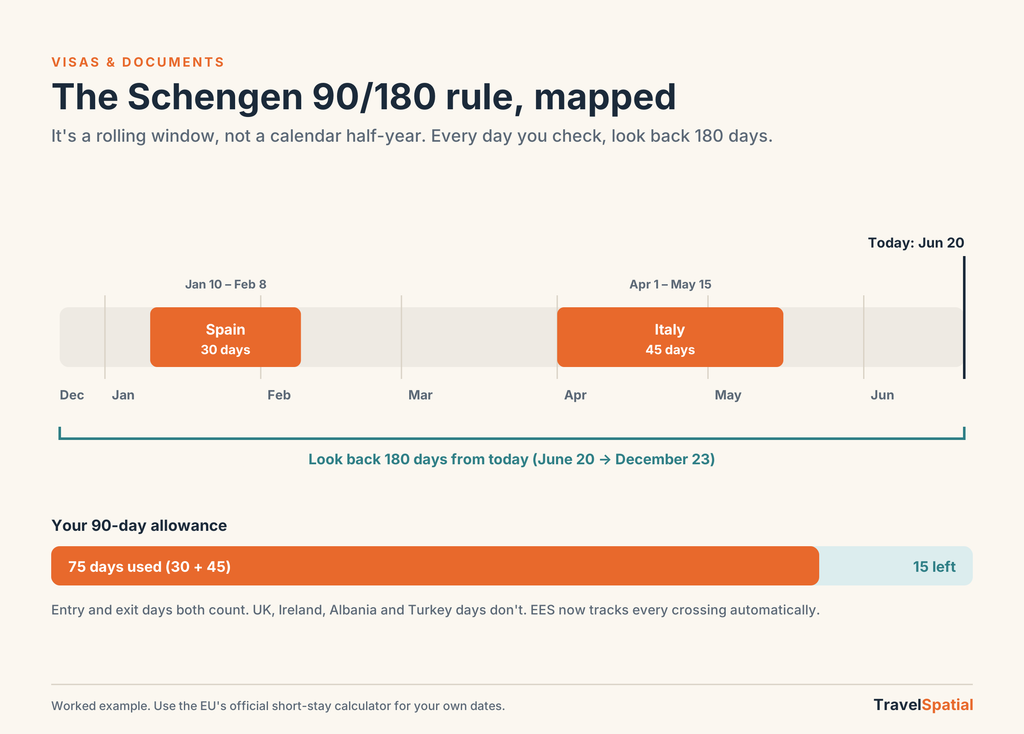
Look back 180 days from today and count every Schengen day, entry and exit days included.
Three details trip people up:
- Entry and exit days both count, even if you land at 11 p.m.
- Non-Schengen countries don’t count. Days in the UK, Ireland, Albania or Turkey are off the clock. Bulgaria, Romania and Croatia are inside Schengen now, so they do count.
- Overstays are now automatic to spot. With EES recording every entry and exit digitally, the system tracks your 90 days for you. An overstay can mean a fine or an entry ban.
The fix: use the EU’s official short-stay calculator before you book a long trip, and again before each re-entry. Digital nomads can stretch a year in Europe by alternating 90 days inside Schengen with 90 days in nearby non-Schengen countries.
Four traps that cost travelers money (or a flight)
Look-alike visa websites. Search “UK ETA” or “ESTA” and the top results are often private agencies. They look official, file the same form you could file yourself and charge two to five times the real fee. Canada’s eTA, for example, costs CA$7 on the government site, while third-party sites charge US$30 to US$100 for the same thing.
The fix: apply only through the government’s own site or official app. Look for a government domain (gov.uk, cbp.dhs.gov, canada.ca, immi.homeaffairs.gov.au) and compare the fee to the table above.
A name that doesn’t match. Your ETA, visa and plane ticket must match your passport exactly, middle names included. A typo in a passport number can void an ETA, and you won’t find out until check-in.
The fix: copy details straight from the photo page, never from memory, and double-check the passport number before you pay.
No proof of onward travel. Many visa-free countries, including much of Southeast Asia and Latin America, can ask how you’re leaving. Airlines sometimes ask before you board, especially on one-way tickets.
The fix: carry a booked exit flight, bus or ferry ticket, or a refundable one you can cancel later.
Transit surprises. Some countries want a permit even if you never leave the airport. Canada needs an eTA to transit by air, and New Zealand has a transit NZeTA.
The fix: check the rules for every country you touch on the way, not only the one at the end.
Build a three-layer document backup
Losing a passport abroad is stressful but fixable, as long as you can prove who you are. Keep your documents in three layers, each in a different place:
- Originals, on you. Passport, plus any physical visa or residence card, in a zipped inside pocket or money belt on travel days and in the room safe otherwise.
- Paper copies, in your bag. A photocopy of your passport photo page and visas, kept apart from the originals, plus two spare passport photos. Embassies ask for both when issuing an emergency passport.
- Digital copies, in the cloud. Scans of your passport, ETAs, visas, insurance policy and bookings in an encrypted folder you can open from any phone or laptop. Share access with someone at home.
Never pack all three layers in the same bag, and never let a hotel or tour company keep your original passport overnight.
Your 15-minute pre-trip document checklist
- Find your rung for each passport and destination on the official immigration site.
- Check the expiry date against the six-month rule (or three months after departure for Schengen).
- Check the issue date if you’re heading to Schengen. It must be under 10 years old on the day you enter.
- Count blank pages. Aim for at least two.
- Apply for ETAs or visas through the official site or app only, at least 72 hours before you fly.
- Match every name and number on permits and tickets to your passport, character by character.
- Book proof of onward travel if you’re on a one-way ticket.
- Check every transit country on your route.
- Count your Schengen days with the EU’s official calculator if you’re staying long.
- Save your three-layer backup and the address of your nearest embassy offline.
Visas and travel documents FAQ
Is an ETA the same as a visa?
No. An ETA is a pre-screening permit for travelers who don’t need a visa. It’s cheaper, faster and filed online, but like a visa, it doesn’t guarantee entry. The border officer still makes the final call.
Do I need ETIAS for Europe right now?
No. As of October 2026, ETIAS isn’t operating and applications aren’t open. The EU says it will announce the start date several months ahead. You do need to go through the new EES biometric check on your first entry.
How far ahead should I apply for an ETA?
At least 72 hours before you fly. Most are approved within minutes, but some get flagged for manual review. For eVisas, allow two to four weeks; for embassy visas, start two to three months out.
Do children need their own ETA?
Yes. In the UK, US, Canada, Australia and New Zealand, every traveler needs their own permit, babies included. Fees are per person, so budget for the whole family.
Can I use my ETA on a new passport?
No. Each ETA is linked to one passport number. When you renew your passport, apply for a new ETA too.
Get the paperwork right, then forget about it
Border rules feel chaotic, but they follow a pattern. Find your rung on the entry ladder. Check both dates on your passport. File any ETA on the official site, with your details copied exactly. Count your Schengen days if you’re staying long. Do those four things and the check-in desk becomes the easiest part of the trip.
Next, put the rest of your trip on the map. Start with how I plan a trip from scratch, make sure a lost passport is covered with travel insurance, explained simply, and stop fees eating your budget with how to avoid travel money fees.
Want border rule changes before they catch you out? Subscribe to the TravelSpatial newsletter below. One honest guide a week, no spam, unsubscribe anytime.
Entry rules, fees and dates in this guide reflect official and published sources as of October 24, 2026, and change often. Always confirm requirements for your passport on the destination government’s official website before you travel. This guide is general information, not legal or immigration advice.
Sources
- VisasNews: UK ETA fee rises to £20
- Service-Public.fr: UK ETA price and validity
- VisasNews: ESTA fee from October 16, 2026
- Government of Canada: Apply for an eTA
- Australian High Commission: Electronic Travel Authority
- Discover New Zealand: NZeTA and visitor levy
- Korean Ministry of Foreign Affairs: K-ETA exemption to Dec 31, 2026
- Navan: ETIAS launch date status
- EY: EES fully operational April 10, 2026
- Hungarian Police: Schengen passport validity rules



17 comments on “Do I Need a Visa? A Map of Every Border Permit (2026)”