
You don’t need to sell your furniture to find out whether remote work and travel suit you. You need one city, one month and a plan for each week. That’s what this guide is: your first month as a digital nomad, told week by week, from the night before you fly to the day you decide whether to keep going.
You won’t be alone in trying it. MBO Partners’ 2025 State of Independence study counted about 18.5 million American workers describing themselves as digital nomads, up from 18.1 million the year before (MBO Partners). Most didn’t start with a one-way ticket. They started with a test.
Before week one: the three conversations
You have three conversations before you book anything. Skipping any of them is how a test month turns into a mess.
With your employer or clients. Can you work from abroad, from which countries and for how long? Some employers allow it, some don’t, and tax and payroll rules can make a short stay matter. Get the answer in writing. If your team is in another time zone, check our time-zone map for remote work before you pick a city.
With the border. For a one-month test, a normal visitor stay usually covers the length of the trip, but entry rules aren’t work permits, and the rules keep changing. Thailand cut its visa-free stay for many passports from 60 days to 30 days from 15 September 2026, according to reports of the Royal Gazette notice (VisasNews). Georgia still lets many nationalities stay a year but has required health and accident insurance for visitors since 1 January 2026 (GPI Holding). The UK Foreign Office sets the minimum at 30,000 GEL of cover for your whole stay (FCDO Georgia entry requirements). Check the official rules for your passport. Our visa map is a good place to start. If you’ll stay longer, check the digital nomad visa income requirements.
With your bank account. Price the month before you go: rent, food, insurance, a desk and a buffer. Have at least the cost of a flight home on a separate card.
Choosing the city: boring is good
Pick somewhere easy for month one: good internet, a working time-zone overlap, other nomads and a short airport transfer. This isn’t the month for a remote island. Our seven nomad-friendly cities all have work, food and coffee within a short walk, which is exactly what you want while you’re learning.
Book the first week’s accommodation only, ideally somewhere with a guaranteed desk and a review that mentions the wifi. You’ll pick the rest once you’ve seen the neighbourhood, choosing between coliving, a monthly Airbnb or a local rental.
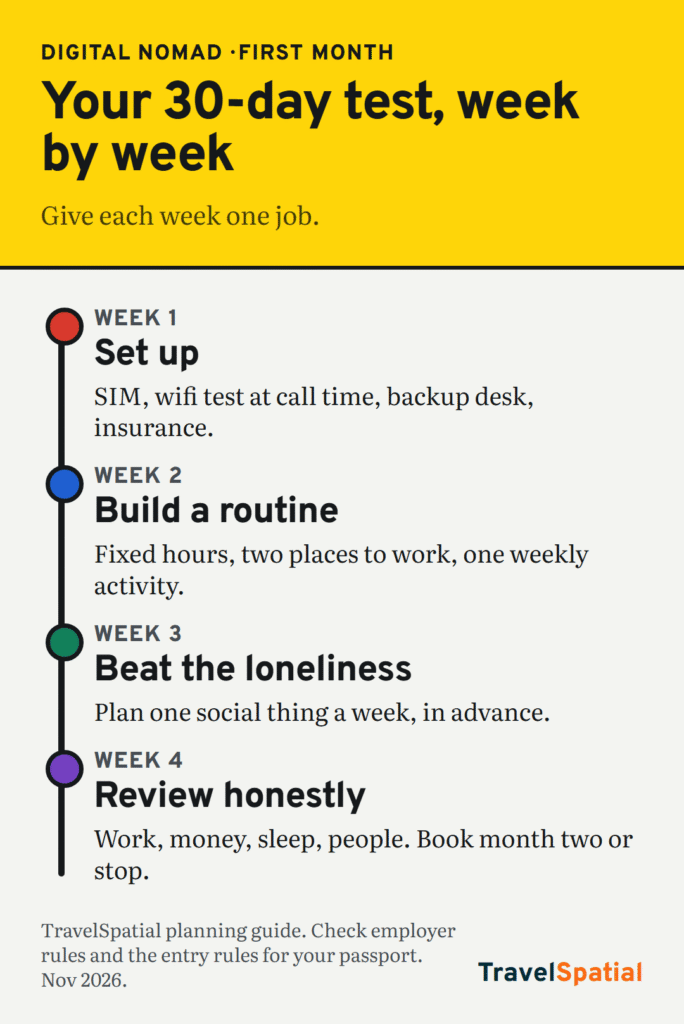
Week one: set up, don’t optimise
You land on a Saturday. That’s deliberate: two days before anyone expects an email from you.
Don’t go sightseeing yet. Spend the weekend on the dull things:
- Get online twice. Buy a local SIM or eSIM with data, and test the flat’s wifi with a speed test at the hour you’ll take calls. If it fails, you still have a hotspot.
- Find a backup desk. Walk to the nearest coworking space or two and ask about day passes. If the power or wifi goes during a meeting, you’ll know where to run.
- Learn the route to food. A supermarket, a pharmacy and one place you can eat cheaply alone. (Our guide to eating alone on a budget explains why the set lunch is your friend.)
- Sort insurance. If your normal policy doesn’t cover long trips, some nomad policies can be bought while you’re already abroad. SafetyWing’s Essential plan, for example, says you can sign up “at any point during your travels” (SafetyWing). Our nomad insurance guide explains what to compare.
On Monday, work your normal hours. Keep the evenings quiet. You’re not on holiday, and the most common week-one mistake is acting as if you are: late nights, then a weak first week of work that makes you doubt the whole idea.
Week one checklist: SIM working · wifi tested at call time · backup desk found · route to groceries · insurance active · first full work week done.
Week two: build the routine
By week two you know where things are. Now you decide when things happen.
Pick a fixed start time and a fixed finish time, and protect both. Decide which days you’ll work from the flat and which from a café or coworking space. Put one thing in the calendar that isn’t work: a class, a run club, a language exchange. That’s your first anchor for meeting people, and it’ll matter in week three.
This is also the week to look at your money. Compare what you’ve spent with what you planned. If you’re over budget, it’s almost always rent, eating out or taxis.
Week two checklist: fixed working hours · two places to work · one recurring activity booked · spending checked against the plan.
Week three: the loneliness week
Week three is when the novelty fades. You’ve seen the main sights, your routine works, and you realise you haven’t had a real conversation in days. This is normal, and it’s the week most first-timers decide the lifestyle isn’t for them, often for the wrong reason.
Do something about it on purpose. Go back to the recurring activity. Accept one invitation you’d normally decline. Join a coworking event or a city’s nomad chat group and turn up to one meetup. If you’d rather avoid dorm-style socialising, our guide on meeting people without a dorm has options that need less energy, and our seven rules for making friends as a digital nomad cover the longer game.
Week three checklist: one social plan a week, made in advance · one conversation that isn’t about work · a call home if you need it.

Week four: the honest review
The last week is for deciding. Answer five questions on paper:
- Did my work quality stay the same, get better or get worse?
- Did I spend within 10–15% of my budget?
- Did I sleep well, and was the flat the problem if I didn’t?
- Did I have enough people around me?
- Do I want to do another month, and where?
If the answers are mostly good, plan month two. You’ll do it better: you’ll book a longer stay in a neighbourhood you’ve chosen, not one you guessed. When you move on, follow our travel-day countdown. If they’re mostly bad, that’s useful too. A month is a cheap way to learn that you prefer a few long trips a year to living on the road.
What to pack (and what not to)
Take less than you think. You’ll buy what you forgot. Bring a laptop stand and a compact keyboard if you work long hours, a universal adapter, noise-cancelling headphones and any medication you need, with prescriptions. Leave the “just in case” outfits at home. Our carry-on floor plan shows how to fit a month into one bag.
Arriving late? Read our airport-to-bed checklist for landing alone at night before you book the flight.
Day 30
Treat your first month as a digital nomad as a test, not a move. Clear it with your employer, check the entry rules for your passport, choose an easy city, and give each week a job: set up, build a routine, deal with the loneliness, review. At the end you’ll know whether the second month is worth booking, and you’ll book it better.
For more guides like this, sign up for the TravelSpatial newsletter below.
Sources
- MBO Partners: Digital Nomads, State of Independence 2025
- VisasNews: Thailand cuts visa-free stay to 30 days from 15 September 2026, checked November 2026 (secondary source; check Thai official channels)
- FCDO Georgia entry requirements (minimum 30,000 GEL, whole stay), checked November 2026
- GPI Holding: mandatory insurance for tourists visiting Georgia, checked November 2026
- SafetyWing Nomad Insurance, checked November 2026
Photo credits
- Balcón en Roma Norte by Tamara Martínez, CC BY-SA 4.0, via Wikimedia Commons
- Mural of Frida the dog in Mexico City by Kylelovesyou, CC0, via Wikimedia Commons
The infographic is original to TravelSpatial. Photos are used under the licences linked above.