

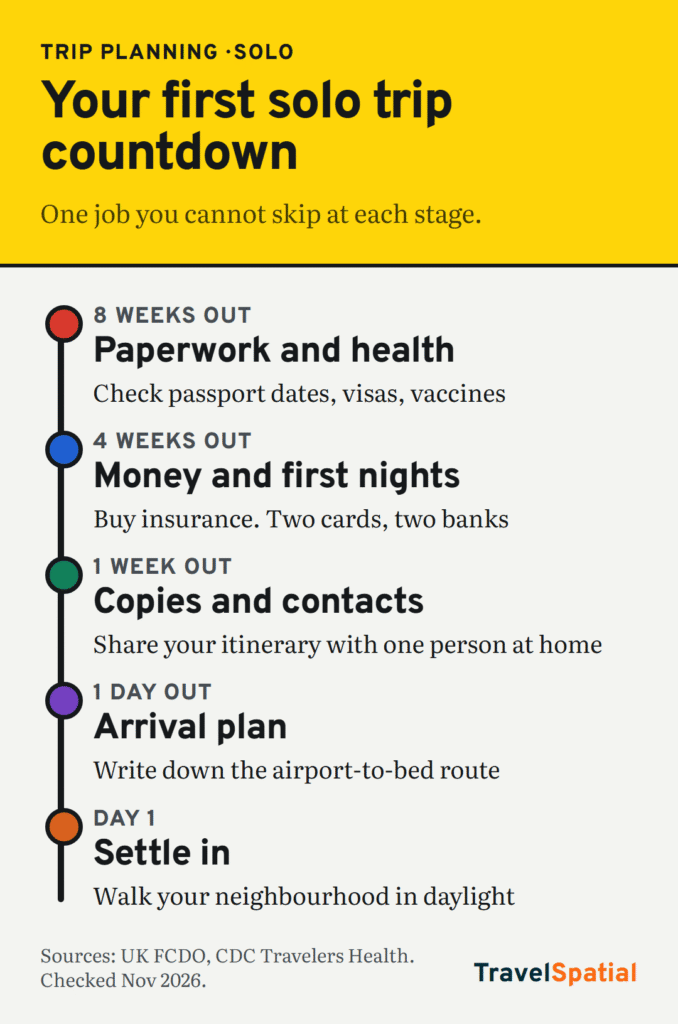
This is a first solo trip checklist arranged by countdown: what to do eight weeks, four weeks, one week and one day before you leave. Work down it in order. Each item is there because, when you travel alone, nobody else will notice if you skip it.
Most checklists are written for anyone going anywhere. This one adds the jobs that matter more when you’re solo: a backup for every card, document and phone, someone at home who knows your plan, and a first night that’s settled before you land.
How to use it: copy the list into your notes app, delete what doesn’t apply, and tick as you go. Rules and links were checked in November 2026.
At a glance
| When | Focus | The one job you can’t skip |
|---|---|---|
| 8 weeks out | Paperwork and health | Check your passport dates against your destination’s rules |
| 4 weeks out | Money, insurance, first nights | Buy insurance and set up a backup card |
| 1 week out | Copies, contacts, offline tools | Share your itinerary with one person at home |
| 1 day out | Arrival | Write down how you’ll get from the airport to your bed |
| Day 1 | Settling in | Walk your neighbourhood in daylight |
8 weeks out: paperwork and health
Start with anything that involves forms, appointments or waiting.
- ☐ Passport dates. There are two to check. Schengen countries need a passport issued less than 10 years before you arrive, and valid for at least 3 months after you plan to leave (UK FCDO, Greece entry requirements). Many other countries want 6 months’ validity. If either date is close, renew now. Renewals take weeks.
- ☐ Visas and travel authorisations. Check the official government page for your destination and your nationality. Our visa guide explains the main types. For Europe, the EU’s new Entry/Exit System (EES) registers non-EU travellers’ fingerprints and photo at the border. ETIAS, the pre-travel authorisation, still had no launch date as of late October 2026 (Schengen Visa Info). Only apply through the official EU site once it opens.
- ☐ Travel health appointment. Book it now. Some vaccines need several doses or time to take effect. The CDC’s destination pages list what’s recommended for each country.
- ☐ Book the big transport. Long-haul flights and any train that sells out (sleeper trains, holiday dates).
- ☐ Decide how much you’re spending. Our first solo trip budget guide gives a savings formula and three worked examples.
Not decided where to go yet? Our guide to first solo trip destinations scores six cities on what matters most first time.
4 weeks out: money, insurance and your first nights
- ☐ Buy travel insurance. Buying it early matters. It can cover you if something forces you to cancel before you leave. Check medical cover, cancellation, and the excess. Our plain-English insurance guide shows what a standard policy covers.
- ☐ Set up two cards from two different banks. If one is blocked, lost or skimmed, you need another that works. Nobody can lend you theirs. Order a card with no foreign transaction fees if you don’t have one. Our travel money fees guide explains which fees to avoid.
- ☐ Book your first two or three nights. Somewhere well reviewed, central, and easy to reach from the airport or station. You can improvise after that.
- ☐ Read up on local norms. Dress codes, tipping, scams aimed at new arrivals. Your government’s travel advice page is the best single source. Sign up for its updates (in the US, the State Department’s STEP programme; in the UK, FCDO travel advice email alerts).
- ☐ Sort your phone. Check that it’s unlocked, then either buy an eSIM for your destination or check your provider’s roaming price. Working data from the moment you land is the best safety tool you’ll have.
1 week out: copies, contacts and offline tools
This week is about backups. When you’re travelling alone, there’s no second person with a copy of your passport or a charged phone.
- ☐ Copy your documents. Photograph your passport photo page, visas, insurance policy and card emergency numbers. Keep the copies in two places: a cloud folder, and an email to yourself.
- ☐ Write an itinerary for one person at home. Include flights, the address of your first nights, and your plans for the first few days. Agree a simple check-in, for example a message every evening, and what they should do if you miss two.
- ☐ Save emergency numbers. The local emergency number (112 works across the EU), your embassy, your insurer’s 24-hour line, and the numbers for blocking your cards.
- ☐ Download offline maps of every city you’ll visit, plus a translation app with your languages downloaded for offline use.
- ☐ Pack a backup kit, separate from your wallet: a second card, some cash in local currency or US dollars or euros, and a printed copy of your passport.
- ☐ Pack light. You’ll carry everything yourself, up stairs and onto trains, with no one to watch your bag while you buy a ticket. Our carry-on packing guide shows how to fit it all in one bag.
1 day out: the arrival plan
- ☐ Write down how you’ll get from the airport to your bed: which train or bus, the last departure time, and the taxi rank or ride-hailing pick-up point as a backup. If you land after dark, follow our airport-to-bed checklist for landing alone at night.
- ☐ Screenshot your first night’s booking, including the address in the local script if it uses one. Taxi drivers can read it, and screenshots work without data.
- ☐ Charge everything: phone, power bank and headphones.
- ☐ Check in online and download your boarding pass.
- ☐ Message your contact at home with your flight number.
Day 1: settle in before you explore
- ☐ Message home when you reach your room.
- ☐ Walk the neighbourhood in daylight. Find the nearest supermarket, pharmacy, cash machine and transport stop. You’ll come back after dark, and it helps if the street already looks familiar.
- ☐ Ask reception which areas to avoid at night and how to get a reliable taxi.
- ☐ Do one small, easy thing, such as a café, a park or a market. Save the big sight for tomorrow, when you’ve slept.
What you can safely skip
You don’t need a detailed plan for every day. Book transport that sells out, your first nights and anything with limited tickets. Leave the rest open. Plans change on the road, more so when you’re alone and can decide on the spot. For the wider planning process, from choosing a route to booking, see how we plan a trip from scratch.
Summary
At 8 weeks, deal with passports, visas, vaccines and big bookings. At 4 weeks, buy insurance, set up two cards and book your first nights. A week out, make copies, share your itinerary with someone at home and download offline maps. The day before, write your airport-to-bed plan. On day 1, walk your neighbourhood in daylight before you do anything else. Everything after that can be decided on the road.
Get printable checklists like this one in the TravelSpatial newsletter.
Sources
- UK FCDO, Greece entry requirements (Schengen passport rules) (updated 3 November 2026)
- Schengen Visa Info, ETIAS has no launch date (checked November 2026)
- CDC Travelers’ Health, destinations
- US State Department, Smart Traveler Enrollment Program
- UK FCDO, foreign travel advice
Photo credits
- Departures board at Miami Airport in Florida, US by Bobby Hidy, CC BY-SA 2.0, via Wikimedia Commons
- Azerbaijan 2023 passport stamps entry and exit by Ash Thawley, CC BY-SA 4.0, via Wikimedia Commons
The infographic is original to TravelSpatial. Photos are used under the licences linked above.



3 comments on “Your First Solo Trip Checklist: What to Do 8 Weeks, 4 Weeks, 1 Week and 1 Day Out”