

Five places your money disappears between your bank and local cash, and the one-line fix for each.
Picture two travelers on the same two-week trip. Same flights, same hostels, same street food. One comes home having paid about $2 in fees for every $1,000 spent. The other paid close to $90. Neither did anything reckless. The second one just said yes to a few friendly questions at an airport counter, a card machine and an ATM.
This guide maps every place your money leaks on the way from your bank account to local cash, and shows you how to avoid travel money fees at each one. It takes about ten minutes to set up before you leave, and it works on any continent.
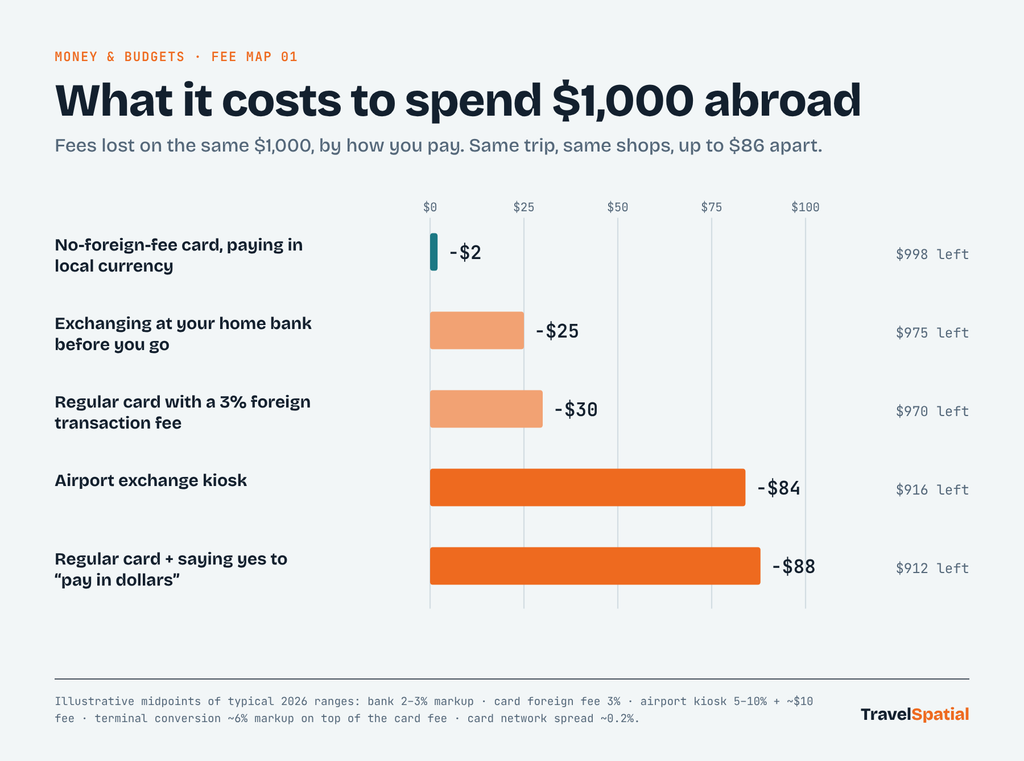
The five places travel money leaks
Almost every travel money fee falls into one of five spots. Each one is easy to dodge once you know where it sits:
- The airport exchange counter, where the rate is the fee.
- The “pay in your home currency?” prompt on card machines and ATMs.
- Your own card’s foreign transaction fee, charged quietly on every purchase.
- Fixed ATM fees and cash advances, which punish small, frequent withdrawals.
- Leftover cash, which you pay to convert a second time on the way home.
Here is how each one works, and the one-line fix for it.
Leak 1: The airport exchange counter
Airport kiosks rarely charge an obvious “fee.” They hide it in the exchange rate. Compared to the mid-market rate (the one you see on Google or XE), airport counters typically sit 5–10% worse, and many add a flat $5–15 charge per transaction. Even at airports where the spread is tighter, 3–5% is common. They can do this because you are a captive customer with nowhere else to go.
The fix: skip the counter. Land with a little emergency cash from home (more on that below), then use a bank-owned ATM in the arrivals hall or in town. If you truly need cash before you find an ATM, change the smallest amount that gets you to your hotel.
Leak 2: “Would you like to pay in dollars?”
This is the most expensive question in travel, and it sounds helpful. A card machine or ATM offers to charge you in your home currency so you “know exactly what you’re paying.” It’s called dynamic currency conversion (DCC), and the terminal uses its own exchange rate with a markup built in.
How big is that markup? Investigations have found DCC raising prices by roughly 2.6% to 12%, and the average across Europe sits around 5%, with outliers near 14% at some ATMs. Merchants often get a cut, which is why staff sometimes push it. Worse, choosing your home currency does not always spare you your card’s own foreign fee, so you can pay twice.
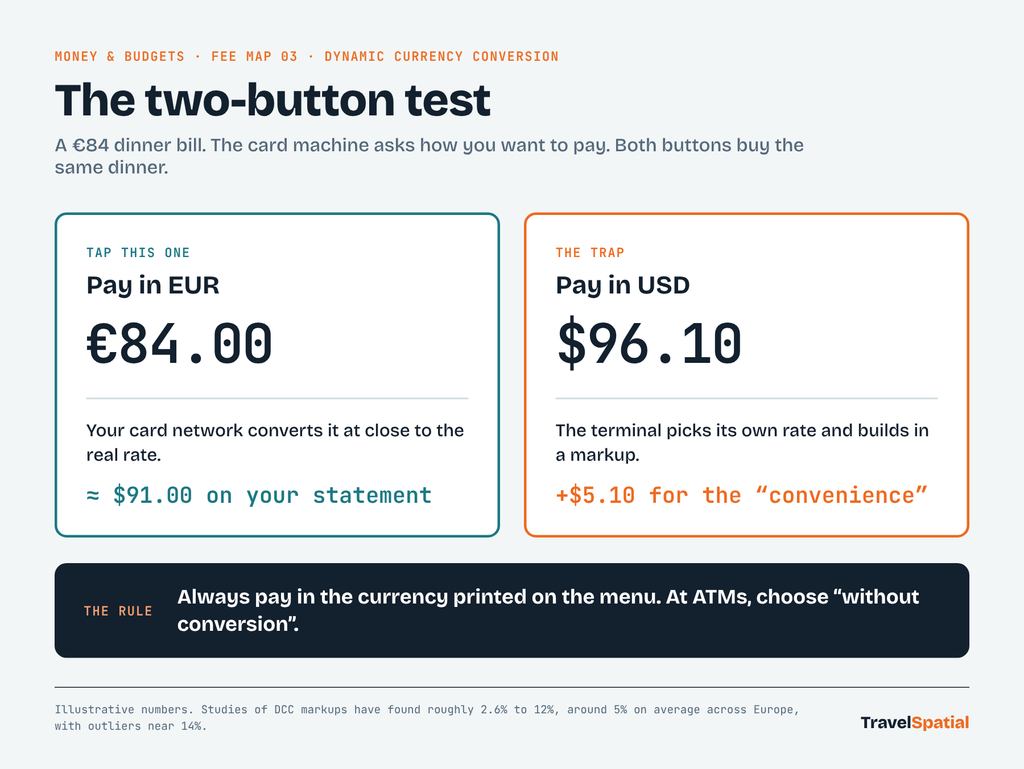
The fix: always pay in the currency printed on the menu or price tag. At ATMs, look for “decline conversion,” “continue without conversion,” or the local currency name. If a cashier converts without asking, you can ask them to void the charge and run it again in local currency.
Leak 3: Your card’s foreign transaction fee
Many credit and debit cards add a surcharge every time you pay in a foreign currency, usually 1–3% and often the full 3%. WalletHub’s 2026 landscape report puts the average at about 1.59%. It never shows up at the till, only on your statement weeks later, which is why so many travelers don’t realize they’re paying it.
On a $3,000 trip, a 3% fee is $90 you could have spent on a cooking class or two extra nights in a guesthouse.
The fix: before you book anything, find your card’s rates-and-fees table and search for “foreign transaction” or “non-sterling transaction.” If it says anything other than 0%, get a card that doesn’t charge one. Most travel credit cards and multi-currency cards (Wise, Revolut and similar) waive it or charge a small, upfront conversion fee instead.
Leak 4: Fixed ATM fees and cash advances
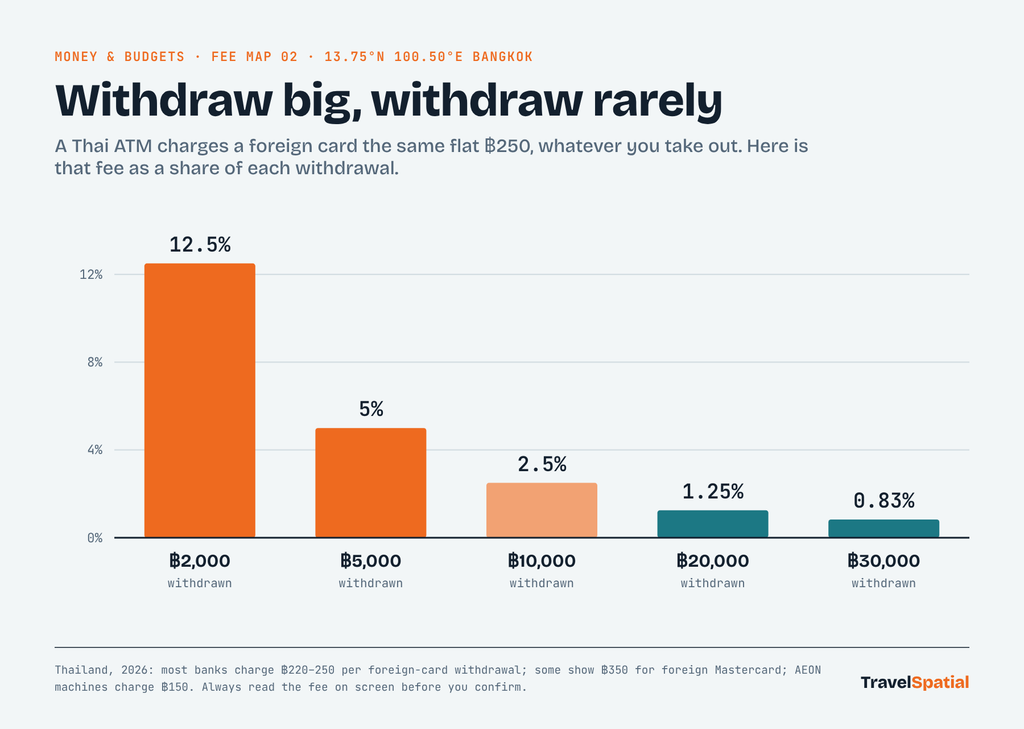
Many countries let local banks charge foreign cards a flat fee per withdrawal. Thailand is the classic example. In 2026, most Thai banks charge ฿220–250 per foreign-card withdrawal, some machines now show ฿350 for foreign Mastercard, and AEON’s machines stay the cheapest at around ฿150.
Because the fee is flat, the size of your withdrawal decides how much it hurts:
Two more ATM traps to avoid:
- Credit cards at ATMs. Most issuers treat this as a cash advance, with its own fee and interest that starts the same day. Use a debit card for cash.
- Independent “tourist” ATMs. Machines in convenience stores and bars often charge more than bank-branch ATMs. A bank ATM, inside or beside a branch, is cheaper and safer.
The fix: withdraw big and rarely, up to what you can store safely. Read the fee on screen before you confirm, and if it looks high, cancel and try another bank or your other card.
Leak 5: Leftover cash
Every time money changes currency, someone takes a cut. Exchanging leftover notes back at the end of a trip means paying a second spread, and most counters won’t take coins at all.
The fix: plan your last withdrawal so you run low near the end. Spend coins at the airport on snacks or water. Keep a small stash of any currency you’ll use again soon, or put the last of it toward your final hotel bill and pay the rest by card.
Build a four-layer travel wallet
Avoiding fees is half the job. The other half is making sure one lost wallet or one frozen card can’t stop your trip. Spread your money across four layers, each kept in a different place:
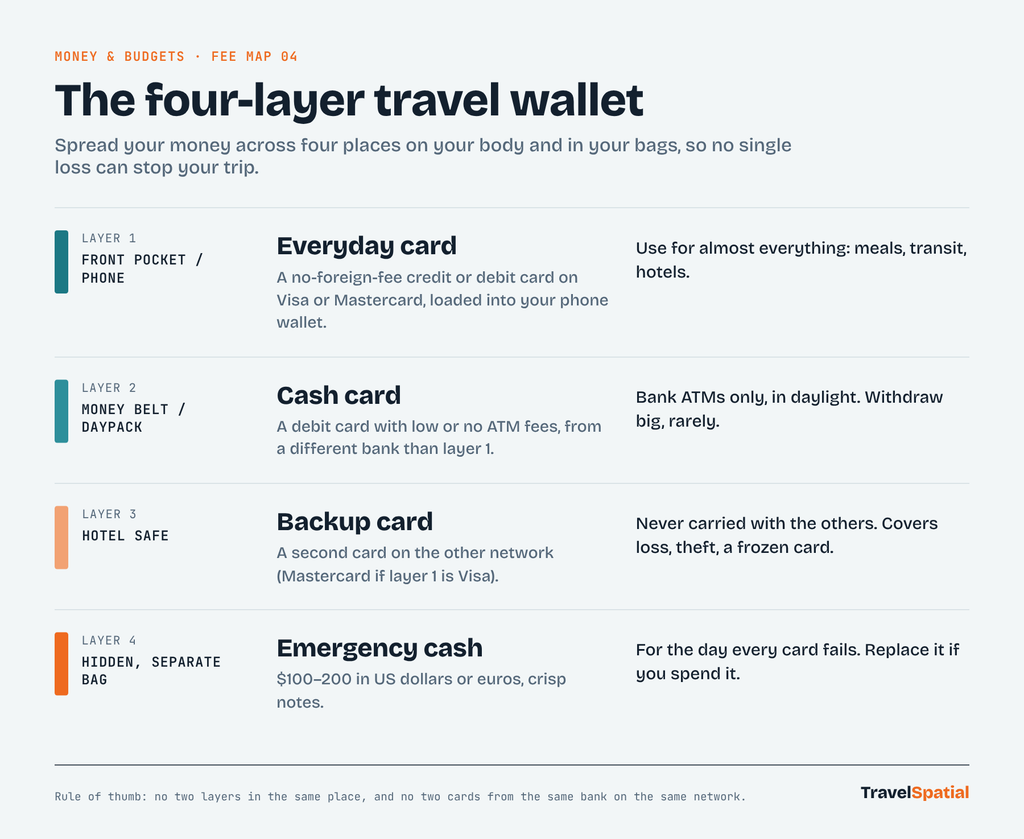
Visa and Mastercard are accepted almost everywhere. American Express and Discover are patchier abroad, so don’t make either your only card.
Your 10-minute pre-trip money checklist
- Check every card’s foreign transaction fee. Keep the 0% ones; leave the rest at home.
- Check your debit card’s ATM fees, and whether your bank refunds other banks’ ATM charges.
- Pack cards on both networks, at least one Visa and one Mastercard.
- Add your everyday card to your phone wallet for tap-to-pay.
- Save your bank’s international phone number somewhere offline, not only in your banking app.
- Turn on transaction alerts so you spot a skimmed card within minutes.
- Look up the local ATM fee and limit for your destination, so you know how much to withdraw at once.
- Bring $100–200 in crisp US dollars or euros as emergency cash.
- Save a currency app with offline rates, so you can sanity-check prices and receipts.
- Memorize one rule: always pay in the local currency.
Travel money FAQ
Is it better to pay in local currency or my home currency?
Local currency, every time. Paying in your home currency triggers dynamic currency conversion, where the terminal sets the rate and adds a markup, usually a few percent and sometimes over 10%.
Should I exchange money before I travel?
Usually not. A home bank typically marks up the rate by 2–3%, and airport counters by more. A fee-free card and a bank ATM on arrival are almost always cheaper. The exception is a small emergency stash in US dollars or euros.
How much cash should I carry when traveling?
Enough for one to three days of cash-only spending, plus your emergency stash. In cash-heavy places like Thai street markets, carry more and top up with large, infrequent ATM withdrawals. In card-friendly cities, a little is fine.
Do no-foreign-fee cards still charge ATM fees?
Often, yes. A 0% foreign transaction fee covers purchases. The local bank can still charge its own ATM fee, and your card issuer may add a withdrawal fee too. Check both.
Keep more of your money for the trip
Most travel money fees aren’t bad luck. They sit in predictable places: the airport counter, the “pay in dollars” button, your card’s fine print, small ATM withdrawals and leftover change. Fix those five spots and the gap between $2 and $88 per $1,000 stays in your pocket.
Next, put those savings to work. Plan your daily spend with my travel budget template, time your trip for lower prices with the shoulder season travel guide, and make sure a lost card is covered with travel insurance, explained simply.
Want one honest budget breakdown a week? Subscribe to the TravelSpatial newsletter below. No spam, unsubscribe anytime.
Fees and rates in this guide reflect published figures as of October 2026 and change often. Check your own card’s terms before you travel. This guide is general information, not financial advice.
Publishing kit
Everything WordPress and your SEO plugin need, ready to paste.SEO title (H1)How to Avoid Travel Money Fees: A Map of Every LeakCopyMeta descriptionAirport kiosks, “pay in dollars?” prompts, card and ATM fees: how to avoid travel money fees at every step, with 4 infographics and a 10-minute checklist.CopyURL slugavoid-travel-money-feesCopyCategoryTravel Tips › Money & Budgets › Saving moneyCopyPrimary keywordavoid travel money feesCopySecondary keywordsdynamic currency conversion, foreign transaction fee, ATM fees abroad, airport currency exchangeCopyCoordinates line0.00°N 0.00°E · Null IslandCopyFeatured image suggestionts-fee-map-1000-dollars.png (also works as the Pinterest pin)Copy



16 comments on “How to Avoid Travel Money Fees: A Map of Every Leak”