

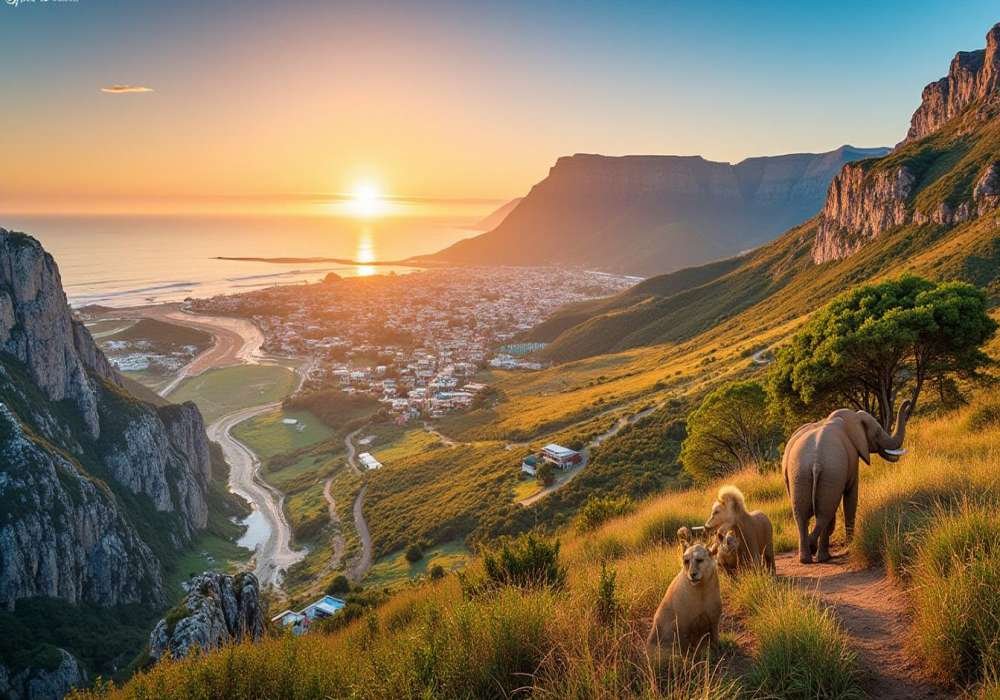
South Africa is two countries’ worth of trips stitched together. One is a coastline: Table Mountain, penguins, wine valleys and the forests of the Garden Route. The other is the bush: Kruger’s 2-million-hectare wilderness, where elephants block the road and lions sleep in the shade of your rental car.
Most first-timers try to do both and end up spending half the trip in transit. This South Africa itinerary fixes that with a simple shape: drive the coast west to east, then fly to the bush. It’s 14 days, about 1,100 km of coastal driving and one internal flight.
Below you’ll find the route as a map, a day-by-day plan, the best months for each region, 2026 daily budgets in rand and dollars, drive times, and the practical stuff: visas, safety and money. Prices are checked against official sources as of October 2026 and converted at roughly R16.5 to US$1.
The route at a glance
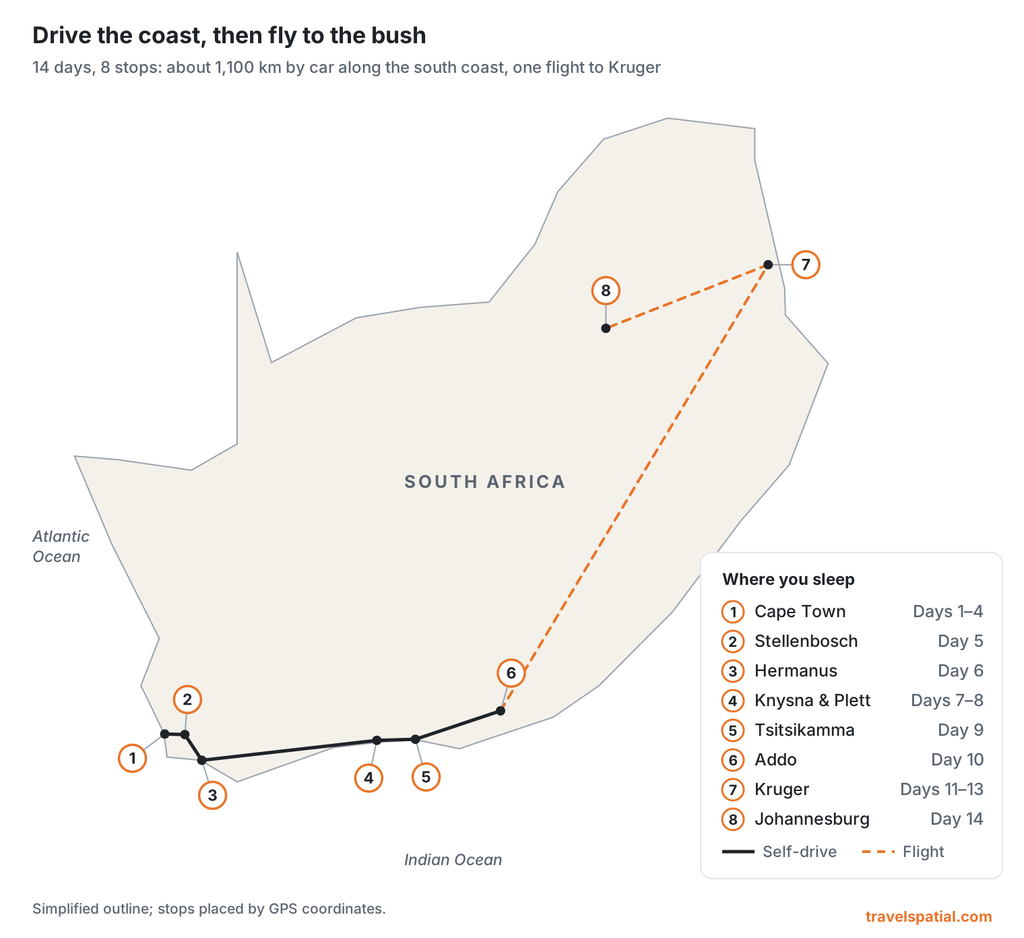
Six of the eight stops sit within 60 km of the south coast; the only long hop, Addo to Kruger, is the one you fly.
The 14-day South Africa itinerary, day by day
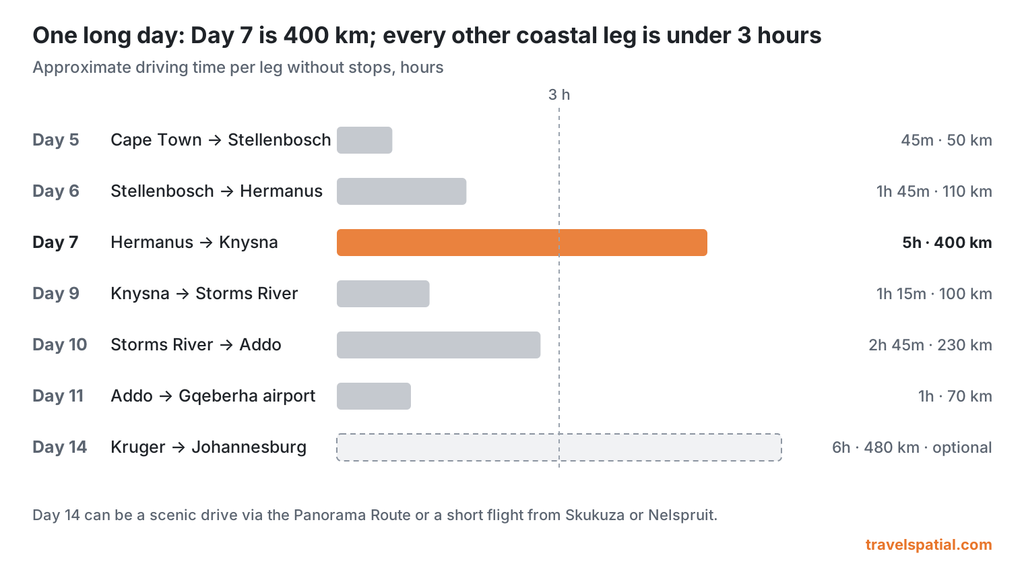
The plan runs Cape Town → Winelands → Whale Coast → Garden Route → Addo → fly → Kruger. Every coastal leg but one is under 3 hours of driving; Day 7 is the long one.
Days 1–4: Cape Town and the Peninsula
- Day 1 — Arrive, V&A Waterfront, Bo-Kaap. Land at Cape Town International, pick up your car (or don’t — you won’t need it until Day 3). Walk the colourful Bo-Kaap streets and eat Cape Malay curry for dinner.
- Day 2 — Table Mountain + city. Go up on the first clear morning; the Cableway closes in high wind. Adult return is R475 online / R530 at the office for 2026/27, and tickets are valid for 7 days (Table Mountain Cableway). Hikers can take Platteklip Gorge up (2–3 hours) and ride down one-way for R300.
- Day 3 — Cape Peninsula loop. Chapman’s Peak Drive → Cape Point → Boulders Beach penguins → Kalk Bay for fish and chips. Cape of Good Hope entry rises to R592 per international adult from 1 November 2026 (ATTA).
- Day 4 — Robben Island or a free day. Book the ferry well ahead in summer, or keep this day as your weather buffer for Table Mountain.
Day 5: Stellenbosch and Franschhoek
50 km from Cape Town. Do two or three tastings, then stay overnight so nobody has to drive after the last pour. The Franschhoek Wine Tram is the easy no-driver option.
Day 6: Hermanus (Whale Coast)
110 km via Sir Lowry’s Pass and the Clarence Drive coast road. From roughly June to November, southern right whales calve close to the cliff path — you can watch them from the shore for free.
Days 7–8: Knysna and Plettenberg Bay
- Day 7 — The long drive. About 400 km (4.5–5 hours) east on the N2. Break it in Swellendam or detour to Cape Agulhas, Africa’s southernmost tip.
- Day 8 — Knysna lagoon and Plett. Walk the Knysna Heads, kayak the lagoon, or take the Robberg Peninsula hike near Plettenberg Bay (seals, dolphins, 2–4 hours).
Day 9: Tsitsikamma (Storms River)
Cross the Storms River Mouth suspension bridge, then pick your adrenaline: forest canopy zipline or the Bloukrans Bridge bungee. Sleep near Storms River.
Day 10: Addo Elephant National Park
About 230 km to Addo, the warm-up safari. Herds of 50+ elephants at the waterholes are common, and it’s malaria-free. International entry rises to R565 per adult per day from November 2026 (Travel and Tour World).
Days 11–13: Kruger National Park
- Day 11 — Fly to the bush. Drop the car at Gqeberha (Port Elizabeth) airport, about 70 km from Addo, and fly via Johannesburg to Kruger Mpumalanga (Nelspruit) or Skukuza. Pick up a new car and enter by Malelane, Numbi or Paul Kruger gate before it closes.
- Days 12–13 — Game drives. Self-drive at dawn, nap at midday, drive again until gate closing. Add one guided sunset or night drive with SANParks — it’s the only way to be out after dark. Base yourself at Skukuza or Lower Sabie for the densest Big Five sightings.
Day 14: Johannesburg and fly home
Fly out of Kruger (Skukuza or Nelspruit) to Johannesburg for your international connection, or drive the Panorama Route (Blyde River Canyon, God’s Window) on the way — roughly 5–6 hours to O.R. Tambo.
Short on time? Cut Days 4 and 9 for a 12-day version. Got more? Add a night in the Cederberg or on Route 62 between Days 6 and 7.
Best time to visit South Africa (by region)
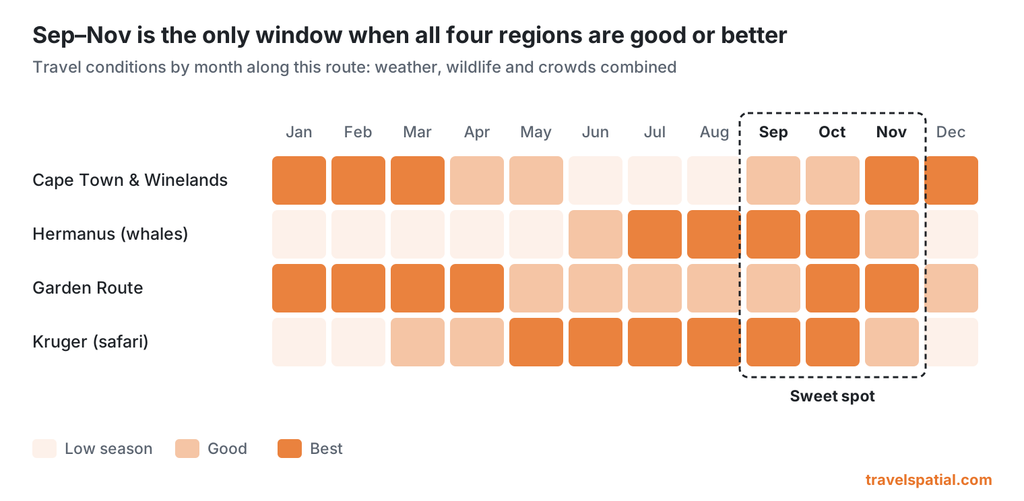
The coast and the bush peak at opposite times of year. The Cape is at its best in its dry summer (November–March), while Kruger is best in its dry winter (May–October), when the bush thins out and animals gather at waterholes.
- September–November is the overlap: spring wildflowers, whales still in Walker Bay, good game viewing and lower prices than December.
- December–January is South African school-holiday peak. Book everything, especially Kruger rest camps, months ahead.
- June–August brings Cape rain and cold fronts, but it’s Kruger’s best season and the cheapest time for the coast.
How much does South Africa cost in 2026?
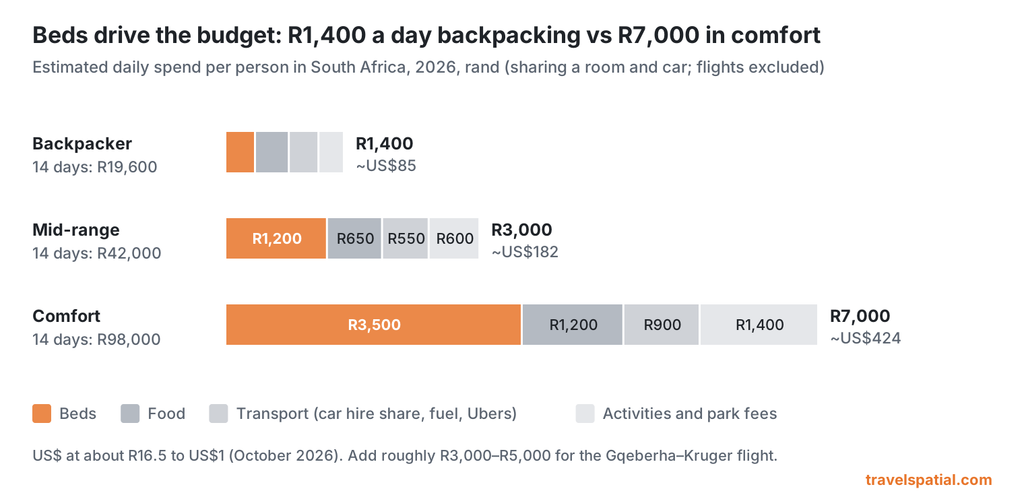
The strong 2026 rand makes South Africa pricier than it was in 2024, but it’s still good value: a backpacker can do this whole route for about US$1,200 before flights. Where you sleep decides most of the gap — food and transport only roughly triple from backpacker to comfort, while beds rise tenfold.
2026 prices worth knowing
| Ticket or fee | International adult | Notes |
|---|---|---|
| Table Mountain Cableway return | R475 online / R530 at office | Valid 7 days; Fast Track R1,200 |
| Kruger daily conservation fee | R692 per day | Up from R602 on 1 Nov 2026 |
| Addo daily conservation fee | R565 per day | Up from R492 |
| Cape of Good Hope (Cape Point) | R592 per day | Up from R515 |
| Hostel dorm bed | R250–R400 per night | Cape Town and Garden Route (Hello Travel) |
Money-saver: staying 7+ days in national parks? A SANParks Wild Card (an annual pass) can beat paying daily fees — check the international cluster price before you buy.
Getting around: drive times, flights and car hire
A self-drive road trip is the easiest way to do this route. Roads on the coast are good, distances are short, and you set your own stops.
- Car hire: Pick up in Cape Town and drop in Gqeberha. One-way fees apply, so compare a few companies. An automatic small SUV is plenty — you don’t need 4×4 for any stop on this route, including Kruger’s main roads.
- Drive on the left. Rental cars come with a manual gearbox unless you ask for automatic.
- Fuel: Most cards work at fuel stations, and attendants fill the tank for you (tip R5–R10).
- The flight: Gqeberha to Kruger usually routes via Johannesburg, so book a through-ticket and allow 4–5 hours door to door.
- Kruger by car: Speed limits are 50 km/h on tar and 40 km/h on gravel, and gates close at fixed times — arriving late means a fine.
Visas, money, power and safety: what changed in 2026
Visas and the new ETA
South Africa officially launched its Electronic Travel Authorisation (ETA) on 12 August 2026, and the fee was set at R500 (about US$30) shortly after (VisasNews). The ETA replaces the paper visa for nationalities that need one.
If you hold a US, UK, Canadian, Irish or most EU passports, nothing changes: you’re still visa-exempt for stays of up to 90 days, and the ETA is optional (VisasNews). Check your own passport on our visa map, and make sure it has two blank pages — South African border officers enforce this.
Money
- Currency: South African rand (ZAR). The rate sat around R16.5 per US dollar in October 2026 (FRED), a much stronger rand than in 2025.
- Cards: Accepted almost everywhere, including park gates and fuel stations. Carry some cash for tips and car guards (R5–R10).
- Tipping: 10–15% in restaurants; R20–R30 for petrol attendants who clean your windscreen; R100–R200 per day for safari guides.
- Fees: Use a no-FX-fee card and always pay in rand, not your home currency. More in our guide to avoiding travel money fees.
Power: load-shedding is (mostly) history
Rolling blackouts were the big travel headache of 2022–2024. Eskom entered winter 2026 after 341 consecutive days without load-shedding and forecast none through August (Business Tech). Some neighbourhoods still get local “load reduction” cuts, so most guesthouses keep backup power anyway.
Safety: the honest version
- Drive in daylight. Plan arrivals before dark, especially on the Day 7 and Day 11 legs. Keep doors locked and bags out of sight at traffic lights.
- Use Uber or Bolt in cities rather than walking at night, even short distances in Cape Town’s CBD or Johannesburg.
- Don’t hike Table Mountain alone. Go in a group, at popular times, on main routes.
- Malaria: Kruger is a low-risk malaria area; the Cape and Garden Route are malaria-free. Ask a travel clinic about prophylaxis for Days 11–13.
- Insurance: Get a policy that covers medical evacuation and rental-car excess. Here’s what travel insurance actually covers.
South Africa travel FAQ
Is 2 weeks enough for South Africa? Yes, for Cape Town, the Garden Route and Kruger — if you fly between the coast and the bush. Driving the full loop takes 2–3 extra days.
How much does a 2-week trip to South Africa cost? Roughly US$1,100–1,300 per person for backpackers and US$2,400–2,700 mid-range, excluding international flights. See the budget chart above.
Do I need a visa for South Africa in 2026? Not if you’re from the US, UK, Canada, Ireland or most of the EU: you get up to 90 days visa-free. Other nationalities apply online for the R500 ETA.
What is the best month to visit South Africa? September to November balances everything: spring flowers, whale season, good game viewing in Kruger and pre-summer prices.
Is it safe to self-drive in South Africa? The main tourist roads (N2, Garden Route, Kruger access roads) are good and well signposted. Drive in daylight, keep valuables hidden, and watch for animals and potholes on rural roads.
Can I see the Big Five without an expensive private lodge? Yes. Self-driving in Kruger with SANParks rest-camp accommodation is one of Africa’s cheapest Big Five safaris; add one guided drive for the best chance at leopard.
The route in one line
Coast first, bush last, one flight in between. Spend four days in Cape Town, roll east through wine country, whale cliffs and forests, warm up with Addo’s elephants, then finish with three dawn game drives in Kruger. Book Kruger rest camps and the internal flight first — they sell out before anything else — and keep one Cape Town day free for Table Mountain weather.
Planning your own version? Start with how I plan a trip from scratch, then grab my travel budget template and plug in the numbers above. And if you want one honest guide like this in your inbox each week, subscribe below.
Sources (checked October 2026)
- Table Mountain Aerial Cableway — ticket prices 2026/27
- ATTA — SANParks raises international conservation fees from 1 Nov 2026
- Travel and Tour World — Kruger fee rises to R692
- VisasNews — ETA now costs R500
- VisasNews — ETA launched; visa-exempt travellers unaffected
- FRED — rand to US dollar spot rate
- BusinessTech — Eskom winter 2026 outlook
- Hello Travel — South Africa daily budget ranges 2026


1 comment on “South Africa in 14 Days: A First-Timer’s Route, Mapped (2026 Costs)”