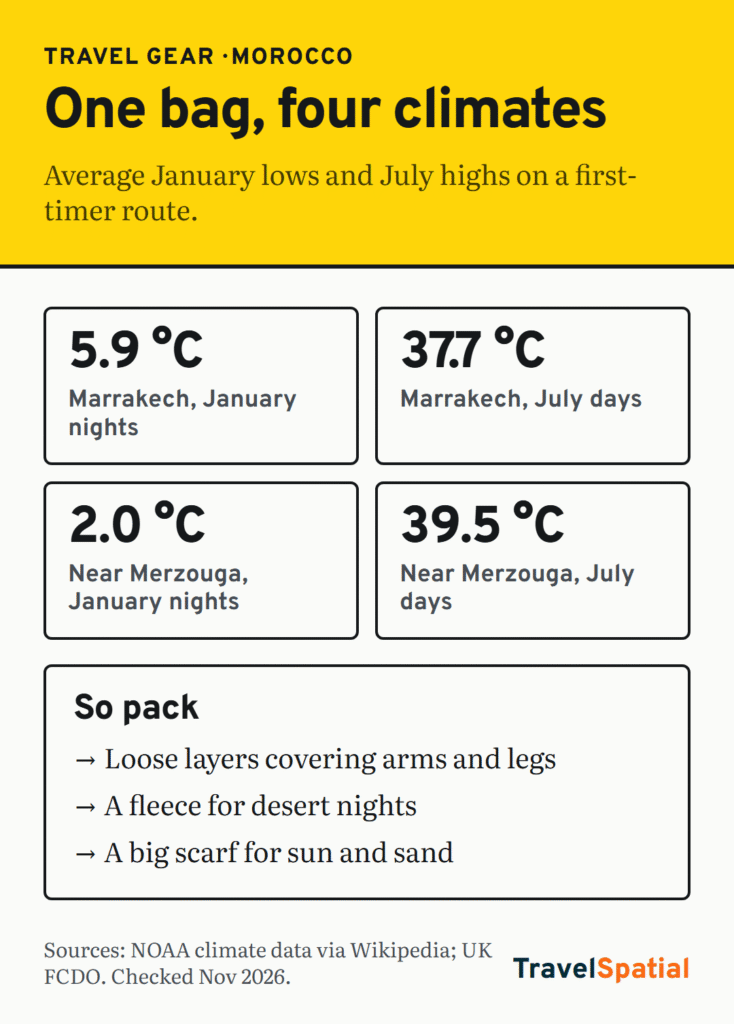
Morocco asks a lot of one suitcase. A first trip often moves from Marrakech’s hot medina to a High Atlas pass, then out to the Saharan dunes and back to a breezy coast. All of that can fit into ten days. In January, the desert edge can drop to around freezing at night, and in July it’s close to 40 °C by day. The same bag has to cover both.
This Morocco packing list for solo women is built for that range. The short version: loose clothes that cover your shoulders, chest and knees; a big scarf that does five jobs; layers you can add and take off; and shoes that grip uneven medina paving. Below is what that means region by region, and the reasons behind it.
Why loose and covered?
Morocco is a Muslim country with a wide range of dress, from jeans and T-shirts in the new towns of the cities to more traditional clothes in the countryside. There’s no dress law for visitors. The UK government’s travel advice for Morocco is direct about what matters for a woman travelling alone: “Women may receive unwanted attention in Morocco, especially when travelling alone. Consider wearing loose-fitting clothing which cover the arms, legs and chest.”
Two honest points belong side by side. Covering up won’t stop harassment, and no one should pretend it does. But loose, covering clothes do mean you’re dressed like the women around you, you’ll be comfortable in villages and at religious sites alike, and you’ll be protected from the sun. Most solo travellers find they get less attention that way.
One bag, four climates
The temperatures below are long-term averages from NOAA climate data, via the Wikipedia climate tables for Marrakesh, Ouarzazate and Errachidia, the nearest station to the Merzouga dunes.
| Place | January (high / low) | July (high / low) | What that means for your bag |
|---|---|---|---|
| Marrakech | 19.1 / 5.9 °C | 37.7 / 20.6 °C | Light layers by day. A warm layer on winter evenings |
| Ouarzazate (gateway to the desert) | 17.3 / 1.8 °C | 38.8 / 22.7 °C | Big swings between day and night |
| Errachidia (near Merzouga) | 15.9 / 2.0 °C | 39.5 / 25.8 °C | Winter desert nights near freezing. Summer days are punishing |
The cities: Marrakech, Fes and Chefchaouen
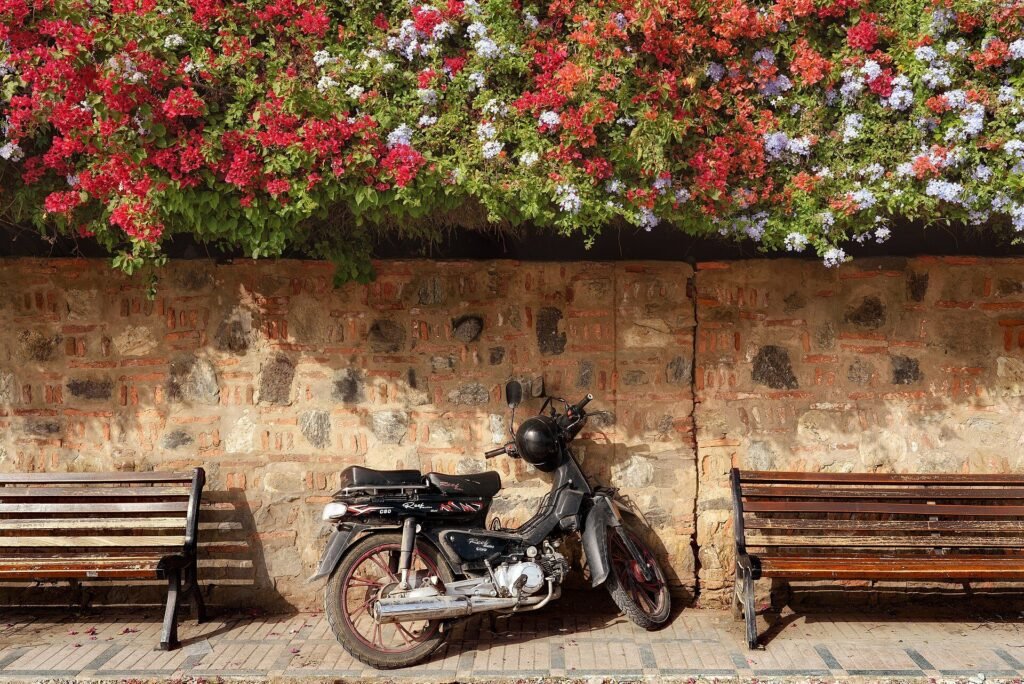
Medinas are mazes of narrow lanes. Some are polished smooth by centuries of feet, some are cobbled, and there are often mopeds and handcarts. Comfortable walking shoes with grip matter more here than anywhere else on the trip.
Pack: – 2 or 3 loose long skirts or wide-leg trousers in light fabrics (linen or cotton) – 3 or 4 tops that cover your shoulders and chest, including at least one long-sleeved one – A light cardigan or overshirt, for buses, cafés and evenings – A large scarf (see below) – Closed walking shoes with grip, and a pair of sandals for the riad – A cross-body bag that zips shut, worn to the front in busy souks
Our tip: pack one outfit you’d happily wear to a smart restaurant. A long dress with a light layer works for riad rooftops and dinners alike.
The mountains: the High Atlas
Driving over the Tizi n’Tichka pass or staying in a mountain village means cooler air, wind and, in winter, snow on the peaks. Add:
- A fleece or warm mid-layer
- A light waterproof or windproof jacket
- Socks warm enough for cold guesthouse floors
The desert: Merzouga and the dunes
A desert camp asks for the widest range of all: strong sun, sand in the wind, and in winter, nights close to freezing.
- For the day: sunglasses, a wide-brimmed hat, high-factor sun cream, lip balm, and the scarf, wrapped over your nose and mouth when the wind lifts the sand
- For the night: a warm layer, a hat and thermal leggings from October to March. Camps usually provide blankets, but you’ll want your own layer as well
- For the dunes: sandals or light shoes you don’t mind filling with sand, and a zip bag to keep sand out of your phone
The coast: Essaouira
The Atlantic coast is cooler and windier than the inland cities. Bring a windproof layer. For the beach, a swimsuit is fine at the water’s edge, with a cover-up for the walk back through town.
The scarf: the most useful thing in your bag
If you pack only one Morocco-specific item, make it a big, light scarf (around 2 metres by 1). It’s:
- Cover for your shoulders or hair when you need it
- Sun protection on a hot afternoon
- A sand mask in the desert
- A blanket on a cold bus or a chilly riad morning
- A pillow or privacy screen on a long journey
What to leave at home
- Short shorts, crop tops and low-cut tops, for anywhere outside the beach
- Expensive jewellery
- Heavy, hard-to-dry jeans (lighter trousers dry overnight)
- Anything you’d hate to see covered in sand
Times when local dress matters more
The UK government advises extra care during Ramadan, which next starts in February 2027. It says to “follow local dress codes”, because clothing that doesn’t meet them “may cause more offence at this time”. Our guide to visiting Morocco during Ramadan 2027 covers what else changes. Rural villages and religious sites also call for more covered clothes.
The checklist
Clothes: 2–3 loose long skirts or trousers · 3–4 tops covering shoulders and chest · 1 long-sleeved top · light overshirt or cardigan · fleece (October to April, or for mountains and desert) · windproof jacket · thermal leggings for desert nights in winter · one smarter outfit · swimsuit and cover-up
Accessories: large scarf · wide-brimmed hat · sunglasses · zip-up cross-body bag
Shoes: closed walking shoes with grip · sandals
Other: high-factor sun cream · lip balm · hand sanitiser · a small torch for riad stairs at night · zip bags for sand
One bag, sorted
Pack for four climates, not one: loose layers that cover your shoulders, chest and knees for the cities; a fleece and windproof for the mountains; sun and sand protection plus a warm layer for desert nights; and a big scarf that does five jobs. Shoes with grip matter more than anything else in the medinas. For the trip itself, our solo female guide to Morocco goes city by city, and our 10-day first-timer’s itinerary puts the route together.
Get our next Morocco guide in the TravelSpatial newsletter.
Sources
- UK FCDO, Morocco travel advice: safety and security (updated 19 August 2026; checked November 2026)
- Climate tables (NOAA data via Wikipedia): Marrakesh, Ouarzazate, Errachidia (checked November 2026)
Photo credits
- Dunes de Merzouga 001 by Dieglop, CC BY-SA 4.0, via Wikimedia Commons
- Entering the souk of Marrakech by Mustang Joe, CC0, via Wikimedia Commons
The infographic is original to TravelSpatial. Photos are used under the licences linked above.