You’ve just arrived after a long day, and the person at reception asks for your passport. Then they put it in a drawer and say you can pick it up later. Is that normal?
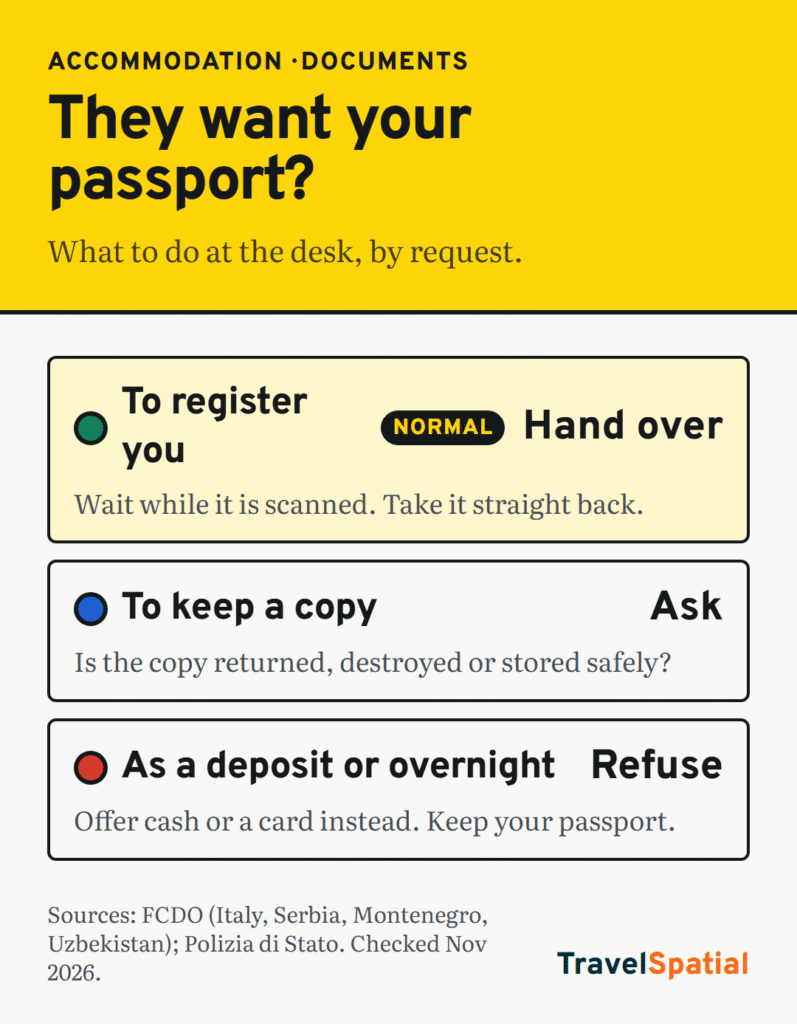
Handing it over is normal. Leaving it behind isn’t. In many countries, hotels and hostels are legally required to record your passport details and pass them to the police or immigration. That takes a few minutes and a scan or a photocopy. It doesn’t require them to keep your passport, and the UK government’s advice for Italy is direct about it: “Do not leave your passport for later collection” (FCDO, Italy, updated 3 November 2026).
Here are seven house rules for the passport moment at check-in, with the exact words to use when it doesn’t go the way it should.
Rule 1: Expect to hand it over, and know why
In a lot of the world, guest registration is the law, not the hostel being nosy.
| Country | What the rule says |
|---|---|
| Italy | Accommodation must send guests’ identity details to the police (Questura) within 24 hours of arrival, through the police’s Alloggiati Web service |
| Serbia | You must be registered with the local police within 24 hours of arrival. Hotels do it for you |
| Montenegro | Register with the police or tourism office within 24 hours. Hotels and some holiday lets do it |
| Uzbekistan | Register within 3 days (weekends count). Hotels register you |
| Indonesia | Hotels register you automatically. In private accommodation, you must register with the local police |
| Cambodia | Hotels, guesthouses and landlords should register you through an app |
Sources: FCDO entry requirements for each country; Polizia di Stato, Alloggiati Web (Italy), checked November 2026.
So when reception asks, hand it over. Refusing to show it at all usually just means no bed.
Rule 2: Watch it get scanned, then take it back
Registration needs your details, not your document. Stand at the desk while they scan, photograph or copy the photo page. Then put the passport back in your pocket before you pick up your key.
What to say: “Can you scan it now? I’ll wait.” If they say they’re busy: “No problem, I’ll wait here until you’ve done it.”
Our tip: if you’re arriving late and tired, have the passport out and open at the photo page before you reach the desk. It speeds everything up and keeps it in your hand.
Rule 3: Ask what happens to the copy
A photocopy of your passport is still personal data. The FCDO’s advice for Italy is that if the hotelier takes a photocopy, you should make sure it’s either returned to you or destroyed.
What to say: “Do you keep the copy, or can I have it back once it’s registered?” Most places scan straight into a system and keep no paper at all. If they do keep a paper copy, it’s fair to ask how it’s stored.
Rule 4: Never leave it as a deposit
This is the one to say no to. Some hostels, guesthouses and rental shops ask to hold a passport as security, for a key, a towel, a locker or a scooter. Your passport is your way out of the country, and you may need it for a bank, a bus ticket, a pharmacy or a police check while it’s sitting in someone else’s drawer.
What to say: “I need to keep my passport with me. Can I leave a cash deposit instead?” Or: “Would you take a card deposit, or a photocopy?”
If they won’t budge, it’s a reason to stay or rent elsewhere. A slightly pricier place that lets you keep your passport is cheaper than a lost one. Our guide to choosing a hostel dorm explains what to look for in reviews before you book.
Rule 5: Collect your registration slip where there is one
In some countries, registration produces a piece of paper you need to keep. Uzbekistan is the clearest example. The FCDO says that when you leave, the authorities may require a full record of where you’ve been, and that missing or late registration can mean a fine for each missing day and possible deportation (FCDO, Uzbekistan). A tour operator’s guide adds that hotel receptions typically hand you a printed registration slip, the next day or when you check out (Eurasia Travel).
What to say at check-out: “Could I have my registration slip, please?” Keep every slip together, with your passport, until you’ve left the country. If you’re travelling between Tashkent, Samarkand and Bukhara, our Afrosiyob train guide covers the route, and each city’s hotel should give you a new slip.

Rule 6: In a private rental, check that someone registers you
Hotels and hostels handle registration as routine. Apartments, rooms in someone’s home and some holiday lets don’t always. And in several countries, if your host doesn’t do it, the duty falls on you.
- Serbia: if you don’t register, the FCDO warns of a fine, arrest and a court appearance.
- Montenegro: the FCDO warns of a fine, detention or a court appearance.
- Indonesia: if you stay in private accommodation, you must register with the local police, or risk a fine of 5 million rupiah.
- Uzbekistan: private hosts should register you on the electronic system, Emehmon.
What to say to a host: “Will you register my stay with the police, or should I do it myself?” Ask before you arrive, by message, so you have the answer in writing.
Rule 7: Carry a copy so the original can stay safe
Once registration is done, you have a choice about where your passport lives day to day. Some countries expect you to carry ID, and some police checks want the original. But for most solo travellers, the bigger risk is losing it on a night out or a crowded bus.
A sensible setup:
- A colour photocopy of the photo page and your entry stamp, in your day bag.
- A photo of both in a cloud folder you can open from any phone.
- The original in your locker or the room safe, unless you need it that day or local rules say to carry it.
Our visa and documents map has a three-layer backup plan. For the room itself, see our test of door stop alarms, travel locks and wedges.
The red flags
Stop and think if:
- someone wants to keep the passport overnight, for “later registration”
- they want it as a deposit and won’t take cash or a card instead
- a person who isn’t staff, or a “helper” outside, offers to handle the registration for you
- you’re asked to pay a fee for registration that’s supposed to be free or included
Each of these has a simple answer: wait while they scan it, offer another deposit, deal only with the desk, and ask for a receipt for any fee.
The house rules on one card
- Hand it over: registration is often the law.
- Wait while it’s scanned, then take it back.
- Ask whether the copy is kept or destroyed.
- Never leave it as a deposit. Offer cash or a card.
- Keep any registration slip until you leave the country.
- In a private rental, confirm who registers you.
- Carry a copy; keep the original safe.
Travelling solo? Get our accommodation and safety guides in your inbox. Sign up for the TravelSpatial newsletter.
Sources
- FCDO, Italy entry requirements (hotels must register passport details; don’t leave it for later collection; photocopies returned or destroyed; updated 3 November 2026)
- Polizia di Stato, Alloggiati Web (guest details to the Questura within 24 hours, art. 109 TULPS; checked November 2026)
- FCDO entry requirements: Serbia, Montenegro, Uzbekistan, Indonesia, Cambodia (registration rules and penalties; checked November 2026)
- Eurasia Travel, Registration in Uzbekistan (registration slips; tour operator guide, checked November 2026)
Photo credits
- Hualien WOW Youth Hostel reception and check-in area, as taken on 30 October 2021 by Kai3952, CC BY-SA 4.0, via Wikimedia Commons
- Youth hostel Vianden Luxembourg 03 by Christian Ries, CC BY-SA 3.0, via Wikimedia Commons
The infographic is original to TravelSpatial. Photos are used under the licences linked above.