Every long trip through Europe has a day when the maths catches up. You’ve been in Lisbon, then Seville, then a slow month in Italy, and somewhere around Ljubljana you count on your fingers and realise you have two weeks of Schengen left. The good news is that Europe doesn’t end where Schengen does. Some of the cheapest, most interesting places on the continent sit just outside it, and time spent there doesn’t touch your 90 days.
This is a guide to those places: where to go when your Schengen days run out, how long each one lets you stay, and what a day there costs. Think of it as the continent’s waiting rooms, except several of them are better than the main hall.

First, the rule you’re escaping
Visitors from outside the EU who don’t need a visa can stay in the Schengen area for 90 days in any 180-day period. It’s one shared allowance for every country using the EU’s Entry/Exit System (EES). The EU’s official travel site lists 29 of them, from Austria to Switzerland, including the newest members, Bulgaria, Croatia and Romania. “Short stay”, it says, means up to 90 days within any 180-day period, “calculated as a single period for all the European countries using the EES” (EU Travel, What is the EES?, checked November 2026).
Since the EES became fully operational on 10 April 2026 (Council of the EU), the counting is no longer done by an officer squinting at stamps. Your entries and exits are recorded digitally with your fingerprints and face, so an overstay is visible the moment you try to leave. The 180-day window rolls: each day, the day 181 days ago drops off. The EU’s short-stay calculator does the arithmetic for you.
One thing that hasn’t started: ETIAS, the EU’s €20 travel authorisation. The official site says it is “currently not in operation” and that the start date will be announced several months ahead (ETIAS). Even when it arrives, ETIAS gives you no extra days. It’s permission to use the 90, not more of them.
Our visa map post explains the 90/180 rule in more detail. This article is about what comes next.
The escape routes at a glance
Stay lengths are the UK government’s figures for British passport holders, checked November 2026. Other passports often get similar terms, and sometimes longer ones, so check your own. Daily costs are Hostelz’s 2026 backpacker averages for a dorm-based budget, in US dollars.
| Country | Visa-free stay (UK passport) | Backpacker cost per day | Worth knowing |
|---|---|---|---|
| Georgia | Up to 1 year | $31 | Health and accident insurance now mandatory |
| North Macedonia | Up to 3 months | $33 | Lake Ohrid, cheap buses south to Greece |
| Albania | 90 days in 180 | $34 | Its own clock, separate from Schengen |
| Serbia | 90 days within 6 months | $35 | Register with police within 24 hours (hotels do it) |
| Montenegro | 90 days in 180 | $53 | Register within 24 hours of arrival |
| Turkey | 90 days in any 180 | $69 | Passport must be valid 150 days from arrival |
| Ireland | Not Schengen; no EES | $88 | British citizens can stay indefinitely |
| Cyprus | 90 days, its own count | $91 | Time in the north counts towards it |
Sources: FCDO country pages for each country (linked below); Hostelz Europe budgets and country pages, checked November 2026.
The Balkans: the long way round
Three countries, three separate clocks, and some of the cheapest days in Europe.
For a backpacker with no Schengen days left, the western Balkans are the obvious answer, and not just as a fallback. Albania, North Macedonia, Serbia and Montenegro each run their own visa-free allowance. Time in one doesn’t count in Schengen, and Montenegro’s FCDO page makes the point explicitly: visits there “do not count towards your 90-day visa-free limit in the Schengen area”.
Stack them and you have months. A British traveller could, on paper, spend up to 90 days in Albania, three months in North Macedonia and 90 days in Serbia, each on its own clock. Bosnia and Herzegovina adds another 90 days within six months.
The cost is the other draw. Hostelz puts a backpacker’s day at $34 in Albania, $33 in North Macedonia and $35 in Serbia, roughly half the European average of $72. Montenegro, with its pricier coast, comes in at $53.
Two pieces of paperwork to know:
- Registration. Serbia requires visitors to register with the local police within 24 hours of arrival, and Montenegro within 24 hours with the police or tourism office. If you’re in a hotel or hostel, staff normally do it for you. In a private rental, ask the host, because the FCDO warns of fines and even court appearances if you skip it.
- Stamps. Bosnia’s guidance is to make sure you get your passport stamped on entry and exit. Check it before you leave the booth.
Georgia: the year-long pause
The furthest escape, and the one with the most generous clock.
If you’d rather stop than keep moving, Georgia is the outlier. British visitors can stay up to one year without a visa (FCDO, Georgia, updated 12 November 2026). It’s also the cheapest place in this guide: Hostelz puts a backpacker day at $31.
There is one newer rule. All visitors must now have health and accident insurance covering their whole stay, including the arrival and departure dates, with cover of at least 30,000 lari. Airlines may ask to see it at check-in. Check that your policy’s paperwork says so in plain words before you fly.
Georgia suits travellers who want to stay put for a while. Our Tbilisi neighbourhood guide for digital nomads compares the best areas for a month or more.
Turkey: the bridge east
A separate 90-day clock, and a long way from Schengen prices.
Turkey gives British visitors 90 days in any 180 without a visa. Hostelz’s daily figure is $69, close to the European average, so it’s less of a budget escape than the Balkans. But it’s a huge country with its own rhythm, and it connects you east towards Georgia.
Watch the passport rule: Turkey wants your passport to be valid for at least 150 days from the date you arrive. And if you’re tempted by a day trip to a Greek island, remember that Greece is in Schengen. The FCDO’s Turkey page notes that EES applies to anyone crossing from Turkey into the EU, and every day on that island comes off your 90.
Ireland and Cyprus: inside the EU, outside the count
Two EU countries that keep their own rules and still stamp passports.
Ireland and Cyprus are both in the EU but not in Schengen. The EU’s own EES page confirms that in these two countries, “passports will still be stamped manually.” Time there doesn’t count towards your Schengen 90.
- Ireland: British citizens can live there indefinitely under the Common Travel Area. Other nationalities follow Ireland’s own visitor rules. It’s expensive: $88 a day on Hostelz’s figures.
- Cyprus: British visitors get 90 days with a separate count of their own. One catch: the Republic of Cyprus counts time in the north towards that total. At $91 a day, it’s the priciest option here.
And for non-British travellers, there’s the UK itself. Most visitors from Europe, the USA, Australia and Canada need an electronic travel authorisation (ETA), which costs £20 and allows visits of up to six months (gov.uk, ETA). Hostelz puts a backpacker day in England at $89.
How to plan the switch
The trick is to use the escape routes on purpose, not in a panic in your last week.
- Count your days now. Put your Schengen entry and exit dates into the EU’s calculator and note the date your allowance runs out.
- Move before you’re at zero. Leave Schengen with a few days to spare. Delays happen, and an overstay is now recorded automatically.
- Let the clock refill. Every day you spend outside Schengen, an old day drops out of your rolling 180-day window. After 90 days outside, you’re back to a full 90.
- Pick the escape that fits your budget. The Balkans and Georgia stretch money furthest. Turkey, Ireland and Cyprus cost about what Western Europe does.
A sample shape for a six-month trip: 85 days in Schengen, then three months across Albania, North Macedonia and Serbia, then back into Schengen with a fresh 90. Price it against our Europe solo budget by country, and use our long-term trip planner to set the dates.
The mistakes that end in a ban
- Thinking Croatia, Bulgaria or Romania are outside. They all use the EES now, and their days count.
- Treating ETIAS as extra time. It will be an entry permission, not an extension.
- Overstaying by “just a few days”. The FCDO warns British travellers that overstaying the Schengen limit can lead to a ban of up to three years.
- Forgetting to register in the Balkans. In Serbia and Montenegro, staying in a private flat means checking that your host has registered you.
In short
When your Schengen days run out, you don’t have to fly home. Georgia gives British visitors up to a year for about $31 a day. Albania, North Macedonia, Serbia and Montenegro each run their own clock and cost $33 to $53 a day. Turkey, Ireland and Cyprus are outside the count too, at Western European prices. Leave Schengen before day 90, let your rolling window refill, and come back with time to spare.
Planning a long trip through Europe? Get our budget and route guides in your inbox. Sign up for the TravelSpatial newsletter.
Sources
- EU Travel, What is the EES? (29 countries, single 90/180 period, Cyprus and Ireland stamp manually; checked November 2026)
- Council of the EU, Entry/Exit System (launched 12 October 2025, fully operational 10 April 2026; checked November 2026)
- ETIAS official site (not in operation, €20 fee; checked November 2026)
- European Commission, short-stay calculator (checked November 2026)
- FCDO entry requirements: Georgia, Albania, North Macedonia, Serbia, Montenegro, Bosnia and Herzegovina, Turkey, Ireland, Cyprus, Italy (stay lengths, registration, insurance, overstay ban; checked November 2026)
- gov.uk, Electronic travel authorisation (£20, up to 6 months; checked November 2026)
- Hostelz, Europe backpacker budget and country budget pages for Turkey, Montenegro, Serbia, Ireland and Cyprus (2026 daily averages; checked November 2026)
Photo credits
- Стариот дел од градот Охрид ,The old town of Ohrid 2 by Makedonski biseri, CC BY-SA 4.0, via Wikimedia Commons
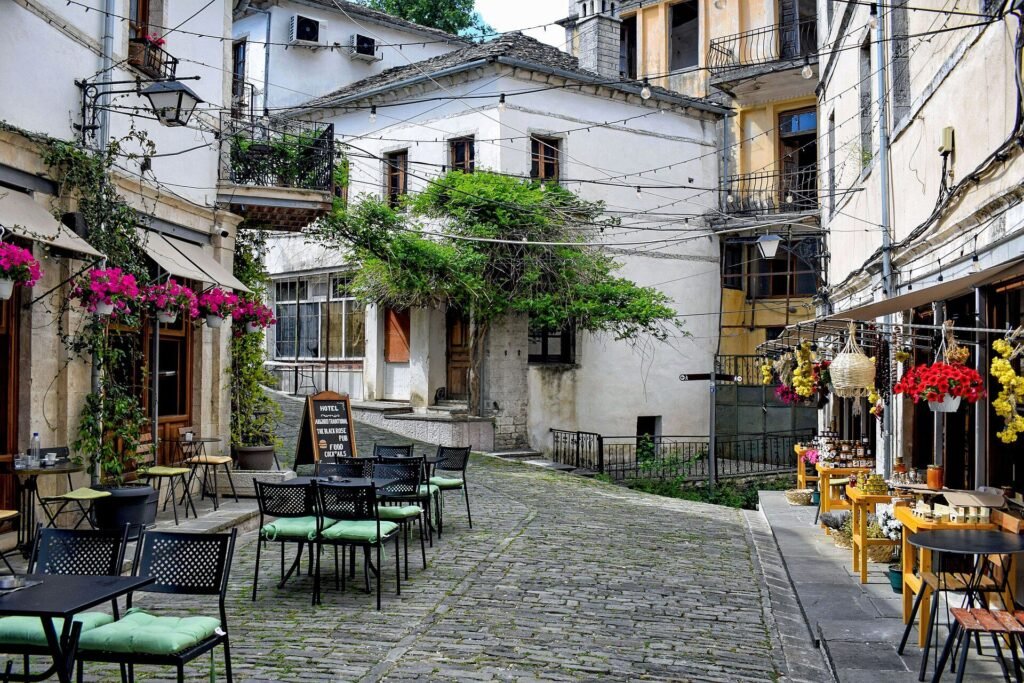
- Gjirokaster, Street in the Old Town by Jocelyn Erskine-Kellie, CC BY-SA 4.0, via Wikimedia Commons
The infographic is original to TravelSpatial. Photos are used under the licences linked above.