Travel gear is where budget trips quietly go over budget. Not on flights. Not on beds. On the shopping basket the week before you leave.
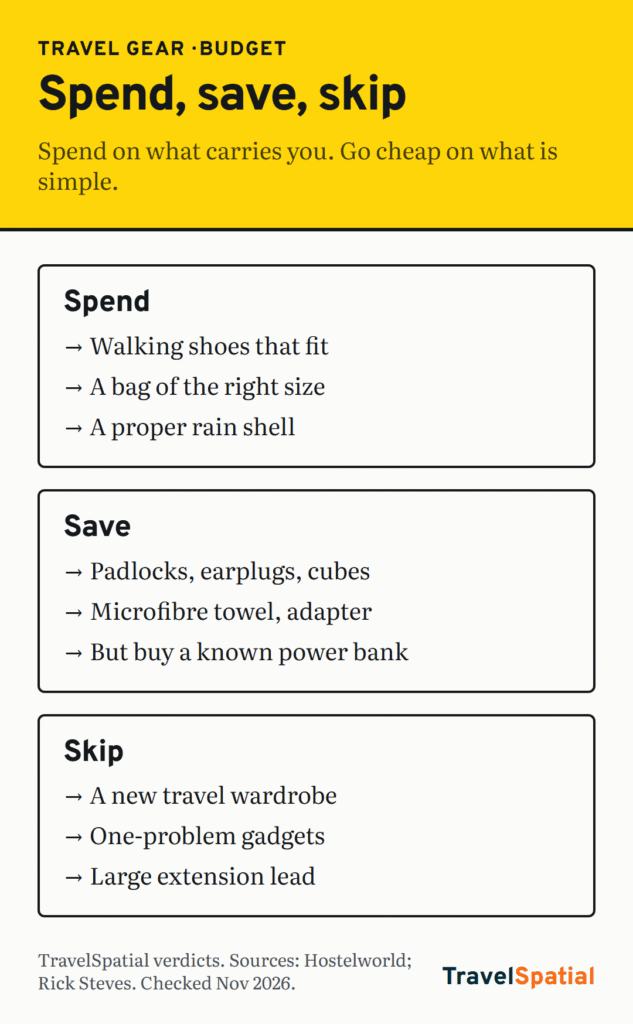
So here’s the short version. Spend on the three things that carry you: your shoes, your bag and your rain layer. Go cheap on anything small, replaceable and simple. Skip the gadgets that solve problems you don’t have. That’s the whole philosophy. The rest of this column is the verdicts.
Spend: the three things that carry you
Your walking shoes
You’ll walk more on a trip than you do in a month at home. Cheap shoes give you blisters on day two, and a blister on a solo trip has no one to carry your bag while you limp. Buy shoes that fit, break them in for two weeks before you leave, and wear them on the plane.
Verdict: spend. It’s the single purchase most likely to make or ruin a day.
Your bag
A bag that fits your back, closes properly and survives being thrown into a bus hold is worth paying for. A bag that’s too big costs you twice: once at the till, then again in checked-bag fees and sore shoulders. Get the size right before the brand. Our backpack size guide shows that 40 litres covers most trips.
Verdict: spend, on the right size.
A proper rain shell
A cheap waterproof works until the first real downpour, and you only find out then. A good shell doubles as a windproof layer on a boat, a mountain or a cold overnight bus.
Verdict: spend, if your trip includes rainy seasons, hills or anywhere north of the Alps in autumn.
Save: small, simple, replaceable
These items are simple enough that the cheap one works as well as the expensive one.
| Item | Why the cheap one is fine |
|---|---|
| Padlock | It only needs to fit a locker loop. A combination lock means no key to lose |
| Foam earplugs | Cheap ones block noise just as well |
| Packing cubes | They’re fabric boxes with zips. Any brand works |
| Microfibre towel | Size matters more than the brand |
| Plug adapter | Choose one with USB ports, so it charges two things at once |
| Sleep mask | Any contoured mask that keeps your eyes in the dark |
Hostelworld’s hostel packing list suggests carrying two small padlocks. Cheap ones make that easy.
One exception: power banks. Buy one from a brand with a real reputation and clear capacity labelling. Airlines limit what you can carry, and a battery’s capacity needs to be printed on it. Our carry-on packing layout sets out the 2026 cabin rules.
Skip: solutions looking for a problem
A whole new “travel wardrobe”
Quick-dry shirts and zip-off trousers are useful, but you don’t need a new set of them. Pack the clothes you already own that dry overnight and go together. Buy one thing locally if you need it.
Verdict: skip. It’s the most expensive way to pack the same bag.
Gadgets for one-off problems
Travel kettles, portable steamers, phone sterilisers, special laundry gadgets. Your accommodation, a sink and a bar of soap cover almost all of these.
Verdict: skip.
A large extension lead
Heavy, bulky and rarely needed. Hostelworld lists large extension cords as “not always needed”. A two-metre charging cable gets your phone to your bed instead.
Verdict: skip.
The money belt question
This is the one on which experienced travellers disagree. Rick Steves calls a money belt “your deep storage” and says, “I never travel without one” (Rick Steves). Plenty of others find them uncomfortable and stop wearing them by week two.
Our view is in the middle. What matters is the idea: keep a backup card and your passport somewhere separate from the day’s spending money. A money belt is one way to do it. A zipped inside pocket or a flat pouch in a locked locker is another.
Verdict: save. If you want one, a plain cheap one is fine. Just carry a day’s spending money in your pocket, as Steves advises, so you’re not digging under your shirt at every café.
If you only have a little to spend: the order
Buy in this order and stop when the money runs out:
- Shoes that fit (if yours don’t)
- A bag of the right size (if yours isn’t)
- Travel insurance. It’s not gear, but it’s the purchase that protects all the others. See travel insurance explained simply
- A power bank from a known brand
- A padlock, earplugs and a microfibre towel
- A rain shell, if your route needs one
- Everything else: borrow it, or buy it there
The whole philosophy, again
Spend on shoes, your bag and a rain shell. Save on padlocks, earplugs, packing cubes, towels and adapters, but buy a reputable power bank. Skip the new wardrobe, the one-problem gadgets and the extension lead. Keep a backup card and your passport separate from your spending money, with or without a money belt. If the budget’s tight, buy in the order above and leave the rest. To plan the money for the trip itself, start with our first solo trip budget guide.
Get our gear verdicts in your inbox. Sign up for the TravelSpatial newsletter.
Sources
- Hostelworld, Hostel packing list: what to bring and what to skip (checked November 2026)
- Rick Steves, Travel with a money belt: your portable safe (checked November 2026)
Photo credits
- Hiking boots by The original uploader was Daniel Case at English Wikipedia., CC BY-SA 3.0, via Wikimedia Commons
- Albareda Youth Hostel – Barcelona by Oh Barcelona, CC BY 2.0, via Wikimedia Commons
The infographic is original to TravelSpatial. Photos are used under the licences linked above.