Jo isn’t a real person. Jo is a composite: the solo traveller who loses a passport on the second-to-last week of a trip, with no one to watch their bags or hold the phone. Every rule, fee and timing in this story comes from official guidance, linked as we go. Jo holds a British passport, so the details follow the UK’s process. Other countries’ processes are similar in shape, but check your own government’s rules.
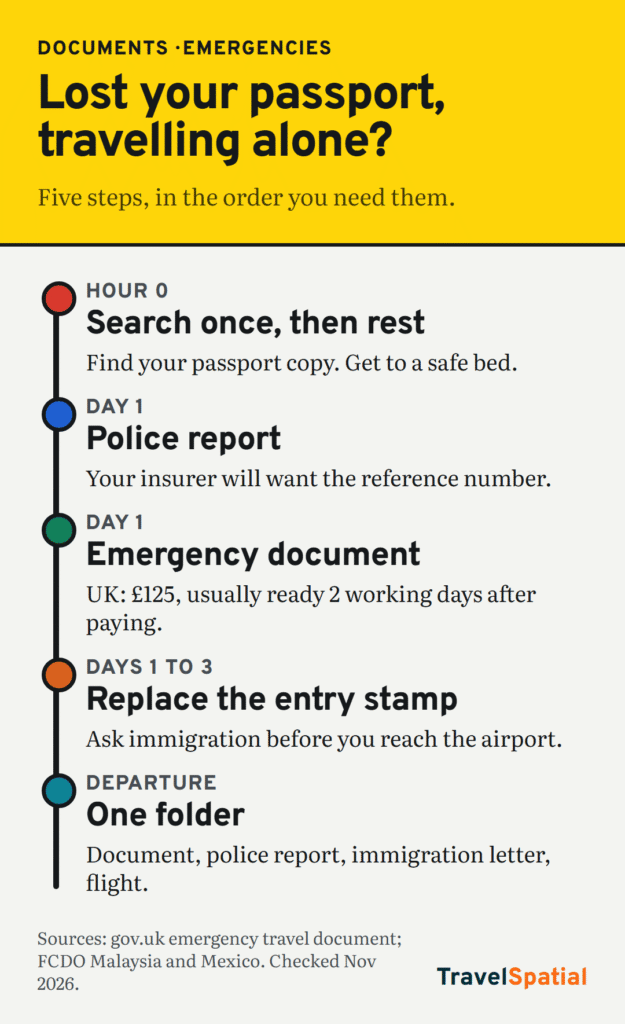
If you’ve just lost your passport abroad, here is what to do, in order: report it, replace it with an emergency travel document, and fix any visa or entry stamp before you try to leave. The UK version of that document costs £125 and is usually ready two working days after you apply and pay (gov.uk, checked November 2026). Jo’s story shows where each step fits, and where the traps are.
Chapter 1: The bus station, 9 p.m.
Jo is in Kuala Lumpur, eleven days from a flight home to London. The overnight bus from Penang arrives late, and somewhere between the luggage hold and the taxi rank, the zip pocket of the daypack is open and empty. The passport is gone. The phone, luckily, is in Jo’s hand.
The first hour of a lost passport is mostly about not making it worse. Jo does three things.
- Retraces the steps once. The bus company’s counter, the seat, the taxi rank. It’s worth one careful look, so Jo gives it twenty minutes, not two hours.
- Checks the backups. Jo has a photo of the passport’s photo page in a cloud folder and a paper copy in the main backpack. That copy is about to save a lot of time.
- Gets to a bed. The hostel is booked and paid for. Jo tells the night desk what happened and asks whether a photocopy is enough to check in tonight. It is, this time. Don’t assume it will be everywhere: some countries require accommodation to register a guest’s passport.
What you’d do differently if you had no backups: email yourself every detail you can remember now (passport number, issue date, expiry date) while it’s fresh. Our document backup plan shows how to set up three layers before you go.
Chapter 2: The police desk, next morning
Jo goes to the nearest police station with the photocopy and asks for a report of a lost passport. It takes most of the morning.
Is it essential? The UK’s emergency travel document pages don’t ask for one. But Jo’s travel insurer will almost certainly want a police report to pay for the replacement and any change to flights, and some countries’ immigration offices will want it too before they issue a fresh entry record. Get the report number in writing. Our step-by-step insurance claim guide covers what else to keep.
Our tip: ask for the report in English as well as the local language if the station can do it. If it can’t, photograph the local-language version clearly.
Chapter 3: The laptop in the hostel lounge
Back at the hostel, Jo applies for an emergency travel document (ETD) online. The UK government lets you apply online if you need to travel within six weeks and your lost passport was issued on or after 1 January 2006 (gov.uk, who can apply).
Here’s what the form needed, according to the UK government’s guidance:
| What you need | Why it matters for a solo traveller |
|---|---|
| A digital passport photo that meets the rules and hasn’t been used before | Jo gets one taken at a photo kiosk in a mall. Phone selfies against a hostel wall often fail |
| A phone number and an email address | The office contacts you this way, so keep your phone charged and on |
| A debit or credit card for the £125 fee | Lost your wallet too? The guidance says a relative or friend can pay for you |
| Your travel plans | They may be printed on the document, so get them right |
Two things surprise Jo in the small print.
You don’t need to cancel the old passport separately. gov.uk says it will usually be cancelled automatically once you’ve paid for the ETD (report a lost or stolen passport). If you’re not applying for an ETD, cancel the old passport as soon as you can.
Your itinerary becomes part of the document. An ETD is usually valid for one single or return journey, and you can travel through a maximum of five countries. If your travel plans change after it’s issued, you’ll need to reapply and pay £125 again. Jo had been thinking about a last-minute stop in Singapore. It doesn’t go on the form. The flight home does.
Don’t book travel until you’re told to. The guidance says to wait for the email confirming your ETD before booking. Jo’s flight was already booked, so it simply goes on the application.
Chapter 4: Two working days
The UK says an ETD will usually be ready to collect, or be sent, two working days after you submit and pay. It can take several weeks if you need to send more documents, need an appointment, or are applying for a child under 16.
Jo applied on a Thursday morning. Two working days means Monday at the earliest, not Saturday. Jo spends the weekend doing two jobs.
Job one: the entry stamp
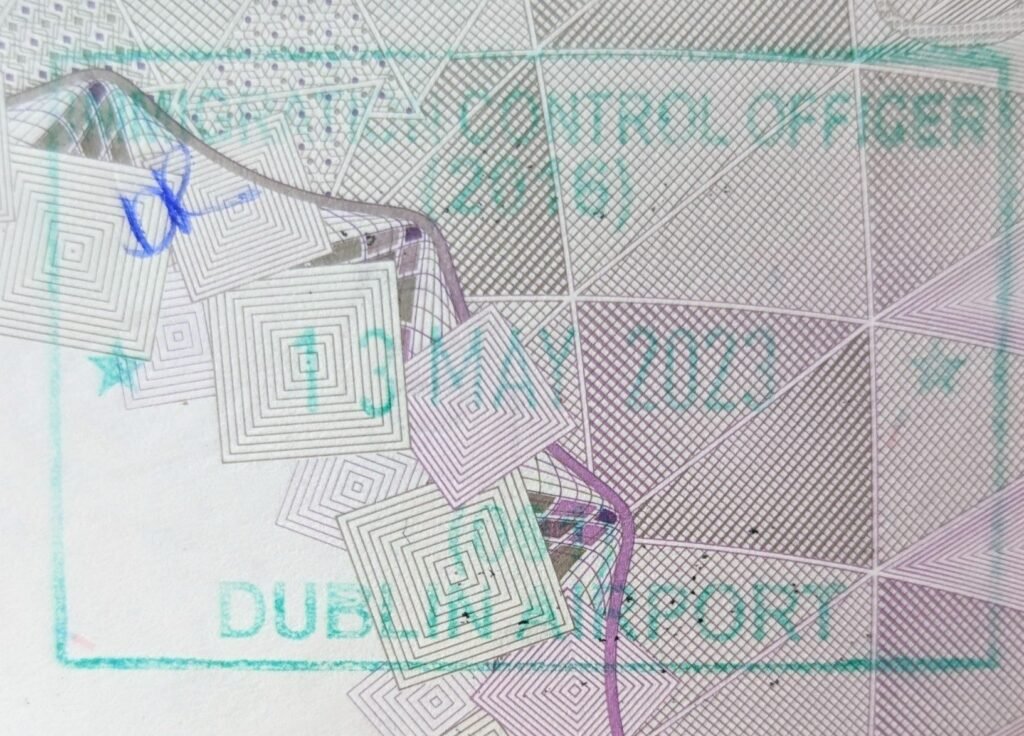
Here’s the trap most people miss. Jo’s entry stamp for Malaysia was in the lost passport. The new document won’t have one. The UK government warns that if you can’t show your original visa or entry stamp when you leave Malaysia, you “may be treated as an overstayer”, and that a replacement visa can take time (FCDO, Malaysia entry requirements).
So Jo contacts the immigration department about replacing the entry record, with the police report, the photocopy of the old passport and proof of the arrival flight. Other countries handle this differently. Mexico, for example, charges a fee of about 700 pesos to replace a lost entry stamp, and you can start the process online or at an airport immigration office (FCDO, Mexico).
If your lost passport held a visa, the same applies with more at stake. A long-stay or multiple-entry visa doesn’t transfer to an emergency document by itself. Start that conversation with the country’s immigration office early, because it may be the slowest part.
Job two: the money
The replacement cost £125, and it isn’t refundable. Jo also changes nothing else, because changing the itinerary would mean a second £125 application. If your wallet went with the passport, our lost card plan covers emergency cash.
Chapter 5: The airport
Monday, the email arrives. Jo collects the ETD and checks every line: name, date of birth, the route, the dates. Then it’s to the airport with a folder holding the ETD, the police report, the immigration letter for the missing entry stamp and the flight booking.
At check-in, the agent reads the ETD slowly and makes a phone call. It takes ten minutes. Then a boarding pass.
At the other end, the UK guidance says border control will keep the emergency travel document when you arrive in the UK, and that this could also happen in other countries. Jo walks out at Heathrow without it. Two weeks later, they apply for a new full passport from home.
What Jo got right, in a list
- A copy of the passport in two places. It sped up the police report, the check-in and the immigration conversation.
- A phone that stayed with them. Solo, your phone is your office. Keep it on your body on travel days.
- No itinerary changes. The ETD covers the journey you list, and changing it costs £125 more.
- The entry stamp sorted before the airport. Leaving it until the departure desk is how a two-day delay becomes a missed flight.
If you’re not British
The shape is the same almost everywhere: report the loss, apply to your country’s embassy or consulate for an emergency document, and replace any visa or entry record with the country you’re in. The fees, timings and how many journeys the document covers vary. Look up your own government’s guidance before you travel, and save the embassy’s address for each country on your route. While you’re at it, read our airport-to-bed checklist for landing alone at night, which builds the same kind of backup into your first night.
Jo’s plan, as a checklist
- Hour 0: retrace your steps once, find your passport copy, get to a safe bed.
- Day 1: get a police report, then apply for your emergency travel document.
- Days 1–3: replace the visa or entry stamp with immigration. Don’t change your itinerary.
- Departure day: carry the emergency document, the police report and the immigration paperwork together.
- Next trip: keep a passport copy in the cloud and on paper, apart from the passport itself.
Get our solo travel checklists in your inbox. Sign up for the TravelSpatial newsletter.
Sources
- gov.uk, Travel urgently from abroad without your UK passport: who can apply (single or return journey, up to 5 countries, travel within 6 weeks, passports issued from 2006; checked November 2026)
- gov.uk, How to apply for an emergency travel document (£125, no refund, 2 working days, what you need, travel plans printed, reapply if plans change, kept at the UK border; checked November 2026)
- gov.uk, Cancel a lost or stolen passport (cancel as soon as possible; cancelled as part of an ETD application; checked November 2026)
- FCDO, Malaysia entry requirements (keep a copy of passport and visa; missing entry stamp on exit; checked November 2026)
- FCDO, Mexico entry requirements (entry stamp replacement fee about 700 pesos; checked November 2026)
Photo credits
- Bus arrival and departure boards at Terminal Bersepadu Selatan (TBS) in Kuala Lumpur, Malaysia (53767933239) by Philip Mallis from Melbourne, CC BY-SA 2.0, via Wikimedia Commons
- Irish passport stamp in a British passport by Asheiou, CC BY-SA 4.0, via Wikimedia Commons
The infographic is original to TravelSpatial. Photos are used under the licences linked above.