

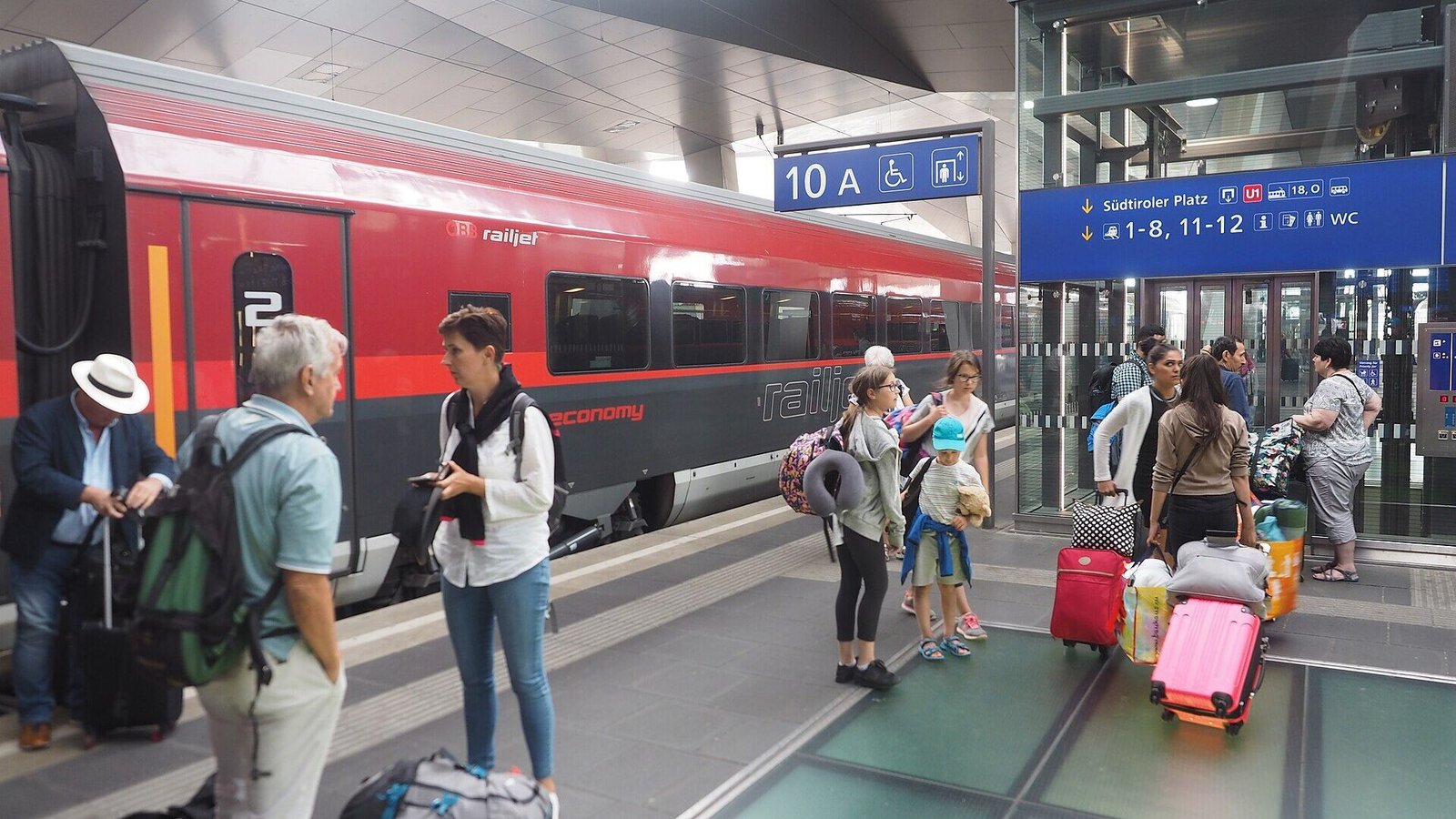
Paris to Budapest is about 1,250 km as the crow flies. You can do it on five direct trains, with about 20 hours on board in total, and never once go to an airport between the first city and the last.
This is the classic first-timer’s route for seeing Europe by train: Paris, Amsterdam, Berlin, Prague, Vienna and Budapest, with three nights in each. Every leg runs city centre to city centre, and none is longer than a working day.
Below you’ll find the route, how long each train takes, what the tickets really cost in 2026, whether a rail pass is worth it (for this route, it usually isn’t), and the new digital border system now running at Europe’s airports. Four infographics let you scan each decision in seconds.
Europe by train at a glance
| Item | What you need to know |
|---|---|
| Route | Paris → Amsterdam → Berlin → Prague → Vienna → Budapest, one way |
| Length | 18 days, three nights per city |
| Trains | 5 direct trains, about 20 hours in total |
| Tickets | About €120 if you book every leg early in 2nd class; a 7-day Interrail pass works out at €413 |
| Borders | All six countries are in the Schengen Area: one full entry check, then occasional spot checks |
| Money | Euro in France, the Netherlands, Germany and Austria; Czech koruna (CZK) in Prague; Hungarian forint (HUF) in Budapest |
| Best time | May–June and September for long days without peak-summer crowds |
Our tip: fly into Paris and home from Budapest on an “open-jaw” ticket. It often costs little more than a return and saves you a day of backtracking.
The route, mapped: 6 cities in 18 days
The route runs west to east, so each train takes you somewhere a little cheaper than the last. Paris and Amsterdam are the priciest stops; Prague and Budapest are where your money goes furthest.

| Days | City | Train to get there |
|---|---|---|
| 1–3 | Paris | Arrive by air, or Eurostar from London |
| 4–6 | Amsterdam | Eurostar, about 3h20 |
| 7–9 | Berlin | ICE, about 5h50 (longer during 2026–27 works) |
| 10–12 | Prague | EuroCity, about 4h15 |
| 13–15 | Vienna | Railjet, about 4h |
| 16–18 | Budapest | Railjet, about 2h40 |
Only have 12 days? Drop Amsterdam and start in Berlin, or cut each stop to two nights. Three nights is the sweet spot because it gives you two full days in each city, with the travel day on top.
Want more time in one country? Our France on a budget itinerary covers two weeks beyond Paris, and our Italy 2-week route works well as a southern alternative.
How long each train takes
Add up the five legs and you spend about 20 hours on trains over 18 days. Each leg is a morning or afternoon, not a whole day, and you skip airport security, transfers and baggage fees every time.

- Paris → Amsterdam (Eurostar, about 3h20): Eurostar quotes from 3 hours 20 minutes centre to centre (Eurostar, checked November 2026).
- Amsterdam → Berlin (ICE, about 5h50): NS International lists 5 hours 51 minutes for the direct train (NS International, checked November 2026).
- Berlin → Prague (EuroCity, about 4h15): direct trains run along the Elbe through Dresden (Everyrail, checked November 2026).
- Prague → Vienna (Railjet, about 4h): the fastest trains take just under four hours (Seat61, checked November 2026).
- Vienna → Budapest (Railjet, about 2h40): the shortest and easiest leg (Everyrail, checked November 2026).
Two 2026 disruptions to plan around:
- Amsterdam → Berlin: from October 2026 to December 2027, track works between Hannover and Berlin divert trains via Hamburg-Harburg, so trips take longer and run less often (NS International). Check your exact train on int.bahn.de before you book.
- Berlin → Prague on Mondays: until 12 December 2026, most Monday trains are cancelled for engineering work (Seat61). Make this a Tuesday-to-Sunday leg.
Rail pass or single tickets? The 2026 numbers
For this route, booking each leg early in second class costs about €120 in total. A 7-day Interrail pass costs €381, plus a mandatory €32 Eurostar seat reservation, so €413. Booking early saves you roughly €290.
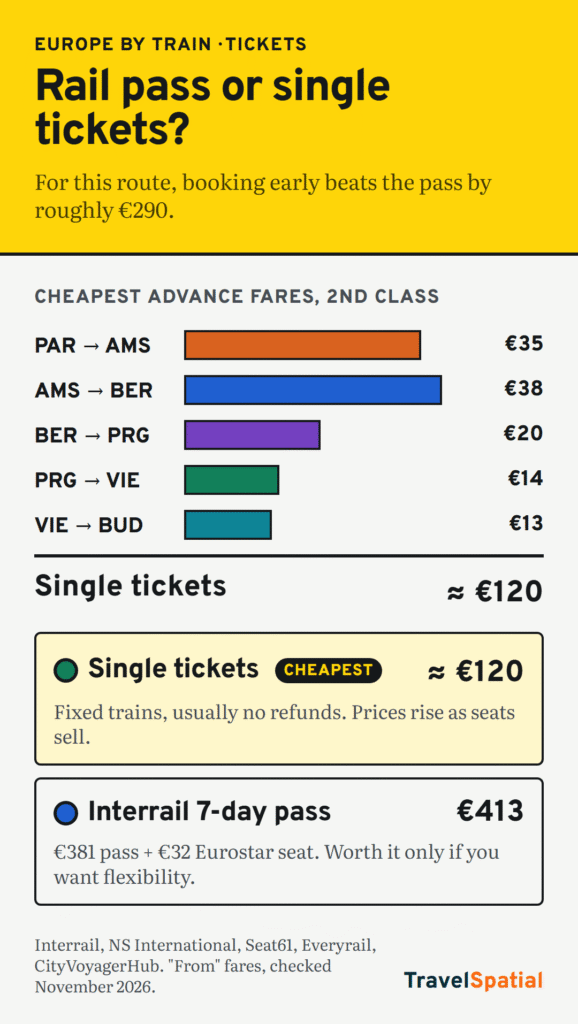
| Leg | Cheapest advance fare (2nd class) | Source |
|---|---|---|
| Paris → Amsterdam | from about €35 | AmsterdamTips |
| Amsterdam → Berlin | from €38 | NS International |
| Berlin → Prague | from about €20 | Everyrail |
| Prague → Vienna | from €14 (RegioJet) | Seat61 |
| Vienna → Budapest | from about €13 | CityVoyagerHub |
| Total | about €120 | “From” prices, checked November 2026 |
These are the lowest prices, and they sell out. Expect to pay more if you book late or travel on a Friday or Sunday. Even if every leg costs double, single tickets still come in under the pass.
When the pass does make sense: if you want to decide on the day, add side trips (Bruges, Dresden, Salzburg, Bratislava), or travel in peak summer when cheap fares are gone. The 2026 Global Pass prices (7 travel days in one month: €381 in 2nd class, €495 in 1st) come from the published Interrail tariff, and the Eurostar reservation fee from Interrail’s fee table (both checked November 2026).
Our tip: book Paris → Amsterdam first, whichever way you buy. Eurostar has only a small quota of pass seats, and it is the leg that sells out soonest. Advance tickets usually open about six months before travel.
Paying in euros, koruna and forint? Our guide to avoiding travel money fees shows how not to lose 3% on every card payment.

Borders in 2026: EES is live, ETIAS isn’t yet
All six countries on this route are in the Schengen Area. If you don’t hold an EU passport, you go through one full border check when you first arrive. After that, the trains between cities have no routine passport control, though Germany and others run spot checks, so keep your passport on you.
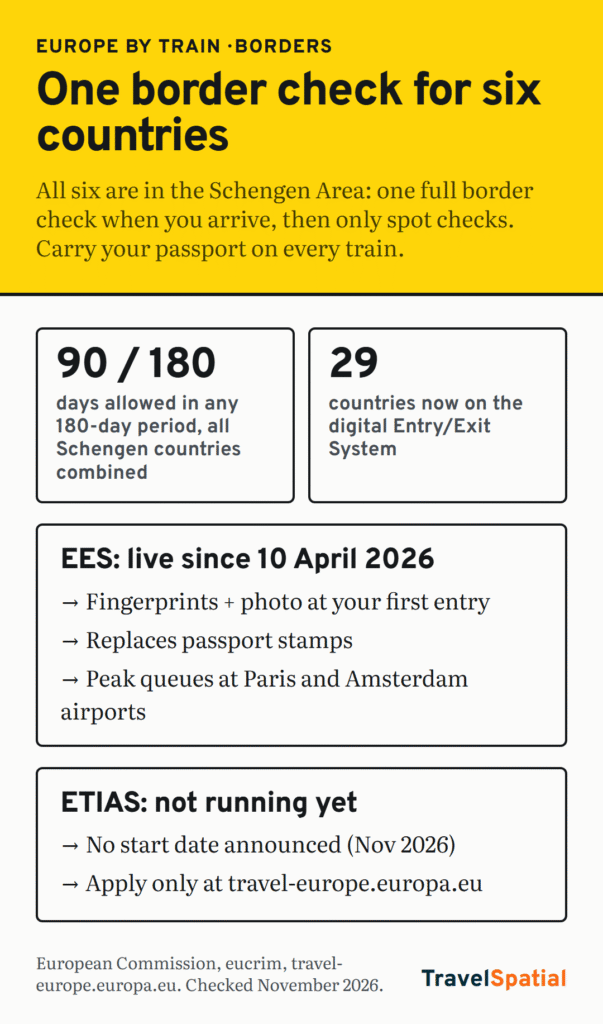
- The 90/180 rule: most visa-free visitors (US, Canada, UK, Australia and others) can stay up to 90 days in any 180-day period, counted across all Schengen countries together. An 18-day trip is well inside that.
- EES (Entry/Exit System): fully operational at all external Schengen borders since 10 April 2026, across 29 countries. Your fingerprints and photo are taken on your first entry, and the system replaces passport stamps (eucrim, checked November 2026). Queues of up to two hours have been reported at peak times at Paris and Amsterdam airports, so leave extra time.
- ETIAS (travel authorisation): not in operation yet, and no start date has been announced as of November 2026. When it does launch, apply only on the official travel-europe.europa.eu site; copycat sites charge extra.
- Coming from London? The UK isn’t in Schengen, so your EES check happens before you board the Eurostar at St Pancras.
Rules depend on your passport. Our visa map of every border permit walks you through checking your own.
How to book Europe by train, step by step
- Fix your dates and book flights first: into Paris, home from Budapest.
- Book Eurostar Paris → Amsterdam on eurostar.com as soon as your dates are set.
- Book the German legs on int.bahn.de: Amsterdam → Berlin and Berlin → Prague. Check for Monday cancellations and the Hamburg diversion.
- Book Prague → Vienna with RegioJet or ÖBB, and Vienna → Budapest with ÖBB.
- Save tickets offline in each operator’s app. Most conductors scan a QR code from your phone.
Building the whole trip from zero? Our 7-step route map for planning a trip covers flights, beds and budget in order.
The short version
Seeing Europe by train from Paris to Budapest takes 18 days, five direct trains and about 20 hours on board. Book each leg early and the tickets total roughly €120, far less than a rail pass; book the Eurostar first. Allow extra time at the airport for the new EES fingerprint check, and leave ETIAS for later: it isn’t running yet.
Want the next route in your inbox? Join the TravelSpatial newsletter for one mapped itinerary a week.
Sources
- Eurostar: Amsterdam to Paris (journey time), checked November 2026
- NS International: Train to Berlin (time, fares from €38)
- NS International: Trains to Germany in 2026 (Hamburg diversion)
- Seat61: Berlin to Prague and Prague to Vienna
- Everyrail: Berlin to Prague and Vienna to Budapest
- AmsterdamTips: Amsterdam–Paris train (Eurostar fares)
- CityVoyagerHub: Vienna to Budapest (advance fares)
- Interrail Global Pass 2026 tariff and Interrail reservation fees
- eucrim: EES since 10 April 2026
- European Union: Travel to Europe (EES and ETIAS)
Photo credits
- ÖBB Railjet at Wien Hauptbahnhof by JIP, CC BY-SA 4.0, via Wikimedia Commons
- Budapest-Keleti station, train shed, 2011 Budapešť 0001 by Dezidor, CC BY 3.0, via Wikimedia Commons
The infographic is original to TravelSpatial. Photos are used under the licences linked above.


5 comments on “Europe by Train, Mapped: 6 Cities in 18 Days (2026 Fares)”