

Seven steps, one countdown, and the order that stops you paying twice. Here is how I go from a blank page to a booked trip.
The most expensive trip-planning mistake isn’t a bad hotel. It’s doing things in the wrong order: booking a flight before checking your passport, locking in a hostel before you know your route, or buying insurance after the storm has a name.
I’ve planned trips the messy way and the methodical way. The methodical way is cheaper, calmer and, oddly, leaves more room for surprises on the road. Timing alone matters: Expedia’s 2026 data shows international travelers who book 31–45 days out pay about $190 less than those who book six months ahead.
This guide is how I plan a trip from scratch, every time. It maps the seven steps in order, the countdown I follow, and what to lock in versus leave open. Use it once and you’ll have a system for every trip after.
My 7-step trip-planning route at a glance
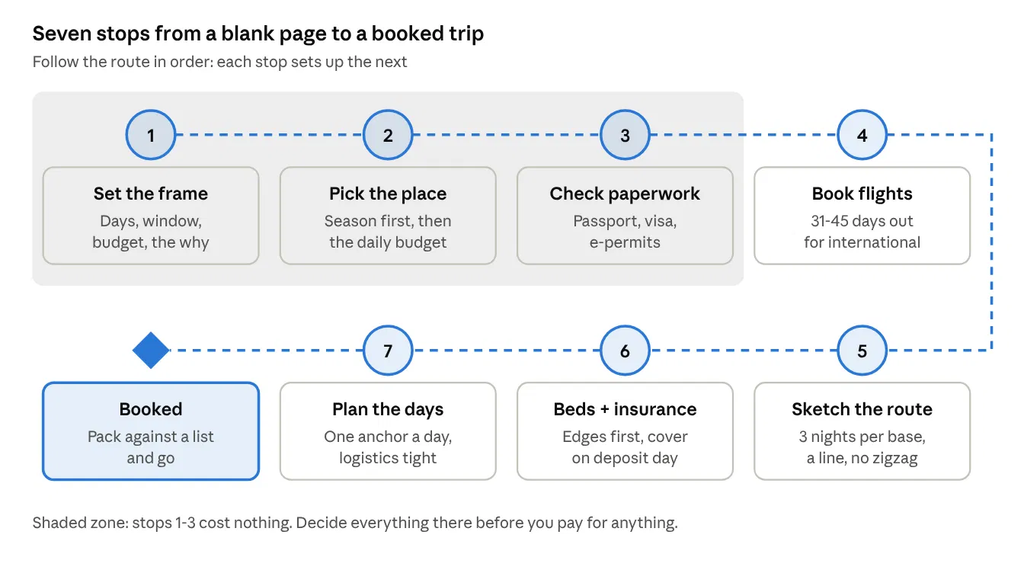
The first three stops cost nothing, and that’s the point. Decide the frame, the place and the paperwork before you spend a cent, and every booking after that is one you won’t have to undo.
Step 1: Set the frame before you pick a place
I never start with a destination. I start with three numbers and one sentence:
- How many days I can actually take, including travel days.
- When I can go, as a window rather than fixed dates.
- How much I can spend, all in, flights included.
- Why I’m going, in one line: “slow food and walking,” “surf and work,” “see my first glacier.”
That sentence is the filter for every decision after it. If the why is “rest,” a five-city sprint fails the test no matter how cheap the flights are.
Tip: write the frame in your notes app before you open a single booking site. Deals are designed to make you forget it.
Step 2: Choose the destination by season and budget
With the frame set, I shortlist two or three places and test each against the calendar and my daily budget.
Season first. The same city can cost half as much a month either side of its peak. Expedia’s 2026 report found August flights 29% cheaper on average than December, and named Tuesday the least busy day to fly. I aim for the shoulder season: good weather, thinner crowds, lower prices.
Budget second. I divide my total budget, minus flights, by the number of nights. That daily figure tells me fast whether a place works. My travel budget template does the math for you.
Then pick. The destination that fits the window, the daily budget and the why wins, even if it wasn’t my first crush.
Step 3: Check the paperwork first
This is the step most people do last, and it’s the one that can cancel everything. Before I spend a cent, I check:
- Passport validity. Many countries want 6 months left after your return date and a couple of blank pages.
- Passport timing. US routine processing currently runs 4–6 weeks, or 2–3 weeks expedited, and mailing adds more on top.
- Visas and e-permits. Use my map of every border permit to see whether you need a visa, an eVisa or an e-authorization.
- Europe’s ETIAS. It’s not live yet. The EU removed its Q4 2026 target in July and says it will announce a date months ahead. Only apply on the official EU site when it opens.
Rule: if the passport needs renewing, that comes before any booking.
Step 4: Book flights in the right window
Flights are usually the biggest single cost, and the one where timing pays most. Expedia’s 2026 Air Hacks data, based on its bookings, shows:
- International economy: booking 31–45 days out saves about $190 versus 180+ days. The cheapest window was 8–15 days out ($585 versus $813), but that’s a gamble on seats.
- US domestic economy: the cheapest window was 15–30 days out, about $130 less than 180+ days.
- Day to fly: Friday was 8% cheaper than Sunday overall; domestically, Tuesday was 14% cheaper.
How I actually do it: I set fare alerts on Google Flights as soon as the destination is picked, watch the price history, and buy when the fare drops into the window. For peak dates, school holidays or a festival, I book earlier, because seats, not prices, run out first.
Bonus check: compare nearby airports. Expedia found the cheapest US departure airports averaged about 25% below the national average fare.
Step 5: Sketch the route on a map
Now I open a map, not a booking site. I drop pins on everything I want to see, then group them into bases: towns I’ll sleep in and explore from.
My pace rules:
- Three nights per base, minimum. One night is a travel day, not a visit.
- One travel day for every base change. Count it in the plan.
- Draw a line, not a zigzag. Open-jaw flights (in to one city, out of another) often save a full day of backtracking.
- First and last nights near the airport or on a direct transit line.
If the route has more bases than the days allow, I cut a base. I don’t cut nights.
Step 6: Book beds and insurance
With the route fixed, I book accommodation in a specific order:
- First night. Always prebooked, always easy to reach at any hour.
- Last night. Near the airport, so a missed train doesn’t mean a missed flight.
- Peak-demand nights. Weekends, festivals and small towns with few beds.
- Everything else. Free-cancellation rates, so the middle of the trip stays flexible.
The same day I pay my first deposit, I buy travel insurance. Buying within roughly two weeks of that deposit is what keeps the best benefits available. My travel insurance map explains the 14-day window.
Step 7: Plan the days loosely, and the logistics tightly
I plan each day as one anchor plus open time. The anchor is the thing with a time slot or a ticket limit: a museum entry, a hike permit, a cooking class. Everything else stays open for what I find on the ground.
What I do plan tightly is the logistics:
- Money: a no-foreign-fee card plus a backup, and a plan for cash. My map of every travel money leak covers the fees.
- Connectivity: an eSIM bought and installed before I fly.
- Offline maps: each base downloaded, with my accommodation pinned.
- Documents: copies of passport, insurance and bookings in a cloud folder and on paper.
- Bag: packed against a list. My carry-on floor plan is the one I use.
My trip-planning countdown
Here’s the same system laid out against the calendar. Start about three months out for an international trip; compress the first two columns for a domestic one.
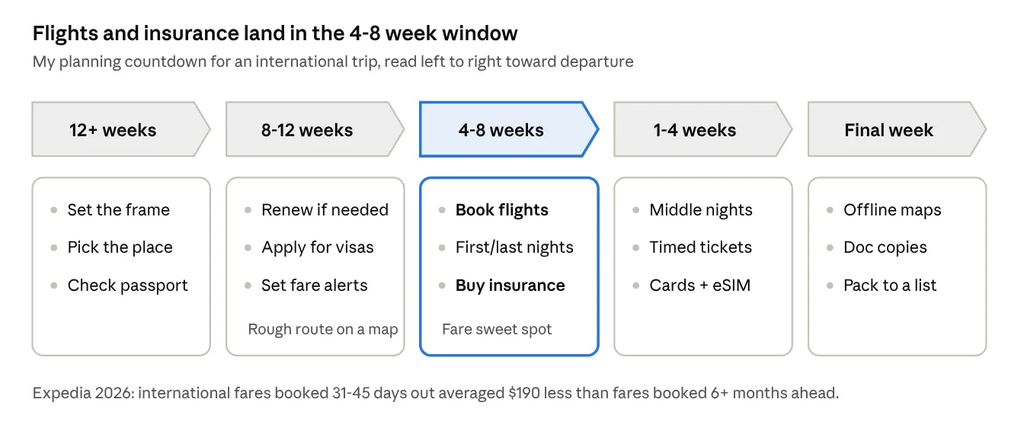
The busiest column is 4–8 weeks out. That’s where the flight sweet spot sits, and it’s usually when the first deposit goes down, so insurance goes in the same session.
What I lock in versus leave open
Not everything deserves an early booking. I sort every booking by two questions: does waiting cost me money or availability, and would changing it later cost me money?
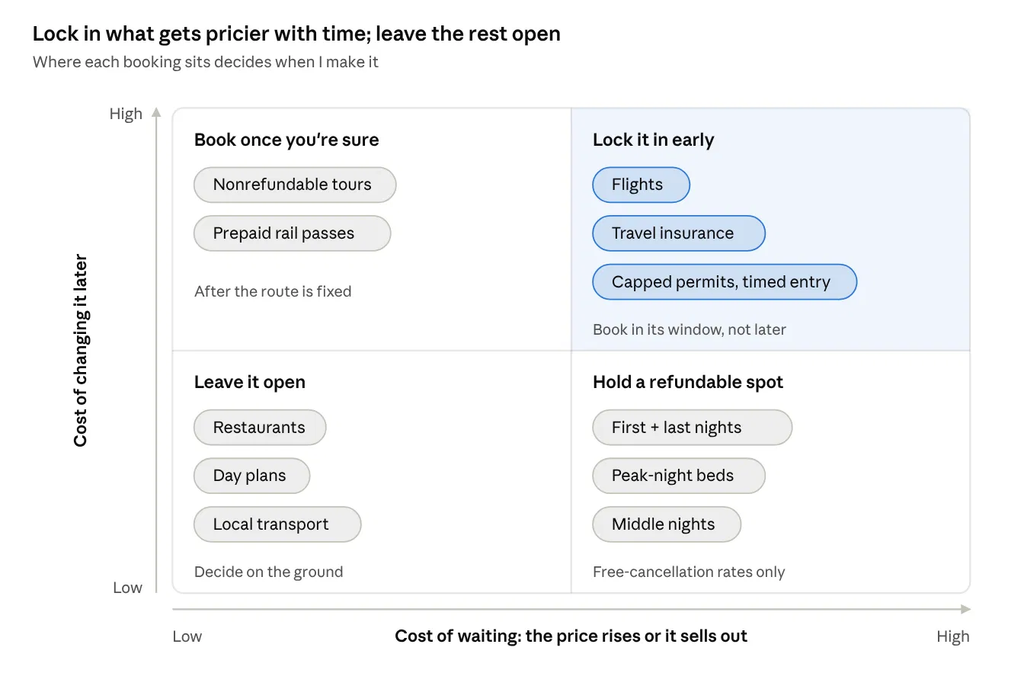
Only the top-right corner gets booked early and for keeps. Most of a good trip lives in the bottom half: refundable holds and open days you fill once you’re there.
The tools I use at each step
You don’t need twenty apps. These are the ones that earn a place on my phone.
| Step | What I use it for | Tool type |
|---|---|---|
| 1. Frame | Days, window, budget, the why | Notes app or my budget template |
| 2. Destination | Comparing fares across flexible dates | Google Flights date grid and Explore map |
| 3. Paperwork | Entry rules and e-permits | Official government sites, plus my visa map |
| 4. Flights | Price history and drop alerts | Google Flights tracking |
| 5. Route | Pins, bases, travel times | Google My Maps or any map app with saved lists |
| 6. Beds and cover | Free-cancellation stays; insurance quotes | A booking site with flexible rates; an insurance comparison site |
| 7. Days and logistics | Offline maps, eSIM, document copies | Offline map downloads, an eSIM app, a cloud folder |
6 trip-planning mistakes I stopped making
- Booking flights before checking the passport. A renewal can take longer than your booking window.
- Booking six months out by default. For most economy routes, the data says that’s the expensive end, not the safe end.
- One-night stops. They look efficient on paper and feel like a relocation service in real life.
- Prepaying the middle of the trip. Lock the edges, keep the middle refundable.
- Buying insurance at the airport. By then the best benefits, and any storm already named, are off the table.
- Planning every hour. The best day of most trips is the one nobody scheduled.
Trip planning FAQ
How far in advance should I start planning a trip?
For an international trip, I start about three months out: enough time for a passport renewal, flight tracking and the best beds. Two to four weeks is workable for a domestic trip if your documents are in order.
When is the cheapest time to book a flight?
Expedia’s 2026 data puts the best value for international economy at 31–45 days out, saving about $190 versus booking six months ahead. Domestic economy was cheapest 15–30 days out. For peak dates, book earlier.
What should I book first when planning a trip?
Paperwork, then flights, then your first and last nights. Insurance comes the same day as your first deposit. Everything else can wait for the route.
How many places should I visit on one trip?
Divide your nights by three and that’s your maximum number of bases. A 14-night trip fits four bases comfortably, five at a push.
Do I need a travel agent to plan a trip?
Not for most trips. Agents earn their fee on complex itineraries, safaris, cruises and group travel. For a city break or a backpacking route, this system and a few free tools are enough.
Your next trip starts with a blank page
Planning a trip from scratch isn’t about finding the perfect deal. It’s about doing things in the right order: frame, destination, paperwork, flights, route, beds and cover, then days. Get the order right and the money, the stress and the surprises take care of themselves.
Next, set your daily spend with my travel budget template, check your entry rules with the border permit map, and protect the trip with travel insurance, explained simply.
Want one honest travel guide a week? Subscribe to the TravelSpatial newsletter below. No spam, unsubscribe anytime.
Fares, processing times and entry rules in this guide reflect published figures as of October 2026 and change often. Always check official sources before you book or travel.



5 comments on “How I Plan a Trip From Scratch: A 7-Step Route Map”