Haggling in the Marrakech souks is a conversation, not a fight. It can feel intimidating on your own, with no friend to exchange looks with and no one to say “let’s go” when it’s time to leave. But there’s a method, and once you’ve done it once, it’s one of the best parts of the city.
This guide walks you through one purchase, step by step, with the lines to use. The example is illustrative. The method comes from published guidance, which we’ve cited.
The method in brief: check fixed prices first at the Ensemble Artisanal, a state-run collective of craft shops (Insight Guides). Decide your maximum before you ask. Open at one third to a half of the first price quoted, move up slowly, and be ready to walk away politely. Pay in cash, in small notes. Once you’ve agreed a price, buy.
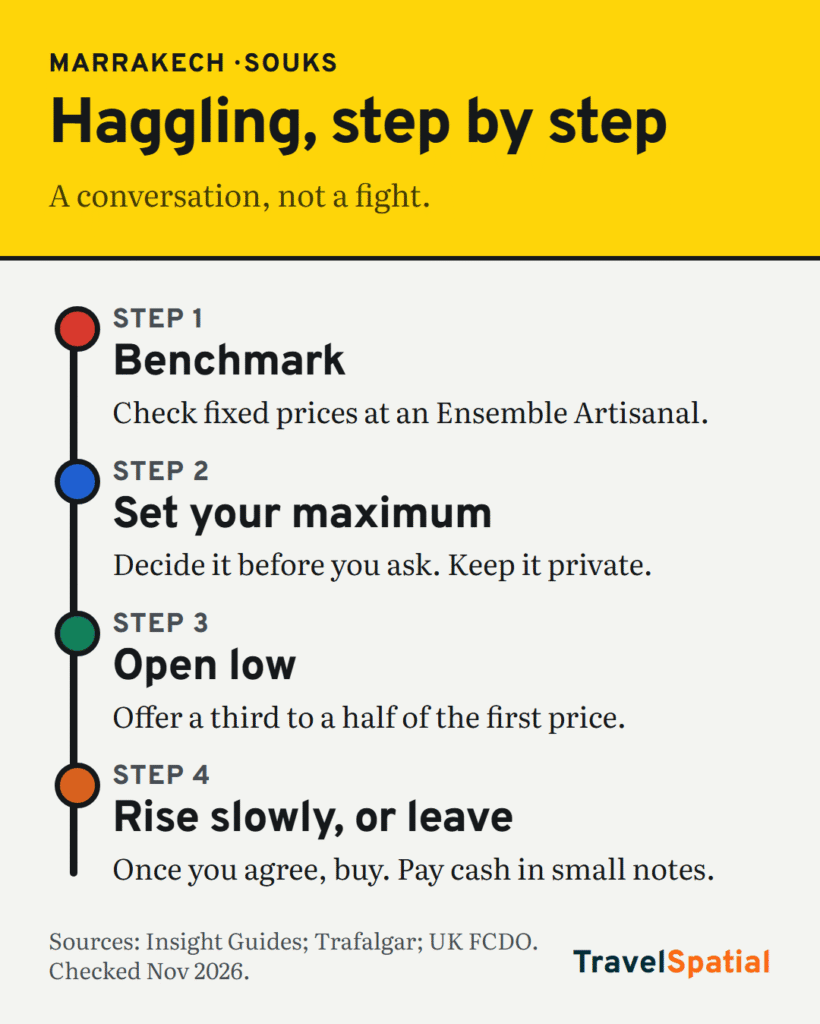
| Step | What you do | What to say |
|---|---|---|
| 1. Benchmark | Check the fixed price of the item somewhere first | Nothing yet. Just look |
| 2. Decide | Set your maximum before you ask | Nothing. Keep it to yourself |
| 3. Ask | Let the seller name the first price | “Bshhal?” (How much?) |
| 4. Open | Offer one third to a half of that price | “That’s too much for me. I can do…” |
| 5. Move | Raise in small steps, slower than they come down | “A little more, but not that much” |
| 6. Close or leave | Agree, or thank them and walk on | “Shukran, maybe later” |
Step 1: benchmark before you browse
The single best thing you can do is know what an item costs before anyone quotes you a price. Insight Guides recommends visiting a local Ensemble Artisanal, where prices are fixed, or looking for shops with “fixed price” signs in the window. Prices there aren’t the lowest you’ll find, but they give you a ceiling.
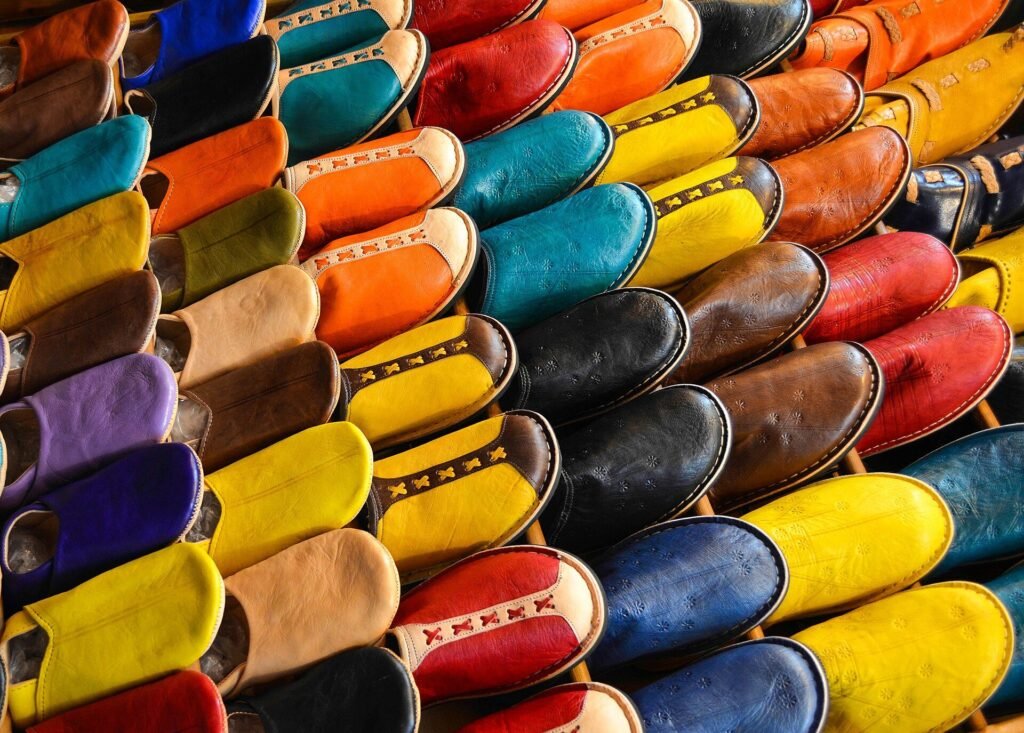
Our example: you want a pair of leather slippers (babouches). At a fixed-price shop, you note what a pair of the quality you like costs. Call that the ceiling.
Step 2: decide your maximum, privately
Before you step into a souk shop, decide the most you’ll pay. It should be at or below your benchmark, and it should be an amount you’d be happy with even if you later spot the same slippers for less. Insight Guides puts it well: there’s no such thing as the right price. There’s only a price you’re happy to pay.
Step 3: let them name the price
Ask, and let the seller go first. If you’re offered mint tea while you look, Insight Guides suggests accepting only if you’re serious about buying. It’s hospitality, but it also signals you’re a likely customer.
Don’t open by saying what you want to spend. Look a little hesitant. Pick the item up, put it down, look at another.
Step 4: make your first offer
This is the step that feels hardest alone. Guides vary on the opening number: Insight Guides suggests one third to a half of the first price, and Trafalgar suggests countering at about 50% lower (Trafalgar, updated May 2025).
Our example: the seller says 400 dirhams. You say: “That’s more than I can spend. I could do 150.” (That’s well inside the one-third-to-half range.) Expect a laugh, a story about the leather, and a counter-offer. That’s the game working, not going wrong.
Keep it friendly. Smile. A joke helps. Trafalgar’s advice is to be firm but fair, and polite throughout.
Step 5: move up slowly
The seller comes down. You go up, but in smaller steps. If they drop by 50, you rise by 20. Repeat. Insight Guides’ advice for this part is short: stick to your guns.
Our example: 400… 300… you go to 180… they say 250… you say 200. That’s your maximum, and you say so: “200 is really my limit.”
Step 6: close, or walk away
If they agree, shake hands and pay. Trafalgar warns that changing your mind after agreeing a price is very poor etiquette. So only make offers you’re willing to pay.
If they don’t agree, thank them and walk on. Insight Guides says to decline politely and leave if you can’t or don’t want to pay the price offered. Often, you’ll be called back before you’ve gone ten steps with a “final price”. If not, there are other shops with similar slippers a few doors along.
Pay in cash, with small notes. Trafalgar suggests carrying small bills, so you don’t have to hand over a large note and wait for change.
Haggling alone: what’s different
Nobody’s watching your back while you concentrate. Keep your bag in front of you and your phone away while you’re mid-deal.
Fake guides target people on their own. The UK government’s travel advice says it’s common for people posing as official guides to harass tourists, and advises checking that a guide has an official badge (FCDO Morocco travel advice). A “helpful” stranger who walks you to his cousin’s shop isn’t a guide.
Don’t tell your taxi driver you’re going shopping. Insight Guides warns that drivers may take you to places that pay them a commission.
Watch the swap. The FCDO also warns about scammers substituting inferior goods for the ones you bought. Watch your item being wrapped.
Women may receive unwanted attention, the FCDO notes, especially when travelling alone. Our solo female travel guide to Morocco covers the city-by-city detail, and our Morocco packing list for solo women helps with what to wear.
What not to haggle
- Food and drink. Café and food-stall prices are generally set.
- Fixed-price shops, including the Ensemble Artisanal. The sign means it.
- Petit taxis. Don’t haggle: the FCDO advises checking the meter is on, or agreeing the fare before you set off.
The souk in six lines
Check the fixed price first at an Ensemble Artisanal. Set your maximum. Let the seller name the price, open at one third to a half, rise slowly, and walk away politely if it doesn’t work. Pay cash in small notes, and once you’ve agreed, buy. Planning the rest of the trip? Our 10-day Morocco itinerary starts in Marrakech.
Get our solo travel guides in your inbox. Sign up for the TravelSpatial newsletter.
Sources
- Insight Guides, Morocco: how to haggle (updated August 2019)
- Trafalgar, The ultimate cheat sheet to bartering in souks and markets (updated May 2025)
- UK Foreign, Commonwealth & Development Office, Morocco travel advice (checked November 2026)
Photo credits
- Babuchas 02 — 2014 — Marrakech, Marruecos by I.Barrios & J.Ligero, CC BY-SA 3.0, via Wikimedia Commons
- Covered Souk Semmarine, Marrakech, 2008 by DimiTalen, CC0, via Wikimedia Commons
The infographic is original to TravelSpatial. Photos are used under the licences linked above.