Wise or Revolut? Both are app-based accounts with a debit card that spends abroad without the usual bank markups, and both are popular with solo travellers. The right one depends on one thing more than any other: how much cash you’ll take out.
This guide is a decision tree. Answer a few questions, and it points you to one card, or to both. We’ve used each company’s UK fee pages (checked November 2026), so the figures are in pounds. If you live elsewhere, the structure is similar but the numbers differ, so check your own country’s page.
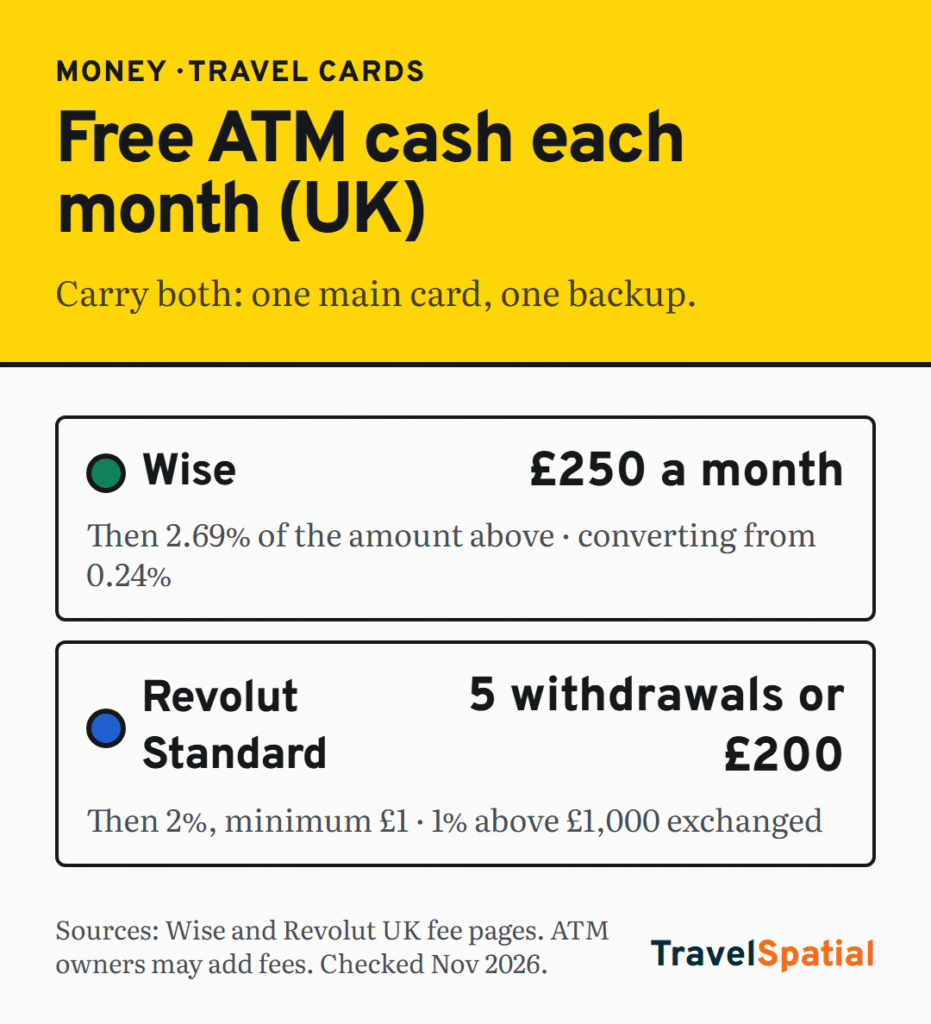
If you only read one paragraph: for cash-heavy trips, Wise’s free ATM allowance is bigger: £250 a month, then 2.69% on the amount above that (Wise). Revolut’s free Standard plan allows five withdrawals or £200 a month, whichever comes first, then 2% (minimum £1) per withdrawal (Revolut). For card spending, both are low-cost: Wise conversions start from 0.24%, and Revolut Standard lets you exchange up to £1,000 a month before a 1% fair-usage fee. For a solo traveller, the best answer is often both: one as your main card and one as the backup.
| Wise (UK) | Revolut Standard (UK) | |
|---|---|---|
| Monthly fee | None | Free |
| Free ATM withdrawals | £250 a month | 5 withdrawals or £200 a rolling month |
| After the allowance | 2.69% of the amount above £250 | 2% per withdrawal, minimum £1 |
| Converting currency | From 0.24%, varies by currency | Variable exchange fee shown in the app; 1% fair-usage fee above £1,000 a month |
| Card | £7 to order | First card free, delivery fee applies |
Both companies note that the ATM’s owner may charge its own fee on top. Neither app can stop that.
Question 1: will you use a lot of cash?
Yes, more than about £200 a month, in many small amounts → lean Wise. Its allowance is measured in money, not number of withdrawals, so you can take out £250 in one go or in ten.
No, mostly card payments → go to Question 2.
Why the difference matters: on Revolut Standard, the allowance ends at five withdrawals even if they’re small. If you’re in a cash-first country where the ATM itself charges a fee each time, you’ll want fewer, larger withdrawals anyway. Thailand is the classic example: our 3-week Thailand backpacking route shows how much of that trip runs on cash.
Question 2: will you spend more than £1,000 a month in foreign currency?
Yes → lean Wise, or consider a paid Revolut plan. On Revolut, the Standard plan’s exchange limit is £1,000 a month, then a 1% fair-usage fee on the rest. Revolut’s Plus plan raises that to £3,000 (0.5% after), and Premium, Metal and Ultra have no limit. Check the plan price in the app before you upgrade.
No → either card works. Go to Question 3.
Question 3: do you want to know the exact fee before you pay?
Yes → Wise shows its fee by currency on its pricing page, starting from 0.24%.
It doesn’t matter much → Revolut says it uses its own variable exchange rate and adds a variable fee, shown in the app, and that for real-time card payments you’ll see the breakdown afterwards (Revolut Standard fees).
Question 4: is this your only card?
Yes → don’t let it be. When you travel alone, nobody else can pay if your card is blocked, lost or refused. Pack a second card from a different company, ideally on a different network. Wise and Revolut work well as each other’s backup, or alongside your normal bank card.
No → you’re set. Keep the two cards in different places.
Three solo trips, costed
These examples use the UK fee figures above, for card fees only. They ignore any fee the ATM’s owner adds, and the exchange-rate fee on card spending, which varies by currency.
Trip 1: a week in Lisbon, mostly card. You take out £100 in cash in two withdrawals. – Wise: within the £250 allowance. £0 in Wise ATM fees. – Revolut Standard: within five withdrawals and £200. £0. – Verdict: a tie. Pick on the app you prefer.
Trip 2: three weeks in Southeast Asia, cash-heavy. You take out £600 in cash, in three withdrawals of £200. – Wise: £250 free, then 2.69% on £350 = £9.42. – Revolut Standard: the first £200 withdrawal uses the whole allowance. The next two pay 2% each = £8. – Verdict: close, slightly in Revolut’s favour. Wise pulls ahead if you split the cash into more, smaller withdrawals.
Trip 3: six weeks across Europe, lots of small withdrawals. You take out £300 in ten withdrawals of £30. – Wise: £250 free, then 2.69% on £50 = £1.35. – Revolut Standard: five free withdrawals (£150), then five more at 2% with a £1 minimum each = £5. – Verdict: Wise, because Revolut’s minimum fee bites on small withdrawals.
All of these are one calendar month or rolling month. Over a longer trip, the allowances reset, so check how your dates fall.
What neither card fixes
- The ATM owner’s fee. In Thailand, that’s about 220 baht a time. Withdraw less often.
- Dynamic currency conversion. If a terminal or ATM asks whether to charge you in pounds, always choose the local currency. Our guide to avoiding travel money fees explains why.
- Countries where cards are awkward. In Argentina, for example, how you pay changes the exchange rate you get. Our South America backpacking budget has the daily costs country by country.
Before you go
- Order the card at least two weeks before you leave, so it arrives in time.
- Add it to your phone’s wallet app, so you can pay contactless even if the plastic card is lost.
- Turn on notifications for every payment.
- Learn where the freeze card button is in the app. You’ll want to find it quickly.
- Keep the second card in a different bag.
Which card, in a sentence or two
If you’ll take out a lot of cash, or make many small withdrawals, Wise’s £250 monthly allowance is easier to live with than Revolut Standard’s five withdrawals or £200. If you mostly pay by card and spend under £1,000 a month abroad, both cost very little. Travelling alone, the strongest setup is both: one in your wallet, one hidden in your bag. For the rest of your trip budget, see how much money you need for your first solo trip.
Fees change. Get our updates first: sign up for the TravelSpatial newsletter.
Sources
- Wise, Card fees (UK) (checked November 2026)
- Wise, Pricing (UK) (checked November 2026)
- Revolut, Personal fees (Standard), United Kingdom (checked November 2026)
Photo credits
- Ingenico iPP350 payment terminal by User:Daylon124, CC0, via Wikimedia Commons
- Cashless-Payment-Devices CreditCard-and-Code-payment by RuinDig/Yuki Uchida, CC BY 4.0, via Wikimedia Commons
The infographic is original to TravelSpatial. Photos are used under the licences linked above.