Tanzania’s mandatory travel insurance rule is short. The UK Foreign Office explains it in fewer than 200 words. But almost every sentence answers a question travellers keep asking: do I need it if I’m already insured, do I pay twice for Zanzibar, can they really turn me away?
So instead of paraphrasing, we’ve taken the official wording sentence by sentence and added what each line means for you. The quotes are from the FCDO’s Tanzania entry requirements (updated 30 October 2026, checked November 2026). Below that, a table compares the handful of other countries that now check insurance at the border.
The rule, sentence by sentence
“All visitors to mainland Tanzania and Zanzibar, except residents, must have mandatory Tanzanian Government-provided inbound travel insurance…”
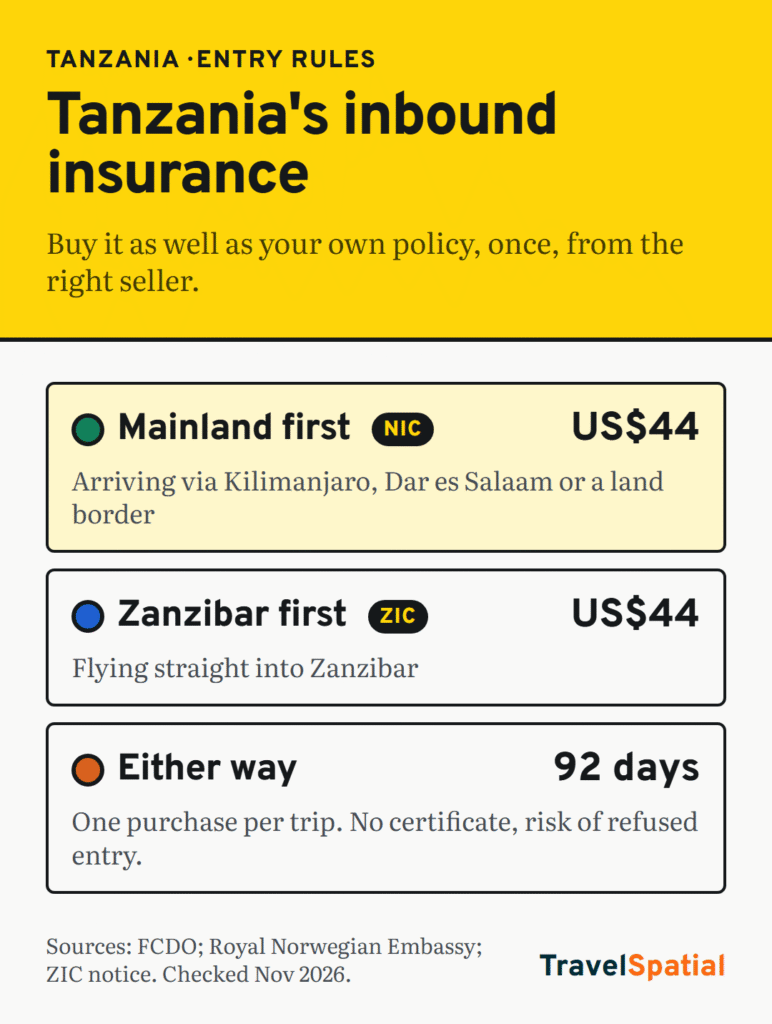
What it means: this isn’t “have some travel insurance”. It’s one specific product, sold by the state. There are two sellers: the National Insurance Corporation (NIC) for the mainland and the Zanzibar Insurance Corporation (ZIC) for the islands. The mainland requirement took effect on 1 October 2026, according to a ZIC public notice dated 7 October 2026. Zanzibar’s own scheme is older.
“…even if they already have a personal policy in place.”
What it means: your own policy doesn’t count instead. You buy the government policy as well as your own. Nothing in the official wording lets you swap one for the other.
“You can buy insurance either online, or at ports of entry upon arrival…”
What it means: you can pay at the airport, but buying online before you fly gets it done before a long queue after a night flight. Mainland-first travellers use the NIC inbound portal. ZIC’s notice says to keep an electronic or printed copy of the certificate and its QR code with you.
“This insurance is valid for the duration of your stay (up to 92 days).”
What it means: one purchase covers a normal safari-plus-beach trip. The cost is US$44, according to the Royal Norwegian Embassy in Dar es Salaam, which also says the cover is for medical emergencies. ZIC’s notice adds that you don’t need to buy another policy if you re-enter within the 92-day period.
“You only need to buy insurance for your first port of entry, either mainland Tanzania or Zanzibar.”
What it means: you don’t pay twice. If you fly into Kilimanjaro and finish in Zanzibar, buy from NIC. If you fly straight into Zanzibar, buy from ZIC. The NIC portal itself says its policy is valid across mainland and Zanzibar. If you’re planning that classic route, our Kilimanjaro to Zanzibar guide has the flights and ferries.

“You may be refused entry if you do not have the required insurance.”
What it means: this is the line that matters. It’s an entry requirement, like your visa, not a recommendation. Treat the certificate as part of your passport folder.
“For travellers who purchased insurance from ZIC before 1 October… [they] may use it where the mainland is their first port of entry…”
What it means: a transition rule for people who bought Zanzibar’s policy early. If you’re booking now, ignore it and follow the first-port rule above.
“You should also make sure you have travel insurance that covers your individual needs.”
What it means: the US$44 policy is a floor, not a plan. It doesn’t replace cover for cancellations, lost bags, a long hospital stay or medical evacuation from a remote park, and nothing on the official pages says it does. Keep your own policy. Our plain-English guide to travel insurance explains what a full policy covers.
Who doesn’t have to buy it
The Norwegian Embassy notice says foreigners who are residents of East African Community (EAC) and Southern African Development Community (SADC) countries are exempt. ZIC adds a catch: that exemption applies to the mainland rule and doesn’t automatically cover Zanzibar’s. If you live in Nairobi or Johannesburg and fly straight to Zanzibar, check with ZIC first.
What it adds to a safari budget
US$44 is small next to park fees, but it’s per person, and solo travellers already pay more for vehicles and rooms. Our budget Serengeti camping safari breakdown includes it in the fixed costs you can’t negotiate down.
Tanzania isn’t alone: countries that check insurance at the border
Several lists of “countries that require travel insurance” are copied from the pandemic years and are now wrong. This table only includes requirements stated in the UK government’s current travel advice or an official EU page, checked in November 2026. Rules can differ by passport, so check your own government’s advice too.
| Where | What you need | Your own policy accepted? | Source |
|---|---|---|---|
| Tanzania (mainland and Zanzibar) | Government inbound policy, US$44, up to 92 days | No, buy it as well | FCDO; Norwegian Embassy |
| Kenya | Kenyan Government travel health insurance, valid 90 days, bought with your eTA (from 5 October 2026) | No, buy it as well | FCDO |
| Georgia | Health and accident insurance for the whole stay, at least 30,000 GEL of cover | Yes, Georgian or foreign insurer | FCDO |
| Galápagos (Ecuador) | Travel health insurance, plus a return flight and transit control card | Yes, but check air ambulance cover | FCDO |
| Schengen area, if you need a visa | Medical insurance for emergency care, hospitalisation and repatriation | Yes, as part of the visa application | European Commission |
A few notes on that table:
- Kenya works like Tanzania: the FCDO says foreign travel insurance policies aren’t accepted instead. Most travellers buy it during the eTA application. If you already hold an eTA, you buy it separately through Kenya’s eCitizen insurance portal. Exempt groups include Kenyan citizens and residents, EAC citizens and passengers transiting airside. We couldn’t find the price on an official page, so check it when you apply.
- Georgia is the opposite model: any insurer will do, but the policy must cover your arrival and departure days, and the FCDO says your airline or the immigration officer may ask to see it. If you’re planning a month in Tbilisi, check that a nomad subscription meets the 30,000 GEL minimum and shows your dates.
- Galápagos sits on top of Ecuador’s normal entry rules. The FCDO also warns that medical facilities on the islands are limited and that your policy should include air ambulance evacuation. Our Galápagos without a cruise guide covers the rest of the paperwork.
- Cuba and mainland Ecuador still appear on many online lists. The UK’s current advice for Cuba (September 2026) doesn’t list an insurance entry requirement. It does say you, or your insurer, may have to pay for treatment in foreign currency before you’re treated, so cover is still wise.
Before you fly to Tanzania: a three-line check
- Which is your first port of entry? Mainland airport or land border: buy from NIC. Zanzibar: buy from ZIC.
- Have you saved the certificate and QR code offline and on paper, next to your passport and visa?
- Is your own policy still active for evacuation, cancellation and everything else the US$44 policy isn’t designed for?
Questions the websites don’t answer can go to the insurers directly. The FCDO lists inbound@zic.co.tz for Zanzibar and wecare.inbound@nicinsurance.co.tz for the mainland.
Entry rules like this change with little warning. The TravelSpatial newsletter flags the ones that matter.
Sources
- FCDO, Tanzania entry requirements (updated 30 October 2026: mandatory government inbound insurance even with your own policy; online or on arrival; up to 92 days; first port of entry only; may be refused entry; ZIC policies bought before 1 October; checked November 2026)
- Royal Norwegian Embassy in Dar es Salaam, Mandatory travel insurance (USD 44, up to 92 days, medical emergencies, EAC and SADC residents exempt; checked November 2026)
- Zanzibar Insurance Corporation, public notice of 7 October 2026 (mainland effective 1 October 2026; insurer depends on first point of entry; keep certificate and QR code; EAC/SADC exemption and Zanzibar; checked November 2026)
- NIC Tanzania inbound travel insurance portal (valid across mainland and Zanzibar; checked November 2026)
- FCDO, Kenya entry requirements (updated 6 November 2026: from 5 October 2026, government travel health insurance, 90 days, with the eTA, foreign policies not accepted; checked November 2026)
- FCDO, Georgia entry requirements (updated 12 November 2026: health and accident insurance, at least 30,000 GEL, whole stay; checked November 2026)
- FCDO, Ecuador entry requirements (updated 20 November 2026: Galápagos travel health insurance; checked November 2026)
- FCDO, Cuba health (payment in foreign currency before treatment; checked November 2026)
- European Commission, Applying for a Schengen visa (medical insurance for emergency care, hospitalisation and repatriation; checked November 2026)
Photo credits
- Arrival Entrance from the airfield to Kilimanjaro International Airport by Hansbaer, CC BY-SA 3.0, via Wikimedia Commons
- Zanzibar 2012 06 06 4182 (7592254980) by Harvey Barrison from Massapequa, NY, USA, CC BY-SA 2.0, via Wikimedia Commons
The infographic is original to TravelSpatial. Photos are used under the licences linked above.