
Dating apps abroad are oddly good at one thing: finding someone local who’ll tell you where they actually eat. Sometimes that turns into a date, sometimes into a friend who shows you the city, sometimes into a story you’ll tell for years. And occasionally into something you’d rather not tell at all.
Canada’s government puts the risk plainly. Dating apps and websites “can be used to lure victims, typically foreigners, to rob or assault them” (Travel.gc.ca, checked November 2026). You can keep swiping. Just plan it the way you’d plan a route home from a bar. Below, that plan follows one match through four stages.
Stage one: the swipe
Before you match with anyone, set up your profile for travel.
Leave out where you’re staying. Canada’s advice is short and clear: “Never share exactly where you’re staying.” That includes photos taken from your balcony, your hostel’s name in your bio and the beach bar you’ll be at “every night this week”.
Leave out your dates too. “Here until Sunday” tells the wrong person how long you’ll be alone in town, and when nobody will expect you somewhere else.
Check whether the country is safe for who you are. This one matters a lot for LGBTQ+ travellers. The UK government says around 70 countries criminalise consensual same-sex activity, and that in some, “entrapment campaigns may target LGBT+ people, including through popular dating apps” (gov.uk, checked November 2026). Tinder says it hides the sexual orientation on your profile while you’re in a territory it has identified as unsafe for LGBTQ+ people, and suggests you also turn off “Show me on Tinder” there (Tinder safety tips, checked November 2026). Read your government’s advice for the destination before you open the app, not after.
Stage two: the chat
Most of the safety work happens here, before you meet. You’re looking for two things: that this person is who they say they are, and that they’re interested in you, not your wallet.
Verify them. Canada’s advice suggests a video call before meeting, a quick web search, a reverse image search of their photos and a look at whether their social accounts are linked. Check whether the app verifies profiles: Bumble, for example, offers photo verification, and ID verification in eleven countries including the UK and US (Bumble, checked November 2026). A verification badge isn’t a guarantee, but its absence is worth noticing.
Watch for the classic scam moves. Tinder’s own safety page lists a few that come up again and again:
- Moving the conversation off the app “right away”, to text, WhatsApp or email
- Refusing to video call or meet
- Asking for money for any reason, “even if the person claims to be in an emergency”
- Claiming to be from your country but stuck somewhere else, needing help to get home
If any of those happen, you don’t owe anyone an explanation. Canada’s advice: “unmatch the moment you feel uncomfortable. It’s ok to change your mind.”
Stage three: the meet
You’ve chatted, you’ve video-called, you’d like to meet. This is where solo travel changes the rules a little, because there’s no flatmate expecting you home.

Pick the place yourself. Canada suggests a busy public place, in daytime, close to your accommodation. A café, a market, a walk somewhere with people around. A first meeting that starts at 11pm in a bar they chose, across town, has three warning signs in one sentence.
Get there and back on your own. Make your own way there and keep enough money to pay your own way and get home. Canada says to carry it. That way, leaving early is always an option, with no awkward negotiation over a shared taxi.
Tell someone. Canada’s advice is to make sure someone knows where you are, and to let them know when you’re back. Bumble’s Share Date feature sends the details of a meetup to a trusted contact and lets you update them as plans change. If your app doesn’t have something similar, a message to a friend does the same job: name, profile screenshot, place, time, when you’ll check in.
Watch your drink. “Never take your eyes off your drink,” says Canada. The UK’s Travel Aware campaign adds two rules for any night out: don’t accept drinks from strangers, and if you feel more drunk than you should, get to safety and get medical help (Travel Aware, checked November 2026).
Hold on to your valuables. Never give anyone your passport, money or bank details. Canada also warns to be wary of gifts, which “could contain hidden drugs”, and could leave you facing a trafficking charge at the airport.
Stage four: the after
The date went well. Or it didn’t. Either way:
- Check in with whoever you told, even if it’s just “home, all fine”.
- Be careful about moving accommodation. A new friend’s spare room is a nice offer, but it’s also the moment you lose your own front door and the staff who know you’re there.
- If something went wrong, report it to the app, then to local police if a crime happened. Canada’s page also links to its guidance on reducing the risk of sexual assault and harassment abroad, and your own embassy can help you find support.
Not looking for a date?
Plenty of travellers use dating apps to find friends, and many apps have a friends mode. But if what you really want is company, there are easier ways. Our guide to meeting people when you travel alone covers the options, and how to make friends in a hostel has the scripts. Staying a month or more? See making friends as a digital nomad.
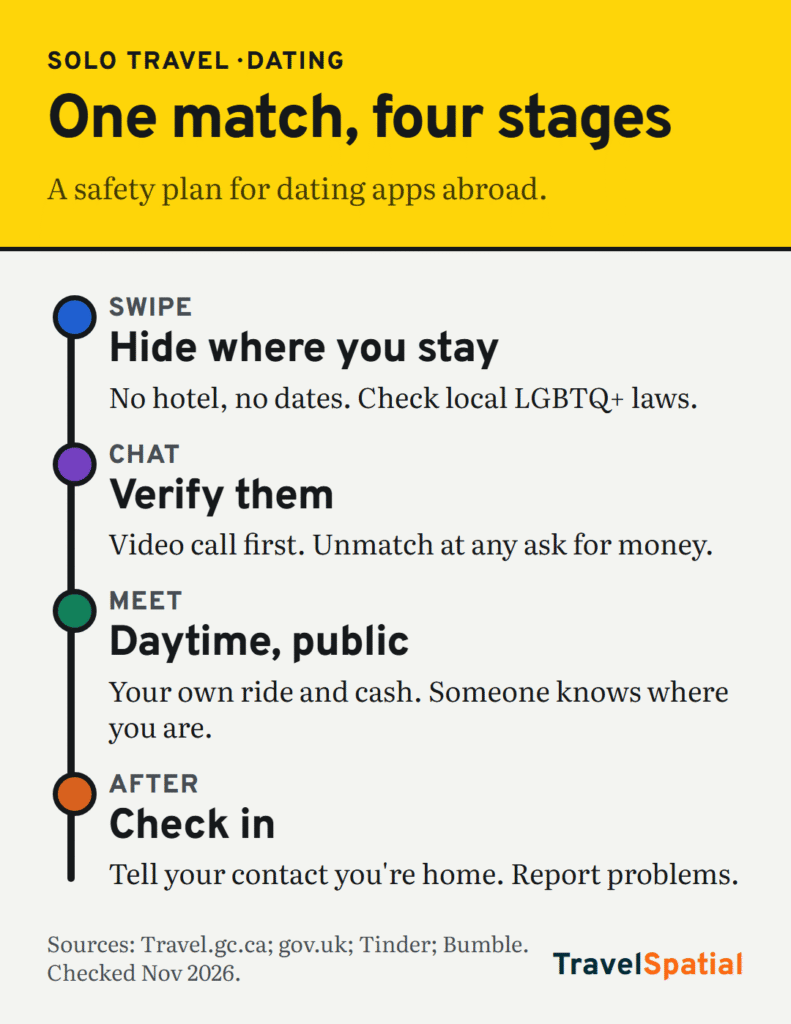
From first swipe to safely home
- Swipe: no accommodation, no dates on your profile; check the country’s LGBTQ+ laws.
- Chat: video call and verify; unmatch at the first ask for money or rush off the app.
- Meet: daytime, public, near your place; your own transport and money; someone knows where you are.
- After: check in; keep your own bed; report anything that went wrong.
And arriving somewhere new late at night before any of this? Start with our airport-to-bed checklist.
Join the TravelSpatial newsletter for more ways to meet people on the road.
Sources
- Travel.gc.ca, Dating outside Canada (apps used to lure foreigners; don’t share where you stay; verify with video call and reverse image search; daytime public first meeting near your accommodation; watch your drink; money to get back; someone knows where you are; no passport, money or bank details; gifts and drugs; checked November 2026)
- gov.uk, Lesbian, gay, bisexual and transgender foreign travel advice (around 70 countries criminalise same-sex activity; entrapment through dating apps; checked November 2026)
- Tinder, Safety tips (orientation hidden in unsafe territories; turn off Show me on Tinder; never send money; moving off the app; refusing to meet or call; stuck-abroad stories; checked November 2026)
- Travel Aware, Spiking and methanol poisoning (don’t accept drinks from strangers; feeling more drunk than expected; get to safety and medical help; checked November 2026)
- Bumble, Dating features (photo verification; ID verification countries; Share Date; checked November 2026)
Photo credits
- Empty Table, Lisbon (33806536974) by Sam, CC BY 2.0, via Wikimedia Commons
- Budapest – Mercado Central – Grand Market Hall – Nagycsarnok – 03 by Xosema, CC BY-SA 4.0, via Wikimedia Commons
The infographic is original to TravelSpatial. Photos are used under the licences linked above.