This page starts with the document itself. Copy it into a note or a shared doc, fill in the blanks and send it to one person at home before you leave. Each section is numbered, and the notes underneath explain why that line is there and what to put in it.
It’s built for a first solo trip, but it works for any trip where nobody travelling with you would notice if you went quiet.
The template
SOLO TRIP SAFETY PLAN
1. Me – Full name (as in passport): ______ – Passport number and expiry: ______ – Nationality: ______ – Medical notes (allergies, conditions, regular medicine): ______
2. The trip – Dates: from ______ to ______ – Rough route (cities, in order): ______ – Where I’m staying each night (name, address, booking reference): see attached list / shared doc ______
3. If something goes wrong – Travel insurer and policy number: ______ – Insurer’s 24-hour assistance number: ______ – My bank’s lost card numbers: ______ – My mobile provider’s lost phone number: ______ – My embassy or consulate in each country: ______
4. Check-ins – Normal days: a message by ______ (local time / your time) – Travel days: a message when I leave and when I arrive – Channel: ______ (and a backup: ______) – Location sharing: on / off, with ______
5. If I go quiet – Wait ______ hours after a missed check-in – Then step 1: message and call me on ______ – Step 2: contact my accommodation for that night – Step 3: call my travel insurer’s assistance line – Step 4: contact our embassy or consulate’s emergency number – Code word that means “I need help but can’t say so”: ______
6. Agreed – My contact: ______ (name, phone) – Date sent: ______
The notes
1. “Me”: why your family needs your passport details
If you lose your passport, or something more serious happens, the first thing an embassy, insurer or police officer asks for is your passport number. Leaving a copy at home means someone can read it out to them, even if your phone and bag are gone. Our first solo trip checklist includes making copies a few weeks before you go.
Add medical notes even if they seem minor. An allergy or a regular medicine matters to a doctor treating you if you can’t explain yourself.
2. “The trip”: a rough route, not a minute-by-minute schedule
Your contact doesn’t need every bus time, just enough to know where to start looking. The list of where you’re staying each night is the most useful line in the whole plan, because a hostel or hotel can confirm whether you came back. Keep it in a shared doc so you can update it as plans change, and they will.
3. “If something goes wrong”: the numbers someone else might need to call
Everything in this section is a phone number you might be unable to call yourself. Your insurer’s assistance number matters most. The UK government advises carrying your policy details abroad, with the insurer’s emergency helpline among them (gov.uk, checked November 2026). Giving it to someone at home is the backup.
Some governments also let you register your trip or sign up for alerts. Canada’s Registration of Canadians Abroad is a free service that lets the government notify you of an emergency at your destination or a personal emergency at home (Travel.gc.ca, checked November 2026). The UK doesn’t register travellers. Instead, you can sign up for email updates on each country’s travel advice page (gov.uk, checked November 2026). Note your choice here.
4. “Check-ins”: agree a rhythm you’ll actually keep
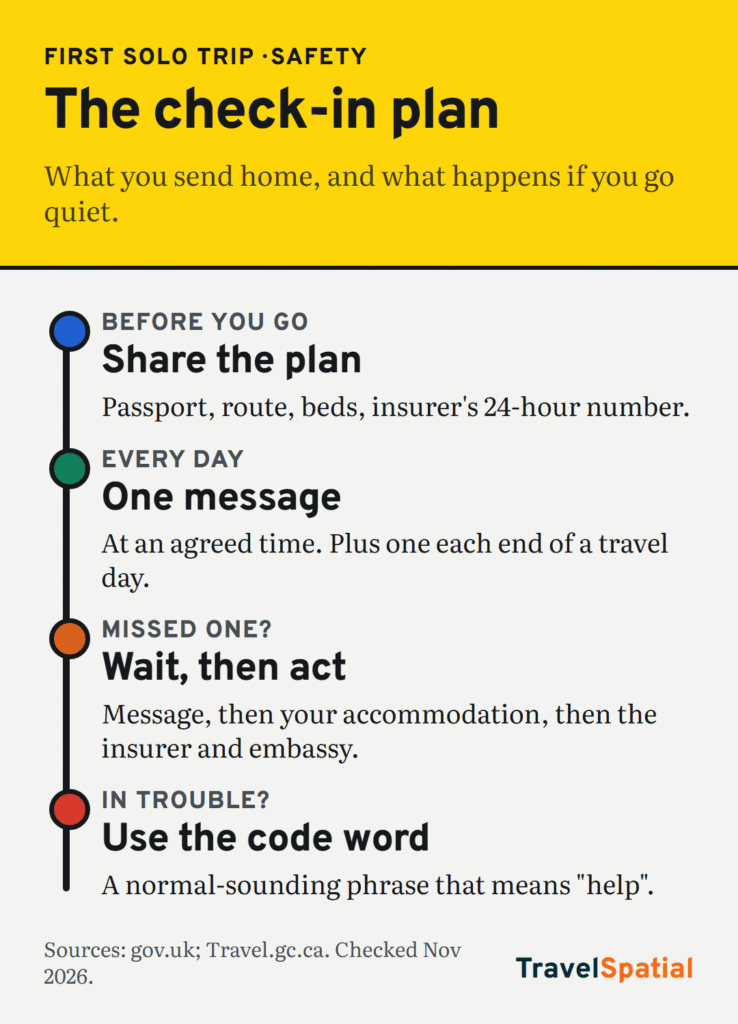
The commonest mistake is promising too much. A daily message at a set time, plus one at each end of a travel day, is enough for most trips and easy to keep. Agree whose time zone you mean.
Pick a backup channel. If your main app or phone fails, what’s plan B? Email, a different messaging app, or the hostel’s phone. If you lose your phone completely, your contact should know you might go quiet for a day while you sort it out.
Location sharing is optional. Google’s Location Sharing, for example, shows the people you choose your real-time location, name, profile picture and battery status. It can also show where you’ve been recently. It’s off by default, and it works through apps like Maps (Google, checked November 2026). Some travellers like the reassurance. Others find it too much for a long trip. Either is fine, but write down which you’ve agreed, so a dead battery isn’t mistaken for an emergency.
Your phone is the hinge of this whole plan. A local SIM or eSIM keeps you reachable without roaming bills. Our eSIM vs local SIM vs roaming guide compares the costs.
5. “If I go quiet”: the part that needs most care
This is the section that turns a worried relative into a useful one. Agree in advance how long they should wait. A few hours on a normal day, longer if you said you’d be on a remote trek or an overnight bus, so they don’t panic over a phone with no signal. Then give them a sequence, from cheapest to most serious: message, call your accommodation, call the insurer, call the embassy.
For hikes, the stakes and the timing are different. A missed return from a trail needs a much faster response, with your route and a time to call mountain rescue. Our hiking alone safety plan has a trip plan built for that.
The code word. Pick a word or phrase that sounds normal in a message (“say hi to the cat”) but means “I’m not safe and can’t say so.” Keep it simple enough that you’ll remember it under stress.
6. “Agreed”: send it, and say thank you

Send the finished plan before you leave and ask your contact to confirm they’ve read section 5. Update the shared doc when your route changes. When you’re home, tell them the plan’s finished, and keep a copy for next time.
How the plan works on the road
| Moment | What you do | What your contact does |
|---|---|---|
| Before you go | Fill in the template, share it | Read it, save the numbers |
| Each day | Send the agreed check-in | Nothing, unless it’s missed |
| Travel days | Message at departure and arrival | Expect a gap in between |
| A missed check-in | (You may not know it’s been missed) | Wait the agreed time, then follow section 5 |
| Arriving late at night | Follow your arrival plan, message when you’re in | Know you might be late |
Arriving somewhere after dark is the moment many first-time solo travellers worry about most. Our airport-to-bed checklist for landing at night pairs well with this plan.
Planning your first trip alone? The TravelSpatial newsletter walks you through it, one guide at a time.
Sources
- gov.uk, Foreign travel insurance (take your policy number and the insurer’s emergency assistance number; checked November 2026)
- gov.uk, Foreign travel advice (sign up for email updates on each country page; checked November 2026)
- Travel.gc.ca, Registration of Canadians Abroad (free; notification of emergencies at your destination or at home; checked November 2026)
- Google, Manage your Location Sharing settings (off by default; shares real-time location, name, picture, battery; recent places; checked November 2026)
Photo credits
- Postcards (4355883743) by mickamroch, CC BY 2.0, via Wikimedia Commons
- 47 Airport departures board free photo – Melbourne Airport timetable – Creative Commons Attribution by Marek Ślusarczyk (Tupungato) Photo portfolio, CC BY 3.0, via Wikimedia Commons
The infographic is original to TravelSpatial. Photos are used under the licences linked above.