Some of the best hours of a solo trip happen after dark. A plate of something you can’t pronounce, a seat at a bar where the bartender starts recommending things, a slow walk back through streets that look different with the lights on. Nobody to agree with about where to go next, and nobody to leave early for.
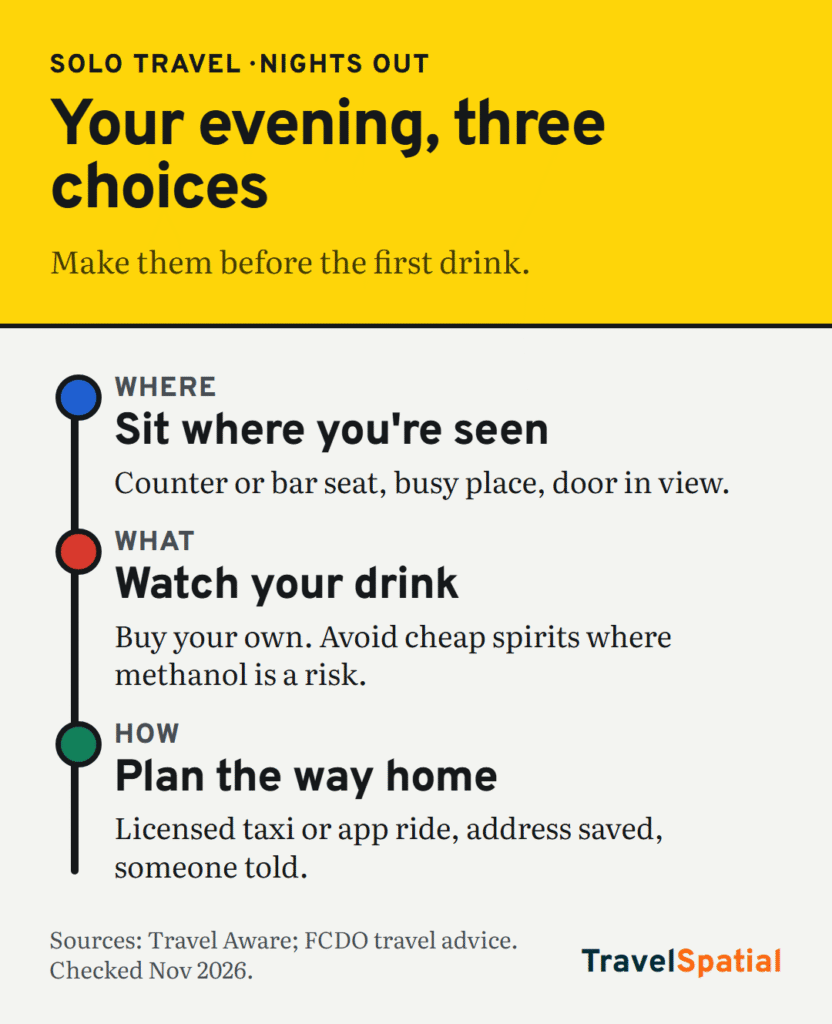
Most of the risk in an evening alone is concentrated in a few moments. Where you sit. What happens to your drink. How you get home. Get those right and the rest is just a good night. This is a guide to those moments, with the official advice you need beside each one.
Where you sit decides most of the evening
The best seat for a solo diner is often the counter. You’re facing the kitchen or the bartender, not a room of couples. Staff notice you, and conversation starts naturally if you want it. The spot to avoid is the dark corner booth. It feels discreet, but it’s where nobody notices whether you’re fine.
If the eating part makes you nervous, start there. Our dinner for one in Europe guide covers city-by-city etiquette for a table for one, and eating alone on a budget finds the set lunches and counters that make solo meals cheap. When the bill comes, tipping for one explains what’s expected where.

A few small habits help:
- Choose busy over hidden. A lively place with a mixed crowd is easier to read than a quiet one.
- Sit where you can see the door, and keep your bag on your lap or looped around a chair leg, not hung on the back.
- Carry your address. Portugal’s UK advice suggests writing down or photographing the name and address of your accommodation before you go out. Where the alphabet is different, save it in the local script too.
The drink: two different risks
Two quite different things can go wrong with a drink, and they need different defences.
Spiking
The UK government’s Travel Aware campaign describes spiking as someone adding drugs or other harmful substances to your drink without you knowing, sometimes to commit theft or sexual assault (Travel Aware, checked November 2026). The Foreign Office warns about it in many popular destinations. Its Indonesia page mentions reports linked to sexual assault in Bali, Lombok and the Gili Islands. Its Thailand page says it happens in tourist areas “with male and female victims”.
The defences are simple and they work best as habits:
- Buy your own drinks, and watch them being made where you can.
- Don’t leave a drink unattended. If you’ve walked away from it, order a new one.
- Don’t accept drinks from strangers. Georgia’s and Turkey’s advice both warn about strangers who approach you to take you to a restaurant or nightclub.
- If a drink smells or tastes odd, leave it.
Sidebar: signs you may have been spiked Feeling more drunk than you should, drowsy or confused. Some people have hallucinations, paranoia or memory blackouts. Travel Aware’s advice: get to safety, seek emergency medical help if needed, and report it to the local police. “Trust your gut – if something feels wrong, it probably is.”
Methanol
Methanol is the other danger, and it can reach anyone’s glass. This industrial alcohol is sometimes illegally mixed into spirits and cocktails. Travel Aware says that as little as 30ml, about a shot, can be fatal for an adult, and 10ml can cause blindness. The FCDO’s Ecuador advice adds that it isn’t possible to identify methanol in a drink by taste or smell.
So the defences are about what you order, not how you guard it:
- Skip free cocktails and shots, unlabelled bottles and suspiciously cheap “brand name” spirits.
- Be careful with spirit-based drinks: shots, cocktails, buckets and jugs.
- Travel Aware suggests choosing branded beers, ciders, wines and premixed drinks in sealed bottles and cans, from licensed bars, shops and restaurants. Avoid homemade, bootleg or street-side alcohol.
- Check the FCDO, or your own government’s advice, for the country. Several pages, including Thailand, Turkey, Kenya and Mexico, now carry a methanol warning.
Sidebar: methanol symptoms aren’t a hangover Travel Aware says to watch for a hangover that feels worse than it should. Early signs: vomiting, poor judgement, loss of balance and drowsiness. Twelve to 48 hours later: stomach pain, vertigo, breathlessness, blurred vision or blindness. Vision problems are a red flag. Don’t try to sleep it off: get urgent medical help.
A note on strength. Spain’s and Thailand’s UK advice both note that drinks in bars are often stronger than in the UK, and Travel Aware says measures abroad can be larger. Two drinks abroad may be three at home. When you’re alone, there’s nobody to tell you that you’ve had enough.
The way home is decided before you leave
Travel Aware’s advice for any night out is to plan your trip home: arrange transport before you go out and note your accommodation’s address. For a solo traveller, that means deciding three things before the first drink:
- How you’ll get back. Walking route, night bus, licensed taxi or ride-hailing app. Thailand’s advice says to pre-arrange transport home so you don’t have to accept lifts in unlicensed vehicles.
- What time. A rough leaving time, set as a phone alarm if you think you’ll lose track.
- Who knows. Someone at home, or the hostel desk, knows where you’re going.
If you use a ride-hailing app, the FCDO’s Indonesia advice is a good rule anywhere: check the driver matches the person on the app, share your journey with a friend through the app, and be wary of drivers who approach you on the street claiming to work for an app. Vietnam’s advice links many reported sexual assaults on foreigners to unlicensed taxi drivers.
Keep enough phone battery for the journey home. A small power bank in your bag means the map and the ride app still work at 1am.
Sidebar: if you’ve just arrived Your first night in a new place is the hardest to judge, because you don’t know the streets or the transport yet. Keep the first evening short and close to where you’re staying. Our airport-to-bed checklist covers arriving after dark.
Last orders
An evening on your own abroad comes down to three choices made in advance. A seat where people can see you. A drink you’ve watched being made, from a bottle you trust. A way home you chose before you went out. Everything else, the conversation at the bar, the dessert you didn’t need, the long way back past the river, is the reason you went out.
For more on eating, drinking and exploring on your own, join the TravelSpatial newsletter.
Sources
- Travel Aware, Spiking and methanol poisoning (what spiking is; signs; reduce the risk; larger measures abroad; plan your trip home and note your address; what to do if spiked; methanol 30ml fatal, 10ml blindness; how to reduce methanol risk; symptoms and timing; don’t sleep it off; checked November 2026)
- FCDO safety pages for Indonesia (spiking in Bali, Lombok, Gilis; ride-hailing checks), Thailand (spiking, male and female victims; pre-arranged transport; stronger drinks; methanol), Vietnam (assaults linked to unlicensed taxis), Georgia and Turkey (strangers inviting you to venues), Spain and Portugal (buy your own drinks; stronger drinks; note your address), Ecuador (methanol can’t be identified by taste or smell), Kenya and Mexico (spiking and methanol warnings) (all checked November 2026)
Photo credits
- Yaowarat at night (32455695783) by Ninara from Helsinki, Finland, CC BY 2.0, via Wikimedia Commons
- 2018-03-07 Inside Gran Via Tapas Bar, Albufeira (1) by Kolforn (Kolforn) I'd appreciate if you could mail me (Kolforn@gmail.com) if you want to use this picture out of the Wikimedia project scope. This file is licensed under the Creative Commons Attribution-Share Alike 4.0 International license. You are free: to share – to copy, distribute and transmit the work to remix – to adapt the work Under the following conditions: attribution – You must give appropriate credit, provide a link to the license, and indicate if changes were made. You may do so in any reasonable manner, but not in any way that suggests the licensor endorses you or your use. share alike – If you remix, transform, or build upon the material, you must distribute your contributions under the same or compatible license as the original.https://creativecommons.org/licenses/by-sa/4.0CC BY-SA 4.0 Creative Commons Attribution-Share Alike 4.0 truetrue, CC BY-SA 4.0, via Wikimedia Commons
The infographic is original to TravelSpatial. Photos are used under the licences linked above.