

Three ways to get data abroad, three price tags, and plenty of articles about them written by companies that sell one of the three. So let’s do the sums ourselves.
The verdict first. For a single country and a week or more, a local SIM is usually the cheapest per day. A travel eSIM costs more but works the moment you land, which matters most when you arrive alone. Roaming is the easiest option and usually the priciest, except inside the EU, where your home EU SIM roams at domestic prices. Below are three trips priced with real numbers, then the solo-traveller factors that can outweigh the price.
The prices we used
Prices were checked in November 2026. Plans change often, so treat these as a snapshot, not a quote.
| Option | Thailand | Japan | Europe (several countries) |
|---|---|---|---|
| Travel eSIM, unlimited (Airalo) | 7 days €19.50 · 10 days €29.00 · 15 days €36.50 | 7 days €25.00 · 15 days €45.00 | 7 days €25.50 · 15 days €45.50 · 30 days €66.00 |
| Local tourist SIM | AIS 8 days/15 GB 299 baht (~US$9.50). True 8 days unlimited 449 baht (~US$14). True 15 days 699 baht (~US$22) | Sold at major airports. We didn’t find an official price to quote | Varies by country |
| Roaming on your home plan | Depends on your provider | Depends on your provider | Domestic price if your SIM is from the EU/EEA |
Sources: Airalo Thailand, Airalo Japan and Airalo Europe store pages (EUR, checked 19 November 2026). Thai SIM prices from The Thaiger’s 2026 SIM guide (updated March 2026; US$ conversions are theirs). EU rules from Your Europe.
Trip 1: eight days in Thailand
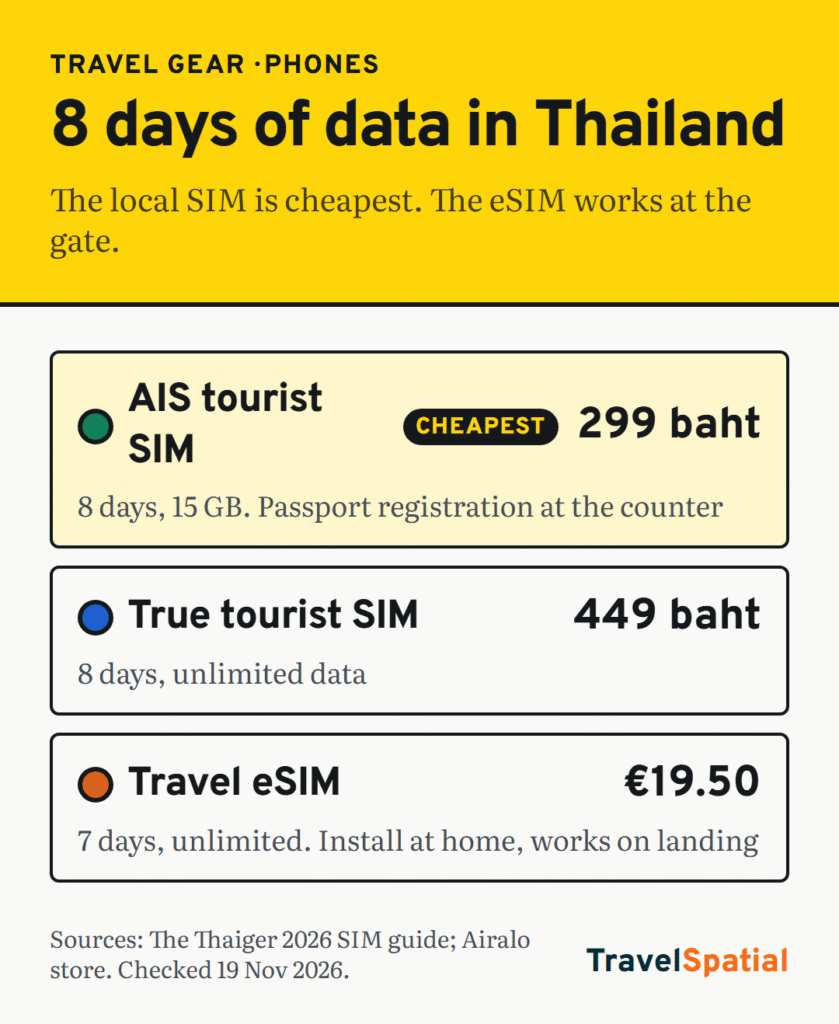
The local SIM wins on price, by a long way. An AIS tourist SIM with 15 GB for eight days costs 299 baht, about a third of the cheapest week-long unlimited eSIM. True’s unlimited eight-day SIM, at 449 baht, still costs less than the eSIM.
The catch: you have to buy it on arrival. Thai law requires passport registration for every SIM, and The Thaiger says registration at the counter takes 10 to 30 minutes. After a long flight, alone, at night, that’s half an hour in a queue before you can call a ride.
Our pick: if you land in the daytime, buy the local SIM at the airport. If you land late, or want a car booked before you reach the exit, an eSIM installed at home is worth paying more for.
Trip 2: two weeks in Japan
Here the choice is mostly between a travel eSIM (€45 for 15 days of unlimited data on Airalo) and roaming on your own plan. Check your provider’s price for Japan. Some home plans include roaming in Japan, many charge a daily pass, and a few charge per megabyte, which is the expensive one.
Our pick: if your home plan doesn’t include Japan, take the eSIM. You’ll use data constantly for train times and maps, and you’ll arrive at a big airport with no queue to join.
Trip 3: three weeks across Europe
This trip depends on where your SIM comes from.
- EU or EEA SIM: under “roam like at home”, your calls, texts and data cost the same as at home in every EU country, plus Iceland, Liechtenstein, Norway, Moldova and Ukraine (Your Europe). Providers can apply a “fair use” limit on data, and they can query long stays if you spend more time abroad than at home. For a three-week trip you need nothing else.
- Non-EU SIM: a regional eSIM covers several countries on one plan. Airalo’s Europe plan covers 41 countries, at €45.50 for 15 days or €66 for 30 days. For three weeks, buy the 30-day plan. That’s still one purchase, compared with a new local SIM at every border.
Watch out for the UK and Switzerland. Neither is in the EU, so an EU SIM’s roam-like-at-home rule doesn’t automatically cover them. Check your plan before you cross.
The factors that matter more when you’re alone
Price isn’t everything. These four points can change the answer.
1. Data at the arrivals gate. A ride-hailing app, a map to your bed and a message home all need data in the first five minutes. An eSIM you installed at home gives you that. A local SIM gives you that after a queue. That’s the reason our airport-to-bed checklist puts phone setup a day before you fly.
2. A local phone number. Most travel eSIMs are data only. A local SIM usually comes with a local number, which helps with taxis, restaurant bookings and hostels that text you a door code.
3. Your home SIM for security texts. Banks often send one-time codes by SMS. On a dual-SIM phone you can keep your home line on for texts and use the eSIM for data. Just turn data roaming off on the home line so it doesn’t run up charges.
4. Is your phone locked? A phone locked to your provider won’t accept another provider’s SIM or eSIM. On an iPhone, go to Settings > General > About. If it says “No SIM Restrictions” next to Carrier Lock, it’s unlocked (Apple Support). Android phones show this in a similar menu. Check before you leave. Unlocking can take days.
Quick decision table
| Your trip | Best choice |
|---|---|
| One country, a week or more, arriving in daylight | Local tourist SIM |
| Arriving late at night, or alone in an unfamiliar airport | eSIM installed at home (you can add a local SIM later) |
| Several countries in one region | Regional eSIM, or your EU SIM inside the EU |
| A short trip and your plan includes the country | Roaming |
| A long stay (a month or more) in one place | Local SIM with a monthly top-up |
The bottom line
On price, the order is usually local SIM, then eSIM, then roaming. Eight days in Thailand cost 299 baht on an AIS tourist SIM, compared with €19.50 for a week on an unlimited eSIM. On convenience, the order flips. For solo travellers, especially anyone landing at night, an eSIM that works at the gate is often worth the difference. Inside the EU, an EU SIM needs nothing extra. Whatever you choose, check that your phone is unlocked before you leave, and keep your home line on for bank codes.
Planning the rest of your arrival? See our first solo trip checklist, and our guide to avoiding travel money fees for the other bill that grows when you travel.
Get price checks like this one in the TravelSpatial newsletter.
Sources
- Airalo, Thailand eSIM, Japan eSIM and Europe eSIM (prices in EUR, checked 19 November 2026)
- The Thaiger, Best SIM cards to stay connected in Thailand (2026) (updated March 2026)
- Your Europe, Mobile roaming costs (last checked by the EU 7 January 2026)
- Apple Support, Use eSIM while traveling internationally with your iPhone (checked November 2026)
Photo credits
- Olkhon Island, GPS navigation, Smartphone, Lake Baikal, Russia by Vyacheslav Argenberg, CC BY 4.0, via Wikimedia Commons
- Formats de cartes SIM by Bidouille82, CC BY-SA 3.0, via Wikimedia Commons
The infographic is original to TravelSpatial. Photos are used under the licences linked above.

1 comment on “eSIM, Local SIM or Roaming? A Solo Traveller’s Data Plan, Costed for 3 Trips”