It’s the morning you leave. Your bag is by the door, and there’s a question most packing lists never ask: can you manage all of this on your own? Can you lift it into an overhead bin, carry it up three flights of hostel stairs, and keep an eye on it while you find a toilet at the airport?
That’s the difference with a solo travel packing list. On a first solo trip, nobody holds your bag, nobody lends you a charger, and nobody else carries the backup card. So this list follows one travel day from your front door to your first full day abroad. At each stage, it tests your bag against one question: what happens if something goes wrong and you’re on your own?
The full checklist is at the end. Read the story first. It explains why each item is on the list.
7:00 a.m. Your front door: the lift test
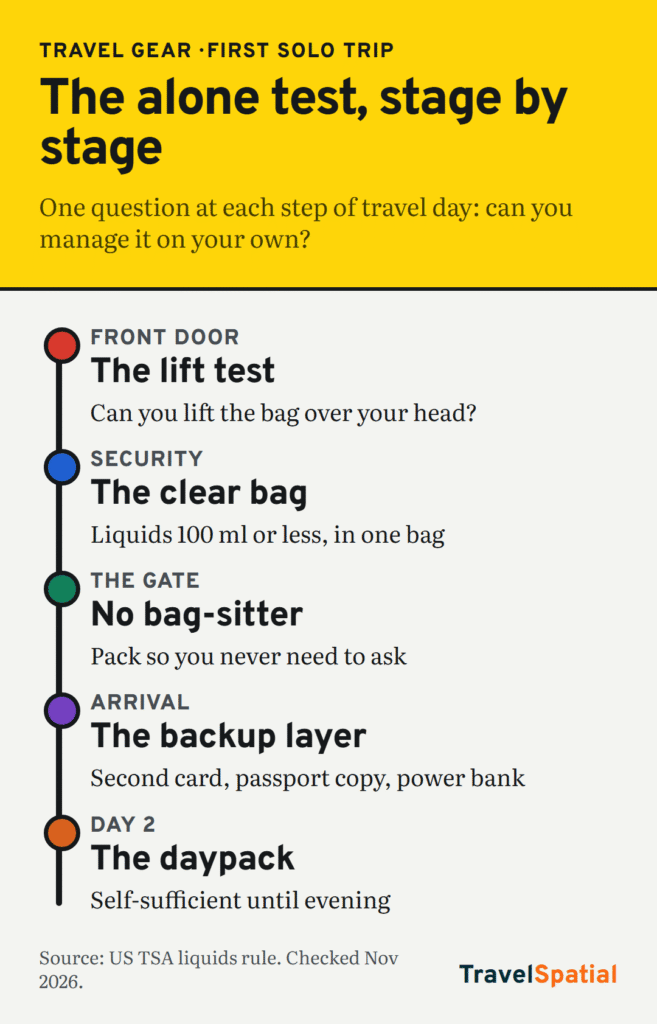
Before you zip anything, pick up the full bag and lift it over your head. That’s the overhead bin. If you can’t do it comfortably, take something out. Most first-time packers overpack shoes and “just in case” clothes. A good rule: wear your bulkiest shoes, pack one lighter pair, and pack clothes for about a week, then do laundry.
What goes in: one main bag you can carry for 20 minutes without stopping, plus a daypack. Our guide to backpack sizes helps if you’re choosing one. For a cabin-only trip, see the carry-on packing layout.
The alone test: you’ll be the one carrying it up the stairs and onto the train.
9:30 a.m. Airport security: the clear bag
At security, your liquids go in one bag. The US TSA rule is a quart-sized bag with containers of 3.4 oz (100 ml) or less (TSA). Many other airports use a similar limit. Pack that bag last so it sits on top.
What goes in: a clear zip bag of travel-size toiletries, prescriptions in their original packaging, and a pen for arrival forms.
The alone test: you’ll go through the scanner with nobody behind you to watch your things. Keep your passport and phone in one zipped pocket until the tray comes out.
11:00 a.m. At the gate, alone
Here’s a small problem that only solo travellers have: you need the toilet, and there’s nobody to watch your bag. Pack so that you can take everything with you easily. A main bag with a waist belt, and a daypack you can wear on your front, means you can go anywhere in the terminal without leaving anything behind.
What goes in: a refillable water bottle (empty through security), a power bank in your hand luggage, a charging cable, and earbuds.
The alone test: nobody will say “I’ll watch your stuff.” Pack so you never need to ask.
6:00 p.m. You land: the backup layer

You land and switch on your phone. This is when a solo traveller’s packing matters most. If a card is declined, a phone dies or a passport goes missing, you’re the only backup there is. So pack a second copy of everything important, and keep it in a different place from the first.
| Item | Main copy | Backup, stored separately |
|---|---|---|
| Money | Everyday card in your wallet | A second card from a different bank, plus some emergency cash, in your main bag |
| Passport | On you | A photo of the data page offline on your phone, and a paper copy |
| Phone | Charged, with data ready | A power bank, and important numbers written on paper |
| Directions to your bed | Offline map on your phone | The address written down, in the local script if it’s different |
Data from the moment you land is the best safety tool you’ll have. Sort out an eSIM or roaming before you leave. Our airport-to-bed checklist covers the rest of your arrival.
The alone test: if your only card fails at the airport ATM, there’s nobody to borrow from. That’s why the second card exists.
10:00 p.m. Your first night
You’re in your room. A few small things make the first night easier: earplugs and an eye mask for unfamiliar noise and light, a small torch or headlamp for finding the bathroom, and a door wedge if you like an extra layer on a guesthouse door. If you’re in a dorm, you need a padlock for the locker.
The alone test: if something wakes you at 2 a.m., you’re the one who deals with it. Small comforts help you sleep, and a good night’s sleep helps you make good decisions the next day.
Day 2: the daypack you’ll carry every day
Your day bag carries everything you need to be self-sufficient until evening: water, a power bank, a light rain layer or scarf, a basic first-aid pouch (plasters, painkillers, rehydration salts, your own medicines), hand sanitiser, the day’s cash and one card. The backup card stays behind.
The alone test: blisters and headaches happen to everyone. Solo, you’ll want the fix in your own bag.
What you don’t need to buy
First solo trips tempt people into buying a whole new kit. You probably don’t need to. Pack what you own, buy the two or three things you’re missing (often a padlock, a power bank and a packing cube), and buy anything else you forgot when you get there. Most cities sell toiletries, chargers and clothes. If money’s tight, our first solo trip budget guide shows where it’s better spent.
The checklist
Bags: main bag you can lift overhead · daypack · packing cubes · a padlock
Documents and money: passport · a photo and a paper copy of the data page · two cards from two banks · emergency cash in a separate place · insurance details · accommodation addresses on paper
Tech: phone with an eSIM or roaming sorted · power bank (in your hand luggage) · charging cable · universal adapter · earbuds · offline maps downloaded
Health: prescriptions in original packaging · a small first-aid pouch · hand sanitiser · sun cream
Toiletries: a clear bag of travel sizes (100 ml or less each)
Sleep: earplugs · eye mask · small torch or headlamp
Clothes: about a week’s worth that mixes and matches · one warm layer · one light rain layer · comfortable walking shoes worn on the plane · one lighter pair · flip-flops
Before you zip it up
Pack a bag you can lift over your head. Put a second copy of every important thing (a card, your passport details, power) in a different place from the first. Carry a daypack that keeps you self-sufficient until evening. That’s what a solo packing list adds to any other one: backups, and a bag that one person can manage. For the jobs to do before you leave, from vaccines to sharing your itinerary, follow our first solo trip checklist.
Get our printable packing lists in the TravelSpatial newsletter.
Sources
- US Transportation Security Administration, liquids rule (checked November 2026)
Photo credits
- Entry side of the Departure Hall at Bergen Airport, Flesland by Odd Roar Aalborg, CC BY-SA 4.0, via Wikimedia Commons
- Helsinki-Vantaa main entrance and departures hall by kallerna, CC BY-SA 4.0, via Wikimedia Commons
The infographic is original to TravelSpatial. Photos are used under the licences linked above.