


Every time you put a foreign card into a Thai ATM, the machine charges you a flat fee. Usually 220 baht. Sometimes up to 250 baht. Do that every second day for three weeks and you’ve paid for a night in a beach bungalow just to get at your own money.
You can’t make the fee disappear. You can make it much smaller. Here are five things the ATM screen won’t tell you.
The fix, in one line: Thai banks charge foreign cards about 220 to 250 baht per withdrawal, whatever the amount (The Longest Way Home, updated March 2026). So withdraw less often and take out more each time, always choose baht when the screen offers your home currency, and use a home card that doesn’t add its own fees on top.
1. The fee is per withdrawal, not per baht
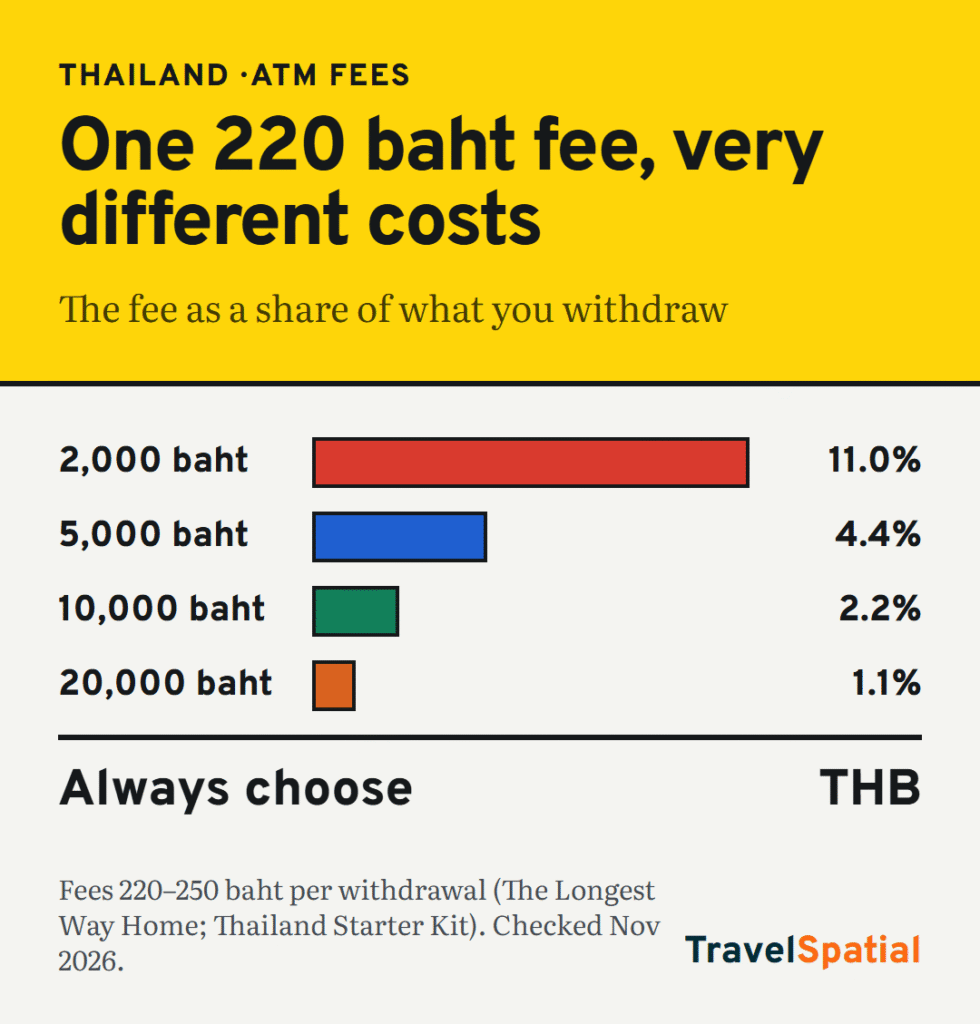
This is the whole game. A 220-baht fee on a 2,000-baht withdrawal is 11%. The same fee on 20,000 baht is just over 1%.
| You withdraw | Fee | Fee as a share |
|---|---|---|
| 2,000 baht | 220 baht | 11.0% |
| 5,000 baht | 220 baht | 4.4% |
| 10,000 baht | 220 baht | 2.2% |
| 20,000 baht | 220 baht | 1.1% |
Same fee, same machine. The only thing that changed is how much you took out.
Our tip: decide how much cash you’ll need for the next week, and take it out in one go. Then split it: some in your wallet, the rest locked in your bag or hostel locker.
2. Not every bank charges the same, and limits differ
Fees and per-withdrawal limits vary by bank. One travel guide, updated in March 2026, lists these:
| Bank | Fee per withdrawal (foreign card) | Maximum per withdrawal |
|---|---|---|
| AEON | 150 baht | 20,000 baht |
| Krungsri | 220–250 baht | 30,000 baht |
| Bangkok Bank | 220–250 baht | 25,000 baht |
| SCB | 220–250 baht | 20,000 baht |
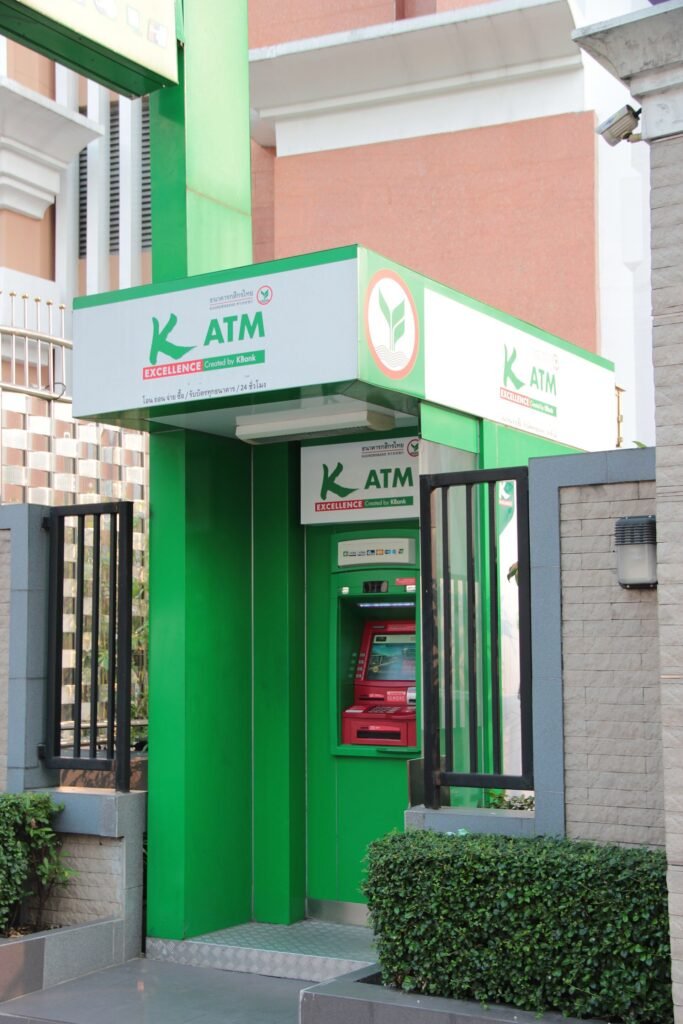
| Kasikorn (KBank) | 220–250 baht | 20,000 baht |
Source: The Longest Way Home (updated 15 March 2026). We couldn’t load the banks’ own fee pages to confirm these, so treat them as a guide and read the fee on the screen before you press confirm. Every Thai ATM shows it.
A higher per-withdrawal limit means fewer fees. Krungsri’s yellow machines are worth looking for if you need a lot of cash at once. The same guide says AEON machines, with the lowest fee, are mostly in supermarkets and malls such as Big C and Lotus’s.
3. “Would you like to be charged in your home currency?” No.
After the fee screen, many machines offer to convert the withdrawal into your home currency on the spot. It sounds helpful. It isn’t. This is called dynamic currency conversion, and the rate it uses is set by the ATM’s bank.
Thailand Starter Kit’s 2026 guide says to always choose baht, and warns that the home-currency option can add 5% or more on top of the normal fees (Thailand Starter Kit, checked November 2026). Pick THB, or “without conversion”, every time. Your own card then does the conversion, usually at a far better rate.
The same trap waits at shop card terminals and hotel desks. Our guide to avoiding travel money fees explains it in more detail.
4. Your own bank may charge you twice
The 220 baht is the Thai bank’s fee. Your home bank can add its own on top: a foreign transaction fee (often a percentage) and sometimes a fixed cash-withdrawal fee.
So the real cost of one withdrawal is:
Thai ATM fee + your bank’s foreign fee + your bank’s cash fee + the exchange rate margin
Some travel cards and app accounts charge nothing extra up to a monthly limit, and a few refund ATM fees. Check your own card’s terms before you go, not at the machine. If you’re choosing a card for the trip, our eSIM, local SIM or roaming guide is a good companion read: it costs out the other “small” fee that adds up on a Thai trip.
5. You need less cash than you think
Thailand is still a cash country for street food, songthaews, small guesthouses and markets. But cards and QR payments work in malls, chain shops, most hotels and many restaurants in the cities. Pay by card wherever it’s accepted, and save your cash for the places where it isn’t.
That cuts the number of trips to the ATM, which is the only thing that really cuts the fee.
What three weeks of cash really costs
Say you need 30,000 baht in cash over a three-week trip. Here’s what the Thai ATM fee alone adds up to, depending on how you withdraw it:
| How you withdraw | Withdrawals | Thai ATM fees |
|---|---|---|
| 3,000 baht every other day | 10 | 2,200 baht |
| 10,000 baht once a week | 3 | 660 baht |
| 15,000 baht twice | 2 | 440 baht |
That’s a difference of 1,760 baht between the first and last rows, on fees alone. Our 3-week Thailand backpacking route shows where on the route you’re most likely to need cash.
Before you go: the 5-minute checklist
- Find out what your home bank charges for foreign ATM withdrawals and foreign card payments.
- Pack two cards from different banks, kept in different places.
- Tell your bank you’re travelling if it asks you to.
- Bring some US dollars or euros as an emergency reserve. Exchange counters in Thai cities change them easily.
- Note the lost-card number for each card on paper.
Bottom line for your Thai cash
The Thai ATM fee is about 220 to 250 baht a go, so the fewer withdrawals you make, the less you pay. Take out a week’s cash at a time, choose baht rather than your home currency, check what your own bank adds, and pay by card where you can. For a full daily budget, see Southeast Asia solo on a budget.
Get our money tips before your next trip. Sign up for the TravelSpatial newsletter.
Sources
- The Longest Way Home, Money in Thailand: ATMs, credit cards and fees (updated 15 March 2026)
- Thailand Starter Kit, Currency exchange in Thailand 2026 (checked November 2026)
- Thailand Starter Kit, How to avoid ATM fees in Thailand (November 2026)
Photo credits
- ATM machines in Siam Paragon by Chainwit., CC BY-SA 4.0, via Wikimedia Commons
- ATM – Kasikornbank by GuillaumeG, CC BY-SA 3.0, via Wikimedia Commons
The infographic is original to TravelSpatial. Photos are used under the licences linked above.

1 comment on “Thailand ATM Fees in 2026: Five Things the Screen Won’t Tell You”