Argentina is the only country most travellers visit where “what’s the exchange rate?” has several right answers. That sounds like a headache. Once you know what the rates are and which one you’re being given, it becomes a way to save money.
This is a plain-English explainer. We’ll start with the vocabulary, then go through each way of paying.
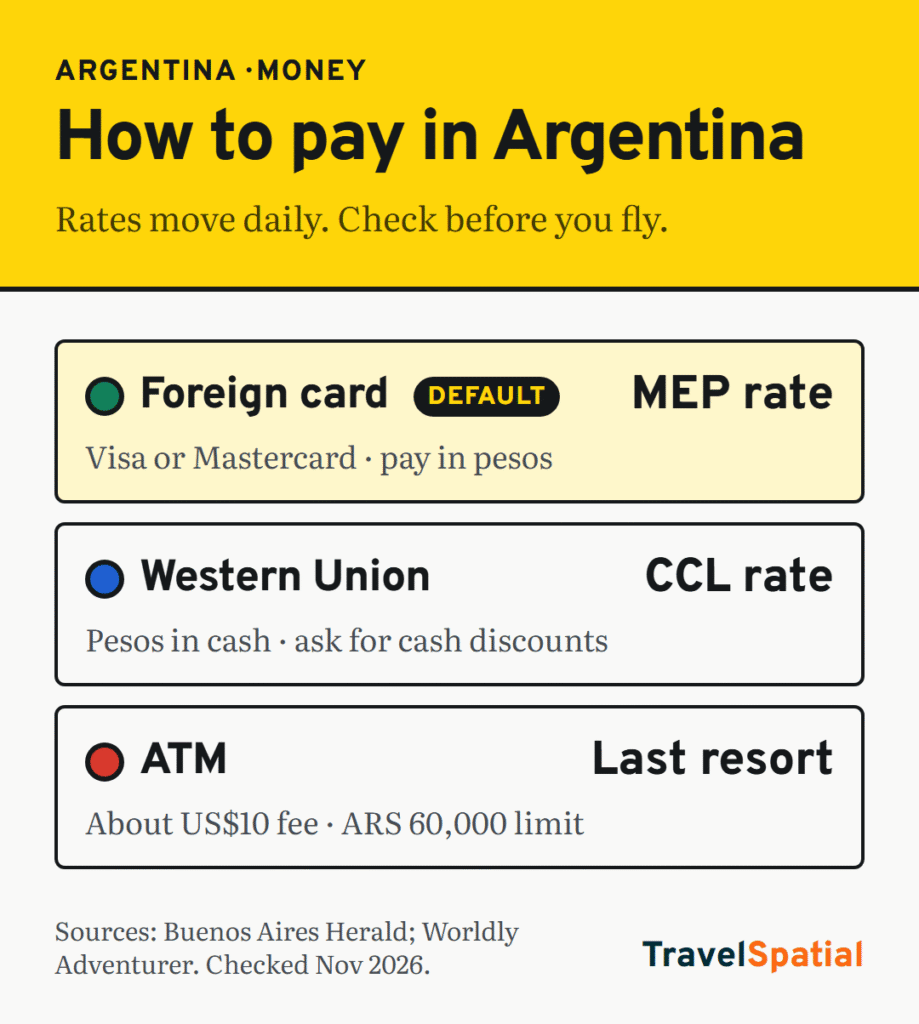
In brief (checked November 2026): pay by foreign Visa or Mastercard for most things, because card payments are converted at the favourable MEP rate. Use Western Union to get pesos in cash, because it pays at a similar or slightly better rate. Avoid ATMs, which charge high fees for small withdrawals. And carry some pesos, because many places give a cash discount.
Argentina’s rates move every day and policy changes often. Treat every figure below as a snapshot and check a live source before you travel.
First, the vocabulary
| Term | What it means for you |
|---|---|
| Official rate (oficial, wholesale) | The rate banks trade at. The one you see on most currency apps |
| MEP rate (dólar MEP, “bolsa”) | A market rate set through bond trading. Foreign card purchases are converted at about this rate |
| CCL rate (contado con liquidación) | Another market rate, through shares traded abroad. Western Union pays about this rate |
| Blue dollar (dólar blue) | The informal street rate for cash US dollars. Not something we recommend chasing |
The gap between these rates is the whole story. On 18 November 2026, the Buenos Aires Herald reported the CCL dollar at AR$1,716 and the wholesale (official) dollar at AR$1,559, a gap of about 10% (Buenos Aires Herald). The Herald said the gap was at its widest since late 2025.
In practice: a way of paying that uses the MEP or CCL rate gives you more pesos for your dollar or euro than one that uses the official rate.
Paying by card: the easy default
Since late 2022, foreign Visa and Mastercard purchases have been converted at a special rate for tourists, close to the MEP rate. The Buenos Aires Herald’s explainer (updated April 2024) said the arrangement was still in force, and that it applies to purchases only, not cash machine withdrawals.
Worldly Adventurer’s guide, updated on 11 November 2026, still says Visa and Mastercard get the MEP rate (Worldly Adventurer).
Two details to know:
- Mastercard may correct later. The Herald reported that Mastercard initially charges at the official rate and refunds the difference afterwards. Don’t panic if the first figure in your banking app looks high.
- Your own bank’s fee still applies. Worldly Adventurer notes foreign-transaction fees of 1 to 3% on many cards. A card with no foreign fee makes the card route even better. Our guide to avoiding travel money fees explains what to look for.
Always pay in pesos when the terminal asks. Choosing your home currency lets the shop’s bank set the rate, which defeats the point.
Cash from Western Union: the best way to get pesos
You’ll still want pesos for buses, small cafés, markets and tips, and to collect cash discounts. Worldly Adventurer recommends sending yourself money through Western Union and collecting pesos at an agent. Its figures, as of November 2026:
- Transfers pay about the CCL rate, slightly higher than MEP
- A fee of about US$25 on a US$500 transfer
- Transfers of up to about US$3,000 a month
Western Union Argentina confirms that operations are made in Argentine pesos (Western Union Argentina). You’ll need your passport and the transfer’s tracking number to collect.
Our tip: send yourself a larger amount once rather than several small transfers, so the fee is a smaller share. Then keep the cash split between your wallet and a locked bag.
ATMs: a last resort
Worldly Adventurer is direct: don’t withdraw pesos at ATMs. It reports fees of around US$10 per withdrawal and a limit of ARS 60,000 per withdrawal. At the Herald’s official rate of AR$1,559, that’s under US$40 per withdrawal, so the fee can be a quarter of the cash.
Keep an ATM card for emergencies, not as your main plan.
US dollars in cash: useful backup, not the main plan
Some travellers bring clean US$50 and US$100 notes to change. You can, but it’s more to carry and lose, and changing on the street means dealing with the informal market. With card payments and Western Union both getting favourable rates, carrying large amounts of cash isn’t necessary for most trips.
If you do bring cash, bring a modest emergency reserve, and keep it separate from your wallet and cards. Travelling alone, that split is your safety net if a wallet goes missing.
Cash discounts: why you want some pesos anyway
Many restaurants, guesthouses and shops offer a lower price for cash, because they avoid card fees. Worldly Adventurer puts the saving at 10 to 30%, though not everywhere offers it. Ask before you pay: “¿Hay descuento en efectivo?” (“Is there a cash discount?”).
That’s why the best plan is a mix: card for big bills, pesos from Western Union for the places that reward cash.
Which to use, and when
| Paying for | Best option | Why |
|---|---|---|
| Hotels, flights, tours, restaurants that take cards | Foreign Visa or Mastercard | MEP rate, no cash to carry |
| Places offering a cash discount | Pesos from Western Union | CCL rate plus the discount |
| Buses, kiosks, markets, tips | Pesos | Cash-only or easier in cash |
| Emergencies | ATM card or US dollar reserve | Expensive but reliable |
A worked example: two weeks alone
Say you’ll spend the equivalent of US$1,000 in Argentina over two weeks. Put about US$700 on a no-foreign-fee card for accommodation, long-distance buses, tours and bigger meals. Send yourself US$300 once through Western Union for cash. Worldly Adventurer quotes about US$25 in fees on US$500, so expect a fee in that region or a little less. Skip the ATMs.
Compare that with withdrawing US$300 in pesos at ATMs: at ARS 60,000 a go, that’s around eight withdrawals at about US$10 each, or roughly US$80 in ATM fees alone. Our South America backpacking budget has the daily figures for Argentina and its neighbours.
Before you go
- Get a card with no foreign-transaction fee if you can. Bring a backup card on a different network.
- Set up Western Union in its app and link your card before you leave.
- Check the day’s MEP, CCL and official rates. The Buenos Aires Herald’s economics pages are a good, English-language start.
- Learn the cash-discount phrase.
- Keep receipts from card payments, so you can check which rate you got.
If you remember three things
In Argentina, pay by foreign card for most things, because purchases convert at about the MEP rate. Get pesos from Western Union, which pays around the CCL rate, and use them where there’s a cash discount. Avoid ATMs. Always pay in pesos at the terminal. And check the rates again before you fly, because in Argentina they don’t stand still. If you’re heading to Buenos Aires, our guide to the ferry day trip to Colonia del Sacramento is a good first outing.
Rates change fast. Get our updates: sign up for the TravelSpatial newsletter.
Sources
- Buenos Aires Herald, Widening dollar gap signals growing economic pressures for Milei (18 November 2026)
- Buenos Aires Herald, Foreign tourist dollar: everything you need to know (updated April 2024)
- Worldly Adventurer, Money in Argentina (updated 11 November 2026)
- Western Union Argentina (checked November 2026)
Photo credits
- Buenos Aires-Avenida de Mayo y Perú by Roberto Fiadone, CC BY 4.0, via Wikimedia Commons
- Buenos Aires – La Boca – Caminito – 200807i by Luis Argerich from Buenos Aires, Argentina, CC BY 2.0, via Wikimedia Commons
The infographic is original to TravelSpatial. Photos are used under the licences linked above.