Let’s be honest about something most nomad guides skip: it can get lonely.
Not lonely in the backpacker sense, where you’re surrounded by people in a dorm and still feel far from home. Lonely in a quieter, more modern way. You work all day from a flat, cook dinner in it, scroll in bed, and realise on Thursday that the only person you’ve spoken to since Monday was the cashier. You’re not doing it wrong. You’re just living alone in a new place, which is hard anywhere.
You’re also in large company. In 2025 the World Health Organization’s Commission on Social Connection found that about one in six people worldwide is affected by loneliness (WHO). Moving cities every month doesn’t cause that, but it doesn’t help either.
So, how do you make friends as a digital nomad? Not with one trick. With a few habits that turn strangers into people you see twice. Here they are.
Why it’s harder than meeting people on a trip
On a short trip, you meet people because everyone’s free. Dorms, tours and hostel bars are full of people with nothing to do tonight. As a nomad, you have a job. You’re busy at 11am on a Wednesday, and so is everyone you’d click with.
The other difference is time. A friendship needs repetition: you meet someone, you see them again, you see them a third time and now you’re friends. On a two-night stop that never happens. On a month-long stay, it can, but only if you go to the same places at the same times.
That’s the whole secret, really. Repetition beats intensity. One big night out gives you a story. Eight Tuesday mornings at the same running club give you a friend.
(If you’re on a shorter trip and just want company tonight, our guide to meeting people travelling solo without a dorm has quicker options.)
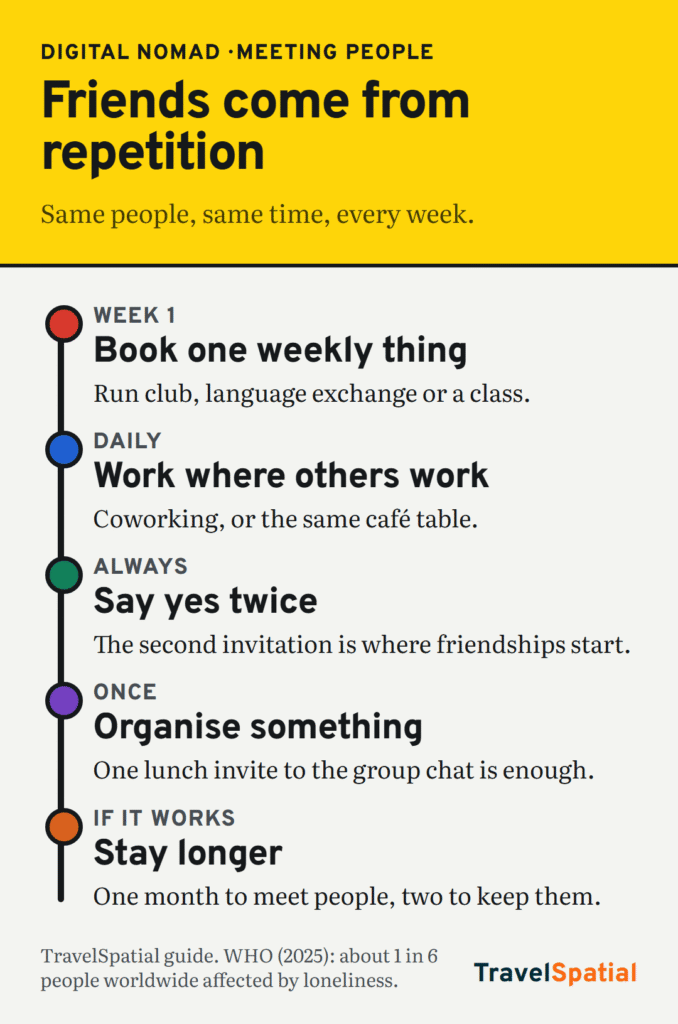
Rule 1: Pick one weekly thing in your first week
Not five. One. A weekly language exchange, a climbing gym’s social night, a run club, a pottery class, a pub quiz. Book it before you’ve unpacked.
Why first week? Because week three is when the loneliness tends to arrive, and you want your weekly thing to already feel normal by then. Nomad meetups and run clubs are now common enough that searching “[city] digital nomad” alongside the activity usually turns something up.
Rule 2: Work where other people work
A home desk is cheap and quiet, and that’s the problem. A coworking space gives you the same faces every day without anyone having to make an effort. Most run events: lunches, talks, Friday drinks. Go to the first one even if you’d rather not.
If coworking doesn’t fit your budget, pick one café and become a regular. Same table, same time, a few days a week. Staff will learn your name before customers do, and that counts.
Rule 3: Say yes to the second invitation
The first invitation is easy to accept because you’re curious. The second one is where friendships are made or lost: the follow-up coffee, the “a few of us are going to the market on Sunday”. Say yes even when you’re tired. Especially when you’re tired.
Rule 4: Be the one who organises, once
Most people in a nomad group chat are waiting for someone else to suggest something. Be that person once. “Anyone fancy lunch at the place on the corner on Thursday?” is enough. If two people come, that’s a win. You now know two people.
Rule 5: Live with people, at least sometimes
Coliving exists for exactly this problem: shared kitchens, a shared workspace and dinners that happen without anyone planning them. It suits the first few weeks in a new city best, when you need people more than privacy. Once you know someone, a flat on your own feels a lot less lonely.
Rule 6: Don’t only make nomad friends
Other nomads understand your life, but they leave. Locals stay. Language exchanges are one of the few events designed for both groups at once. Even with beginner Spanish, Thai or Georgian, you’ll get more out of a city when someone who lives there tells you where they eat.
Rule 7: Stay longer than feels necessary
One month is enough to meet people. Two months is enough to keep them. If you’ve found a city where you have a weekly thing and a few names in your phone, consider staying. The rest of the world will still be there.

When it’s not just loneliness
Feeling low for a few days is part of living somewhere new. Feeling low for weeks, sleeping badly and losing interest in things you usually enjoy is different. Call someone at home. Some travel and nomad health insurance plans include telemedicine or mental-health support. Check what yours covers before you need it: our nomad insurance guide explains what to look for.
A quick note on dating apps
Dating apps are a real way to meet people abroad. They’re also used by criminals in some places to target foreigners travelling alone, and the UK Foreign Office warns about this in several countries, including Colombia (see our Medellín guide). Meet in public, tell someone where you’re going, and watch your drink. That’s standard advice anywhere, not a reason to stay home.
If you remember one thing
Friendship as a nomad comes from repetition, not luck. Book one weekly activity in your first week, work where other people work, accept second invitations, organise one thing yourself, try coliving early on, make local friends as well as nomad ones, and stay long enough for it all to add up. A lot of nomad loneliness can be fixed with a calendar.
Still choosing a base? Our seven nomad-friendly cities all have strong communities. And if you’re not sure which hours you’ll be free, check the time-zone map for remote work first. A city where you work until midnight is a hard place to make friends.
Want more like this? Sign up for the TravelSpatial newsletter below.
Sources
- World Health Organization: Social connection linked to improved health and reduced risk of early death (30 June 2025)
- UK FCDO foreign travel advice: country pages include warnings about dating-app crime (for example Colombia), checked November 2026
Photo credits
- Ho Chi Minh City, Nguyen Hue Street, 2020-01 CN-04 by Steffen Schmitz (more photos), CC BY-SA 4.0, via Wikimedia Commons
- Vake Park, Tbilisi City, Georgia Country, autumn Season 07 by Mostafameraji, CC0, via Wikimedia Commons
The infographic is original to TravelSpatial. Photos are used under the licences linked above.