


Three people land in three cities with the same question: where do I sleep for the next 30 nights? One books a coliving room, one books a monthly Airbnb, and one rents from a local agency. None of them is wrong. Each of them is right for a different month.
That’s the honest answer to coliving vs Airbnb for digital nomads. Neither is always cheaper. What decides it is what the price includes, how much flexibility you’re buying, and whether you need people around you or a door you can close. Below are three case files that show when each option wins, followed by the cost stack and the booking rules that catch people out.
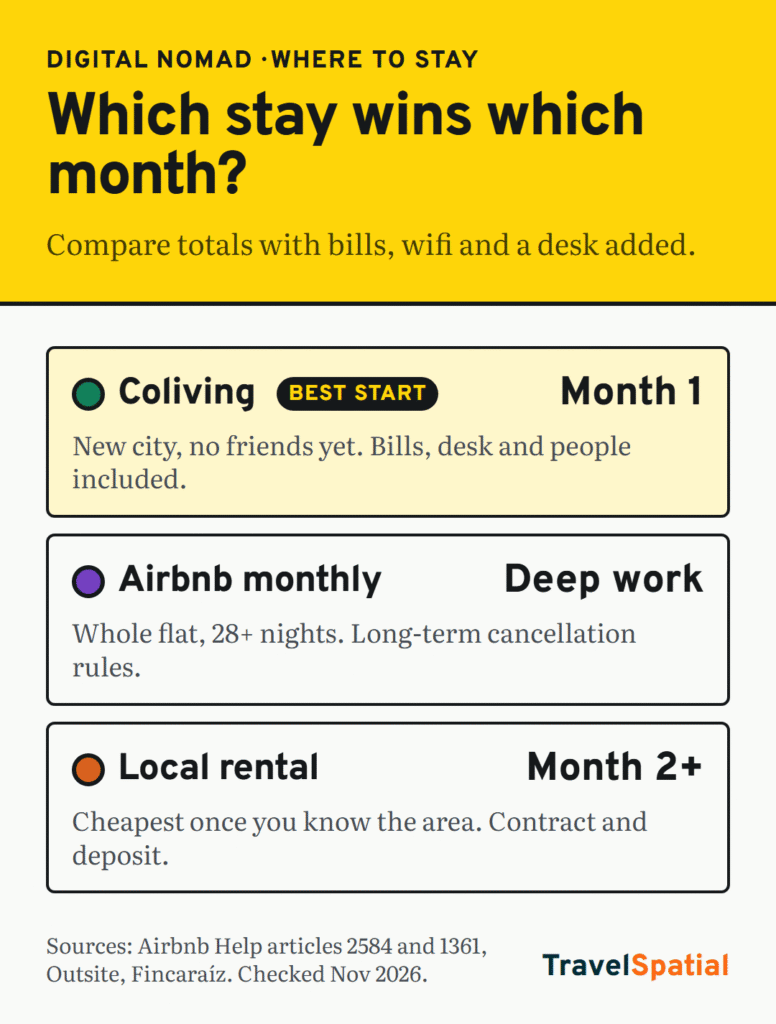
First, compare the same things
Before any case file, line the three options up on what you actually get:
| Coliving | Airbnb monthly (28+ nights) | Local rental | |
|---|---|---|---|
| Usually included | Room, wifi, bills, cleaning, shared workspace, events | Whole flat or room, wifi, bills (check the listing) | The flat. Bills, wifi and furniture vary |
| Booking | Online, from a few nights | Online, monthly instalments | Viewings, contract, deposit |
| Flexibility | High | Medium (long-term cancellation rules) | Low (contract terms) |
| Community | Built in | None | None |
| Private space | Usually a bedroom only | A whole flat if you book one | A whole flat |
| Best for | Month one in a new city | A month of deep work | Month two onwards in a city you like |
The trap is comparing a coliving room price with an Airbnb price without adding everything else. A coliving price is meant to include your desk and bills. A flat often doesn’t include coworking at all.
Case file 1: The first month in a new city
The situation: you’ve never been to the city, you don’t know anyone, and you don’t know which neighbourhood suits you.
The verdict: coliving. You’re paying for two things a flat can’t give you: people from day one, and the chance to leave without losing much money if the area turns out to be wrong.
Prices depend heavily on the season and the operator. As one example, Outsite, a coliving chain, says stays run “from 3 nights to 3 months” and was advertising a Portugal winter offer of €700 for 28 nights (December 2026 to February 2027, 28-night minimum, book by 30 November) on its homepage when we checked in November 2026. Its deals and member discounts depend on a paid membership ($199 a year or $499 lifetime), so add that if you join just for one stay.
Compare that with Numbeo’s average for a central one-bedroom in Lisbon: about US$1,588 a month on a long-term lease (updated November 2026), before bills and before any coworking. In an expensive city, a coliving room in the off-season can undercut a flat outright.
Watch for: shared bathrooms, small desks, and “community” that turns out to be one chat group. Read reviews from people who stayed a month, not a weekend.
Case file 2: The second month in a city you like
The situation: you’ve spent a few weeks somewhere, you know which streets you like, and you want to stay another one to three months.
The verdict: a local rental, if you can manage the paperwork, or a monthly Airbnb booked directly for the area you now know.
This is where local platforms make the biggest difference. In Medellín, for example, a furnished one-bedroom in El Poblado was listed at COP 4,700,000 a month on Fincaraíz, while two-bedroom flats in Laureles started around COP 2,100,000 (unfurnished, first page of results, November 2026). These are asking prices, not averages. Local listings are often unfurnished and may want a guarantor or a longer contract.
Before you sign anything:
- Ask what’s included: internet, gas, building fees (administración in Colombia), cleaning.
- In Colombia, ask the property’s estrato (a 1–6 neighbourhood band). Medellín’s city hall says strata 1–3 get utility subsidies, strata 5 and 6 pay a contribution on top, and 4 pays the standard rate (Alcaldía de Medellín). A flat in a higher estrato costs more to run.
- Never send a deposit before seeing the flat, in person or on a live video call.
Case file 3: A month of deep work
The situation: you have a launch, an exam or a deadline. You need quiet, a proper desk and a door that closes.
The verdict: a whole-flat Airbnb on a monthly booking. Coliving’s social side becomes a distraction, and a local rental takes too long to set up.
Airbnb treats any reservation of 28 nights or more as a monthly stay. You “pay for your first month when you book, and the rest in monthly installments,” and listings “may offer monthly discounts” (Airbnb Help, article 2584, checked November 2026). To see those prices, search with dates at least 28 nights apart.
Watch for: the desk. Ask the host for a photo of the workspace and a recent speed-test screenshot before you book. A sofa and a coffee table aren’t an office.

The cancellation rules nobody reads
Here’s where monthly stays catch people out. On Airbnb, the long-term cancellation policy applies automatically to every reservation of 28 nights or more and “generally requires 30 days’ notice” (Airbnb, article 2584). Airbnb’s guest-cancellation page adds that your first payment “might be nonrefundable”, and if you cancel after the trip has started, “the following month of the reservation is nonrefundable” (Airbnb, article 1361).
In practice:
- Booking two months and leaving after one costs you money. Book one month, then extend if you like it.
- The 24-hour free cancellation window doesn’t apply. Airbnb says stays of 28 nights or more “have their own long-term cancellation policies” (article 4052).
- Moving your dates by one night can change the price, because 27 nights isn’t a monthly stay. Compare the final total for identical dates.
Coliving operators set their own terms, so read them. Local contracts can require notice of a month or more, and some keep the deposit if you leave early.
A quick decision guide
- New city, no friends, unsure of the area: coliving for the first two to four weeks. It’s also the easiest way to make friends as a nomad.
- Expensive city, off-season: check coliving deals first. They can beat a flat.
- Cheap city, staying put: a monthly Airbnb or a local flat usually wins on price.
- Need silence: a whole flat, whatever it costs.
- Staying three months or more: move to a local rental once you know the city.
If you’re still deciding between a hostel private room and a hotel for the first few nights, our solo traveller’s guide covers that step.
Which one, then?
Coliving tends to win your first month, when community and flexibility matter most, and in pricey cities during the off-season. A monthly Airbnb wins when you need privacy and fast setup. A local rental wins once you know the city and want to stay. Whichever you pick, compare totals that include bills, wifi and a desk, and book one month at a time until you’re sure. For how rent fits the rest of a month’s spending, see what a digital nomad really spends per month, and if it’s your first time, our first-month plan.
Want the next guide? Join the TravelSpatial newsletter below.
Sources
- Airbnb Help: Benefits of booking a monthly stay (article 2584), checked November 2026
- Airbnb Help: Monthly stay cancellations by guest (article 1361), checked November 2026
- Airbnb Help: article 4052 on the 24-hour cancellation window, checked November 2026
- Outsite homepage: stay lengths, Portugal 28-night offer and membership prices, checked November 2026
- Numbeo: Lisbon cost of living, updated 16 November 2026
- Fincaraíz: El Poblado rentals and Laureles rentals, checked November 2026
- Alcaldía de Medellín: which strata get subsidies and which contribute
Photo credits
- Plant in a coworking space (Unsplash) by Dan Gold danielcgold, CC0, via Wikimedia Commons
- Workspace with laptop, sandwich, and juice during afternoon in a cozy cafe setting by Shixart1985, CC BY 2.0, via Wikimedia Commons
The infographic is original to TravelSpatial. Photos are used under the licences linked above.



1 comment on “Coliving, Airbnb Monthly or a Local Rental? Three Case Files for Digital Nomads”