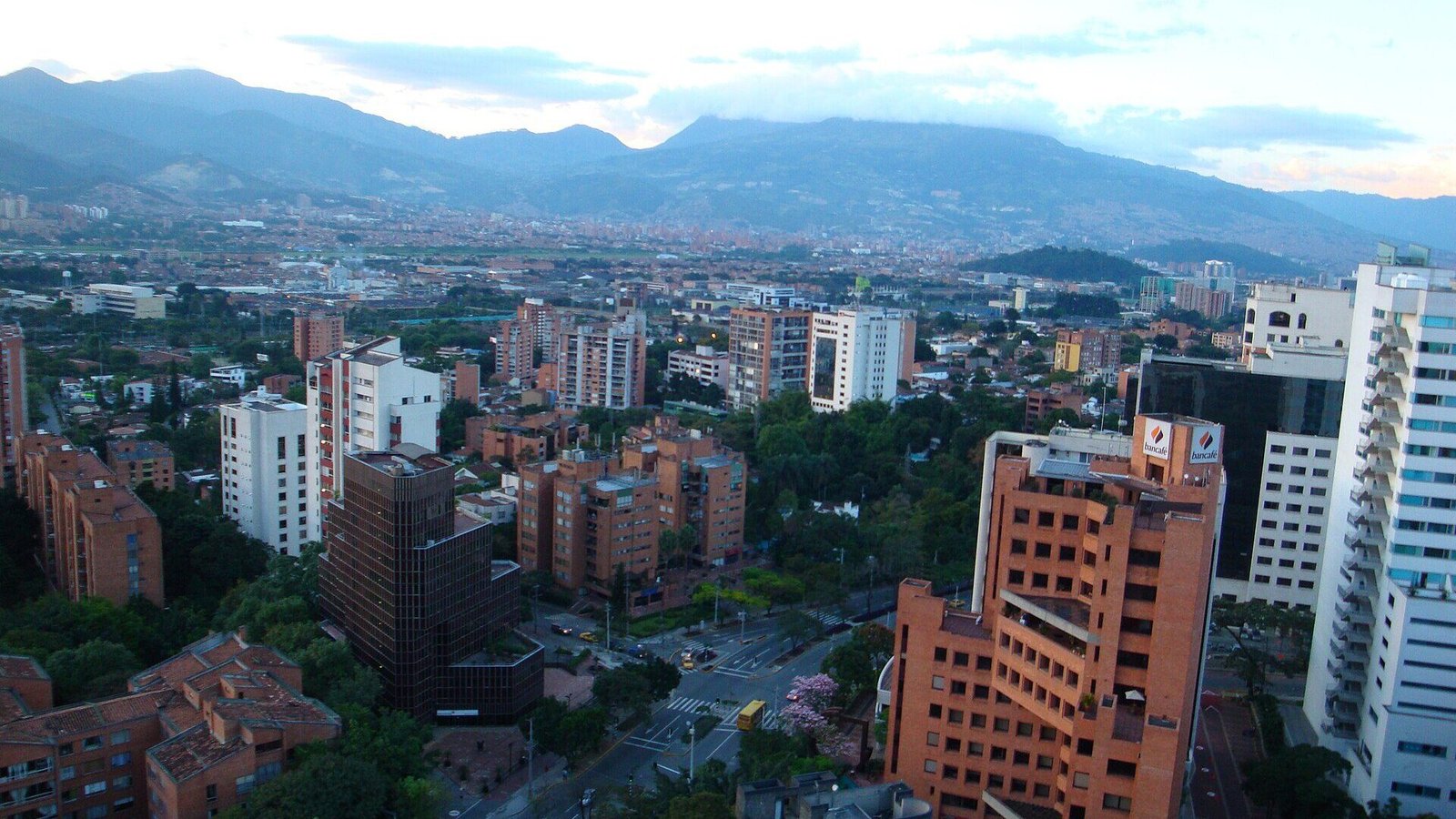
Medellín sits in the Aburrá Valley, its brick-red barrios climbing the slopes on both sides, the Metro running along the valley floor like a spine. Where you live along that spine shapes your month more than anything else: what you pay, how loud your nights are, who you meet and how far you walk for coffee.
For a month or more, three areas come up again and again: El Poblado, Laureles and Envigado. Here’s who each one suits, what the listings were asking in November 2026, and the paperwork and safety points to sort before you sign. Short answer: Laureles for most people staying a month, El Poblado if you want the nomad scene on your doorstep, and Envigado if you’d rather live like a local and pay less.
El Poblado: the scene, and the price
Hilly, green and busy, El Poblado is where most first-time visitors end up, and it has the most coworking spaces, cafés with good wifi, gyms and English spoken. The streets around Parque Lleras and Provenza are the nightlife centre. That’s great on a Friday. It’s less great when your bedroom faces the street on a Tuesday.
Who it suits: your first two weeks, if you want to meet other nomads fast, or if you value walkable everything over price.
Who should skip it: light sleepers, and anyone on a tight budget.
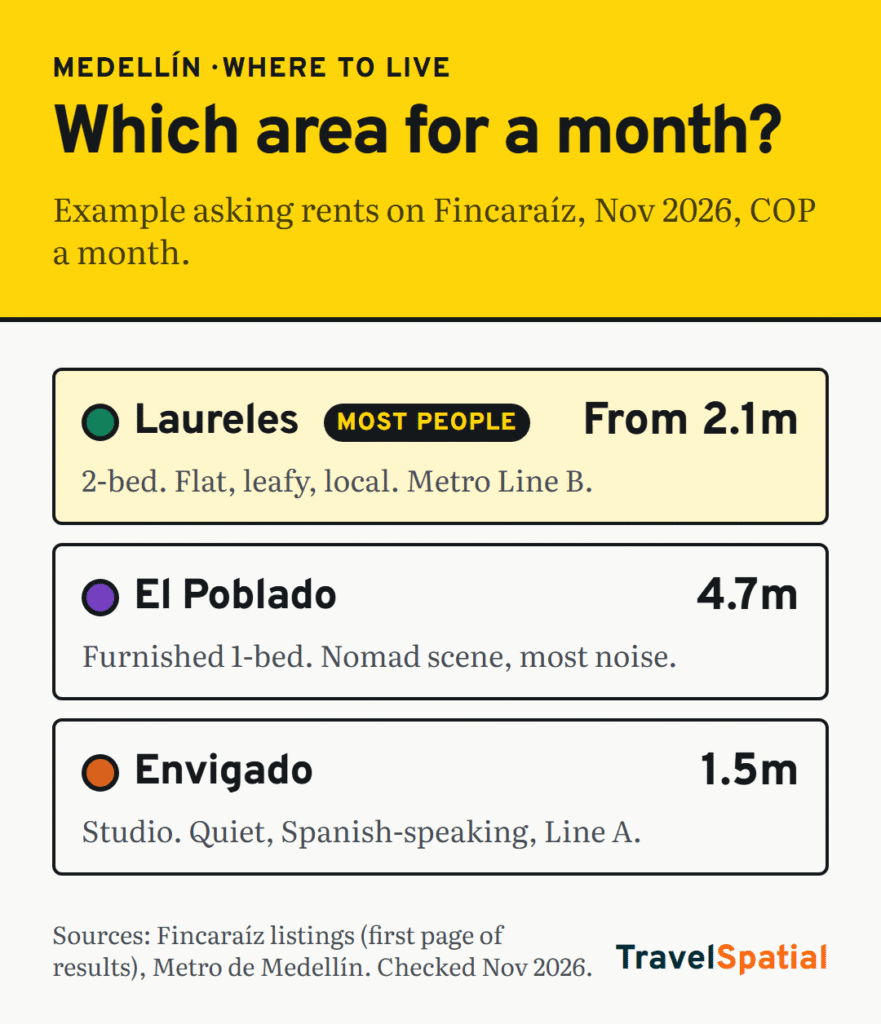
The rent signal: on Fincaraíz, a furnished 40 m² one-bedroom was listed at COP 4,700,000 a month and a furnished two-bedroom at COP 5,000,000 (first page of results, checked November 2026). Those are asking prices for individual listings, not averages, but they show why El Poblado pulls Numbeo’s central one-bedroom average for Medellín up to about US$1,293, against about US$640 outside the centre.
Getting around: Poblado station is on Metro Line A. Much of the neighbourhood is uphill from it, so allow for walks or short taxi rides.
Laureles: flat streets and long lunches
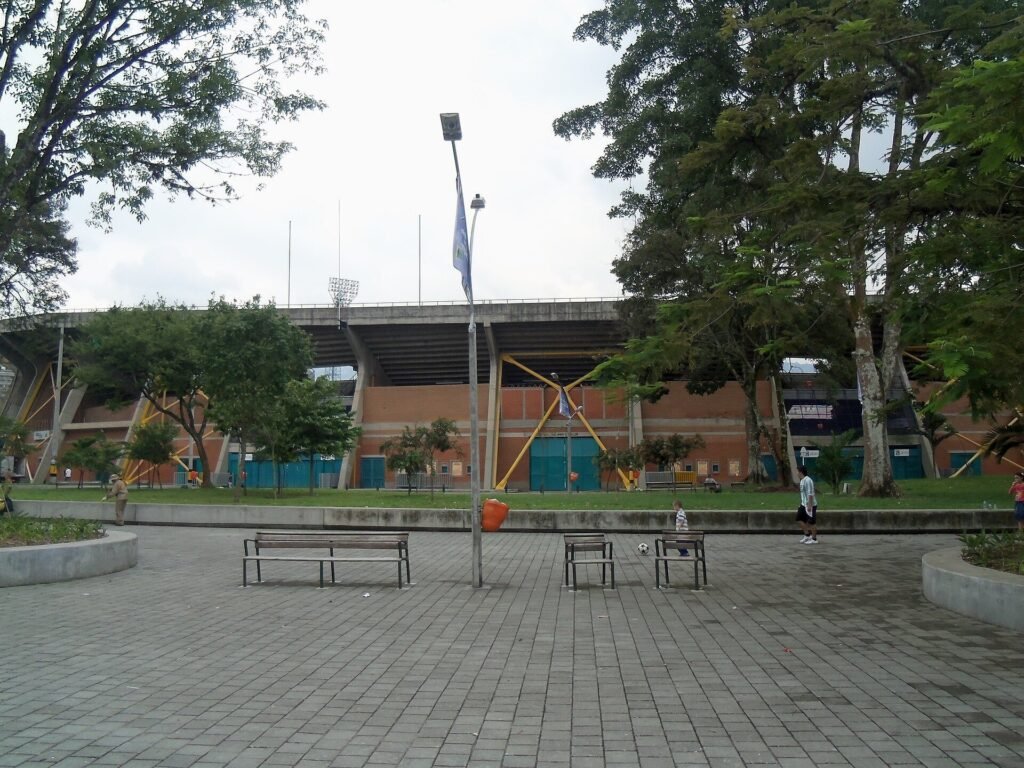
Cross the river to the west and the city changes. Laureles is flat, leafy and residential, laid out on a pattern of curving streets around small circular parks. It has its own restaurant strips, and Carrera 70 near the stadium gets lively, but most of the neighbourhood goes quiet at night.
Who it suits: most people staying a month or longer. You get walkability, cafés to work from and a more local feel, without El Poblado’s prices.
Who should skip it: anyone who wants to step out of the door into the nomad scene every night. You’ll be taking a short ride to get there.
The rent signal: the first page of Laureles listings on Fincaraíz showed two-bedroom flats from about COP 2,100,000 to 3,100,000 a month, none marked as furnished (November 2026). Furnished monthly lets cost more, but the starting point is far lower than across the river.
Getting around: Estadio and Floresta stations, on Metro Line B, serve the area.
Envigado: a town of its own
Envigado is technically a separate municipality at the south end of the valley, but the Metro and the city’s growth have joined it to Medellín. It has a busy main square, local bakeries, family restaurants and far fewer foreigners. Expect more Spanish, fewer laptops in cafés and more neighbours who’ve lived on the same street for years.
Who it suits: a second or third month, anyone who wants to practise Spanish, and anyone with a lower budget.
Who should skip it: first-timers who want an English-speaking support system from day one, and anyone who needs a coworking space on every corner.
The rent signal: a small one-bedroom apartaestudio was listed at COP 1,500,000 on Fincaraíz, and two-bedroom flats started around COP 1,900,000 (November 2026).
Getting around: Envigado station is on Metro Line A, four stops south of Poblado.
Side by side
| El Poblado | Laureles | Envigado | |
|---|---|---|---|
| Feel | Busy, international | Residential, local | Small town |
| Noise at night | High near Lleras and Provenza | Low to medium | Low |
| Nomad infrastructure | Most | Good | Least |
| Example asking rent | COP 4.7m (furnished 1-bed) | From COP 2.1m (2-bed) | COP 1.5m (studio) |
| Metro | Poblado (Line A) | Estadio, Floresta (Line B) | Envigado (Line A) |
| Best for | First two weeks | One to three months | Month two onwards |
Listing prices from Fincaraíz, first page of results, November 2026.
Three things to understand before you sign
Estrato. Every property in Colombia has a socioeconomic band from 1 to 6. It affects your utility bills. Medellín’s city hall says strata 1–3 receive subsidies, strata 5 and 6 pay contributions on top of their bills, and stratum 4 pays the standard rate (Alcaldía de Medellín). Much of El Poblado is in the top bands, so the same electricity use can cost more there.
The Metro card. Buy a Cívica card if you’re staying for weeks. The Metro’s fare page lists the card at COP 12,100 and a standard trip at about COP 4,400, with cheaper “frequent” fares on a personalised card (Metro de Medellín, checked November 2026). Check the current fares there before you go.
Your stay. Migración Colombia’s pre-registration, Check-MIG, is free and online, and its own page describes it as “de uso no obligatorio” (not mandatory) (Migración Colombia). Check how long you’re allowed to stay on your entry stamp. Staying longer means an extension or a visa: Colombia’s digital nomad visa asks for monthly income of about three times the minimum wage, which nomad-visa specialists put at COP 5,252,715 a month in 2026 (Nexo Legal). Confirm it with the Colombian foreign ministry, Cancillería, before you apply. Our visa income comparison shows how it stacks up against other countries.
Safety: the dating-app warning
The UK Foreign Office warns that criminals in Colombia use dating apps and websites to target foreigners travelling alone, sometimes using drugs such as scopolamine to rob them. It advises against going to strangers’ accommodation, leaving drinks unattended, or hailing taxis in the street: use pre-booked ones (FCDO Colombia safety advice, checked November 2026). It also names Medellín among the cities where pickpocketing and robbery are a problem. None of this is a reason to skip the city. It’s a reason to meet new people in public, keep an eye on your drink and use ride apps. Our guide to making friends as a digital nomad has safer ways to meet people.
Where to sign
Choose Laureles for a month of work with a local rhythm and walkable cafés, El Poblado for the nomad scene and the most coworking, and Envigado for lower rents and more Spanish. Book your first week, walk all three, then sign for the rest. To see how Medellín’s costs compare with other bases, read what a digital nomad really spends per month. Medellín was one of the seven bases in our nomad cities where work fits in a 15-minute walk, and if you’re travelling on after your month, our Colombia route and costs maps the rest of the country.
Get the next guide in your inbox: sign up for the TravelSpatial newsletter below.
Sources
- Fincaraíz: El Poblado, Laureles and Envigado rental listings, checked November 2026
- Numbeo: Medellín cost of living, updated 16 November 2026
- Alcaldía de Medellín: subsidies and contributions by stratum
- Metro de Medellín: fares, checked November 2026
- Migración Colombia: Check-MIG, checked November 2026
- Nexo Legal: Colombia digital nomad visa (secondary source), checked November 2026
- UK FCDO: Colombia safety and security, checked November 2026
Photo credits
- Valley of Medellín- skyline by User: (WT-shared) CONOCER at wts wikivoyage, Public domain, via Wikimedia Commons
- Laureles – Estadio, Medellín, Antioquia, Colombia – panoramio (3) by Zack Knowles, CC BY-SA 3.0, via Wikimedia Commons
The infographic is original to TravelSpatial. Photos are used under the licences linked above.