


The alarm went off at 1:45 a.m. in a guesthouse off Hang Bac Street, and the Old Quarter was finally quiet. I propped the laptop on a pillow, pointed the camera at a blank wall and joined a 2 p.m. standup in New York. Nine faces in daylight. Mine, lit blue, asking whether anyone could repeat the question.
I lasted eleven days. Hanoi was perfect. The schedule was not.
That’s the part most remote-work guides skip. They rank cities by coworking spaces, coffee and visa rules. All of that matters. But before any of it, one number decides whether a base will work for you: its longitude. Every 15 degrees east or west of your employer moves your workday by an hour. Choose the wrong meridian and the best city in the world turns into a night shift.
This guide maps the overlap. You’ll see what a 9-to-5 in New York, San Francisco, London or Berlin looks like from nine popular nomad bases, which bases fit each employer, and the visa and clock changes that took effect this autumn.
How Remote Work Time Zones Are Laid Out
You don’t need your employer’s full eight hours. You need about four hours of shared daylight: enough for meetings, quick replies and the occasional fire. Everything else can be async. With that rule, the globe splits into four bands for anyone working remotely.
- Same day, same hours. Within two hours of your employer. Mexico City for a New York team, Lisbon for a London one. You simply live where you are.
- Shifted but civil. Three to five hours ahead. A New York workday ends in Buenos Aires at 7 p.m. You start late, finish late, and still have mornings.
- Split shift. Six to nine hours apart. A London 9-to-5 runs 4 p.m. to midnight in Bangkok. Workable if you take meetings in the evening and protect your mornings.
- Night shift. Ten or more hours apart. New York from Hanoi or Bali. Only works if your job is almost fully async, and even then, plan to burn out in weeks, not months.
The band you’re in matters more than the city you’re in. A good café in band 4 is still a café at 3 a.m.
The Overlap Map: Nine Bases, Four Employers
Each cell shows your employer’s 9 a.m.–5 p.m. in that city’s local time, for northern winter (November to March). Bases run west to east, the way the sun crosses them.
| Base (coordinates, UTC offset) | New York 9–5 | San Francisco 9–5 | London 9–5 | Berlin 9–5 |
|---|---|---|---|---|
| Mexico City (19.43°N 99.13°W, UTC−6) | 8 a.m.–4 p.m. | 11 a.m.–7 p.m. | 3–11 a.m. | 2–10 a.m. |
| Medellín (6.24°N 75.58°W, UTC−5) | 9 a.m.–5 p.m. | noon–8 p.m. | 4 a.m.–noon | 3–11 a.m. |
| Lima (12.05°S 77.04°W, UTC−5) | 9 a.m.–5 p.m. | noon–8 p.m. | 4 a.m.–noon | 3–11 a.m. |
| Buenos Aires (34.61°S 58.37°W, UTC−3) | 11 a.m.–7 p.m. | 2–10 p.m. | 6 a.m.–2 p.m. | 5 a.m.–1 p.m. |
| Lisbon (38.72°N 9.14°W, UTC+0) | 2–10 p.m. | 5 p.m.–1 a.m. | 9 a.m.–5 p.m. | 8 a.m.–4 p.m. |
| Marrakech (31.63°N 7.99°W, UTC+0) | 2–10 p.m. | 5 p.m.–1 a.m. | 9 a.m.–5 p.m. | 8 a.m.–4 p.m. |
| Bangkok (13.75°N 100.50°E, UTC+7) | 9 p.m.–5 a.m. | midnight–8 a.m. | 4 p.m.–midnight | 3–11 p.m. |
| Hanoi (21.03°N 105.85°E, UTC+7) | 9 p.m.–5 a.m. | midnight–8 a.m. | 4 p.m.–midnight | 3–11 p.m. |
| Bali (8.65°S 115.22°E, UTC+8) | 10 p.m.–6 a.m. | 1–9 a.m. | 5 p.m.–1 a.m. | 4 p.m.–midnight |
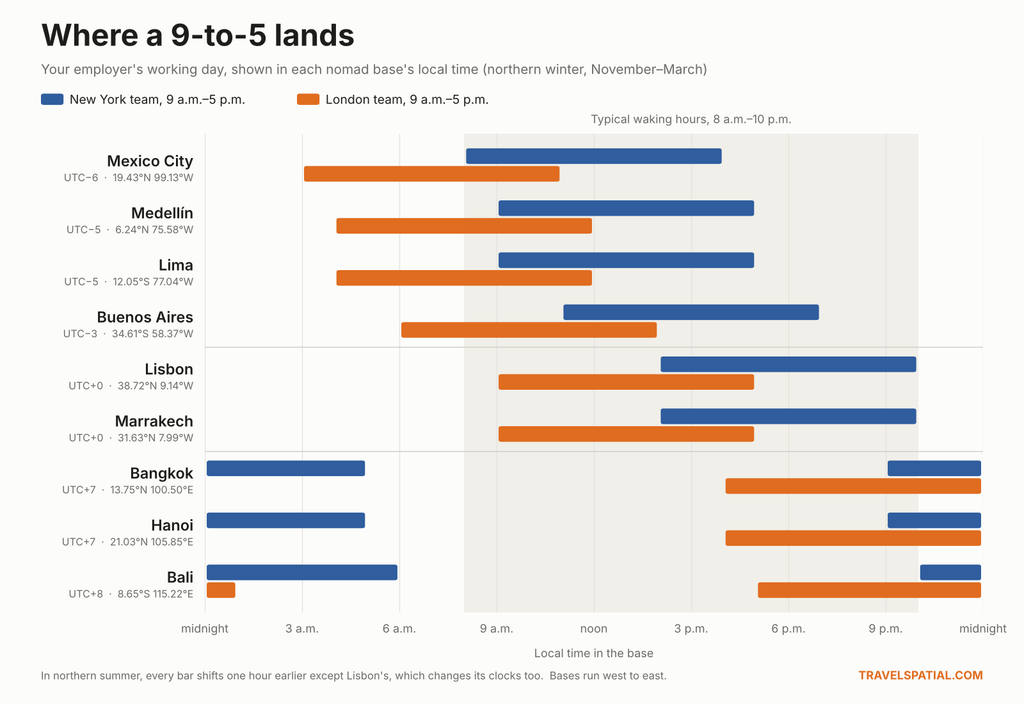
In northern summer (late March to late October), New York, London and Berlin move their clocks forward one hour. Lisbon moves with them. Mexico City, Medellín, Lima, Buenos Aires, Marrakech, Bangkok, Hanoi and Bali don’t change, so every overlap with those bases slides one hour earlier: a New York day runs 10 a.m.–6 p.m. in Buenos Aires, a London day 3–11 p.m. in Bangkok.
Where to Base Yourself, by Employer
If your team is in New York or Toronto: go south, not east
The Andes and the Pacific coast sit on almost the same meridian as the US East Coast. In Medellín or Lima your workday is their workday.
- Medellín. Colombia’s digital nomad visa (Type V) runs up to two years. The income test is three times the minimum wage: COP 5,252,715 a month in 2026, about US$1,400 (Colombia Move). It also requires health insurance with repatriation cover.
- Lima. Peru created a digital nomad category in 2023, but the application procedure still isn’t live. Most remote workers enter visa-free; US passports can get up to 180 days (Visa Atlas).
- Buenos Aires is the stretch option: two hours ahead, so you start at 11 a.m. and finish at 7 p.m. The digital nomad residence is 180 days, extendable once to 360, and open only to visa-exempt passports (Golden Harbors).
If your team is in San Francisco or Seattle: stay in the Americas
West Coast hours are hard to export. Mexico City puts you two hours ahead, with a civil 11 a.m.–7 p.m. day. Mexico has no nomad visa. The FMM tourist permit allows up to 180 days, but in 2026 officers often grant only the days your plans justify (Guadalajara Reporter). Carry an onward ticket and a lease or booking.
If your team is in London or Berlin: the Atlantic edge or Southeast Asia
Lisbon and Marrakech give you a mirror-image workday. Portugal’s D8 visa needs €3,680 a month in active income in 2026 (Portugalist).
Bangkok is the split-shift classic: a free morning, then a London day from 4 p.m. to midnight, or a Berlin day from 3 p.m. to 11 p.m. Pick a desk near your Skytrain line with the Bangkok coworking guide, and check its evening hours before you sign up. The Destination Thailand Visa (DTV) allows 180 days per entry over five years, with THB 500,000 in funds and a THB 10,000 fee (EIG Law).
Hanoi works on the same hours. Vietnam has no nomad visa, so most remote workers use the 90-day multiple-entry e-visa, about US$50 (Freaking Nomads). Bali is an hour later still. Indonesia’s E33G remote worker visa lasts one year and requires US$60,000 a year from a foreign employer (Taxes for Expats).
Map Notes: What Changed This Autumn
Map Notes
- Morocco moved its clocks. On 20 September 2026, Morocco dropped its permanent UTC+1 and returned to plain GMT, with no seasonal changes (Hespress). Marrakech now matches Lisbon in winter and sits an hour behind it in summer. Check any calendar invites created before the switch.
- The gap weeks. Europe ends daylight saving on 25 October; the US follows on 1 November. For that one week, a New York day starts at 1 p.m. in Lisbon, not 2 p.m. The same gap opens in March.
- Thailand halved its visa-free stay. Since 15 September 2026, eligible visitors get 30 days, not 60, with one 30-day extension and two land-border entries a year (TTG Asia). Border runs are no longer a long-stay plan.
- The DTV got stricter. Applications filed from 31 August 2026 need a police clearance certificate and proof of residence where you apply (Envoy Global).
- Mexico’s 180 days aren’t automatic. Bring proof of your plans to the counter, or expect a shorter FMM.
Visa rules here are checked as of October 2026 and change often. Confirm with the official consulate before you book.
The Honest Take
Most nomads choose a city and then try to bend their job around it. Do it the other way. Find your employer on the map, run a finger north or south along the same band, and start your shortlist there. For New York, that’s the Andes. For London, it’s the Atlantic edge, or Bangkok if you’ll trade evenings for free mornings.
The night shift doesn’t last. I gave Hanoi eleven days and the city deserved months. Go back on a schedule that fits, and it will.
Next step: open your calendar, count your meetings last week, and note when they started in your employer’s time. That number tells you which band you can live in. Then read the Bangkok coworking guide or the Buenos Aires layout guide to pick a neighborhood, and subscribe below for one honest guide a week.
Sources
- Morocco returns to GMT from 20 September 2026 (Hespress)
- Thailand cuts visa-free stay to 30 days (TTG Asia)
- Thailand tightens DTV requirements (Envoy Global)
- DTV funds, fee and stay rules (EIG Law)
- Vietnam 90-day e-visa (Freaking Nomads)
- Indonesia E33G remote worker visa (Taxes for Expats)
- Colombia digital nomad visa income, 2026 (Colombia Move)
- Peru digital nomad category status (Visa Atlas)
- Argentina digital nomad visa (Golden Harbors)
- Mexico FMM no longer defaults to 180 days (Guadalajara Reporter)
- Portugal D8 income requirement 2026 (Portugalist)
Overlap times were computed with the IANA time-zone database for January 2027 (winter) and July 2027 (summer).


4 comments on “Your Longitude Is Your Schedule: A Time-Zone Map for Remote Work”