The easiest way to choose where to live in Tbilisi is to walk it, from the old town’s balconies up through the cafés to the leafy streets on the hill and out to the Soviet-era towers by the metro. Each stretch of that walk is a different month: different noise, different rent, different people. This guide follows the route, then covers what makes Tbilisi work for digital nomads, and the two rules that changed in 2026.
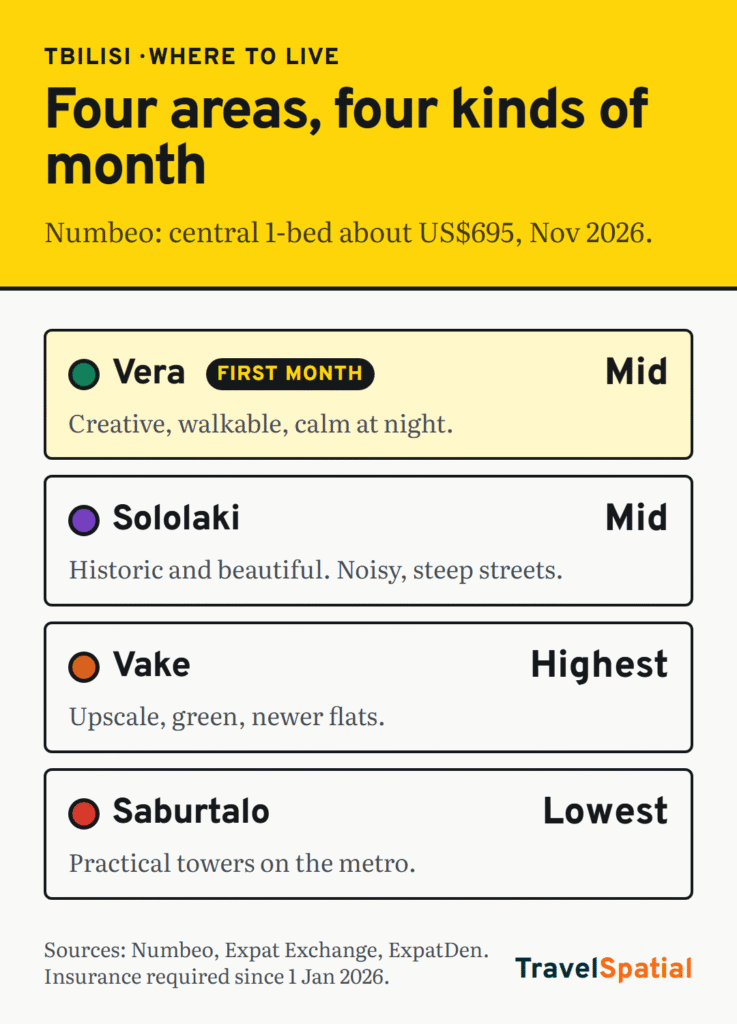
The quick answer: Vera suits most people staying a month: central, walkable and creative. Sololaki is the most atmospheric, and the noisiest. Vake is calmer and smarter. Saburtalo is the practical, cheaper choice on the metro.
Why Tbilisi, at all
Three things put Tbilisi on nomad shortlists.
The length of stay. Georgia lets citizens of a long list of countries, including the US, UK, EU states, Canada and Australia, stay visa-free for up to a year. Check your own passport against the Georgian foreign ministry’s list before you plan around it. If yours doesn’t qualify, see our digital nomad visa income comparison.
The time zone. Georgia is on UTC+4 all year. That’s a workable overlap with Europe in the morning and with Asia in the evening. Our time-zone map for remote work shows how it compares with other bases.
The cost. Numbeo puts a central one-bedroom at about US$695 a month and one outside the centre at about US$471, with everyday costs for one person around US$688 a month excluding rent (updated 16 November 2026). Coffee isn’t cheap, at about US$3.58 for a cappuccino, but rent is. Our monthly budget for eight nomad bases puts Tbilisi in context.
Stop 1: Sololaki, the old town’s edge
Start below the old fortress walls, in the streets that climb away from Freedom Square. Sololaki is Tbilisi at its most photogenic: carved wooden balconies, Art Nouveau entrance halls, courtyards draped in vines and laundry.
Live here if you want character, short walks to restaurants and wine bars, and don’t mind stairs.
Think twice if you’re a light sleeper. The streets are narrow and steep, and sound bounces off the walls. Old buildings can also mean old wiring, weak heating and patchy wifi. Ask for a speed test and winter heating details before you book.

Stop 2: Vera, the sweet spot
Walk up Rustaveli Avenue past the theatres and turn uphill, and you’re in Vera. It’s a quieter, residential grid of old townhouses, small parks, specialty coffee shops and restaurants. This is where many nomads end up, and it’s easy to see why: you’re a short walk from the centre and from Vake, but most streets are calm by night.
Live here if it’s your first month. You’ll find cafés to work from, places to eat alone, and enough other remote workers to meet people without trying.
Think twice if you want brand-new buildings with lifts. Much of Vera’s housing is older, and the hills are real.
Stop 3: Vake, up the hill
Keep climbing west and the streets get wider, the cars newer and the cafés more polished. Vake is one of Tbilisi’s most expensive residential areas, built around the large Vake Park, with gyms, international restaurants and newer flats.
Live here if you want quiet, green space, modern buildings and a gym nearby, and you’re happy to pay more.
Think twice if you want to walk to the old town in five minutes, or if you’re on a tight budget. Vake also has fewer nomad hangouts, so you’ll travel a little further to meet people.
Stop 4: Saburtalo, by metro
From here, it’s easier to take the metro. Saburtalo is a big district of Soviet-era and newer apartment towers, shopping streets and universities, on the metro line. It’s less pretty than the first three stops but more practical.
Live here if budget matters most, you want a newer flat with a lift, or you’ll be staying several months.
Think twice if you want old-town charm on your doorstep. You’ll be commuting to it.
Side by side
| Sololaki | Vera | Vake | Saburtalo | |
|---|---|---|---|---|
| Feel | Historic, lively | Creative, residential | Upscale, green | Practical, local |
| Night noise | High | Low to medium | Low | Low to medium |
| Walk to old town | Minutes | 15–25 min | Longer, uphill | Metro ride |
| Price | Mid | Mid | Highest | Lowest |
| Best for | Character | First month | Quiet comfort | Longer, cheaper stays |
Our summary of the four areas, based on the guides listed in the sources.
Getting around
The metro is cheap and fast for longer trips. Recent guides put a ride at GEL 1 with a Metromoney card, which costs GEL 2 and includes 90 minutes of transfers (madloba.info, checked November 2026). Guides disagree on what a foreign bank card costs per tap, so check the price at the barrier. For short trips, most people use ride-hailing apps, which are generally cheaper than street taxis.
The two 2026 rules to know
Insurance is now required. Since 1 January 2026, visitors to Georgia must have health and accident insurance covering their whole stay, under a government resolution implementing the country’s tourism law (GPI Holding; Georgia Today). The UK Foreign Office says the cover must be at least 30,000 GEL, must run from your arrival day to your departure day, and can come from a Georgian or a foreign insurer. Your airline or the border officer may ask to see it (FCDO Georgia entry requirements, updated 12 November 2026). Buy it before you travel and carry the certificate. If you use a monthly nomad plan, make sure the certificate shows your dates and cover. Our guide to travel insurance basics explains what to look for.
The “1% tax” isn’t automatic. Georgia’s small business status lets a registered individual entrepreneur pay 1% tax on turnover up to GEL 500,000 a year (Andersen Georgia). It’s often described as a nomad tax perk, but it involves registering a business, may depend on tax residency, and doesn’t change what you owe at home. Get advice from a qualified adviser before you register.
End of the walk
For a first month as a digital nomad in Tbilisi, base yourself in Vera. Choose Sololaki for atmosphere if you sleep well, Vake for calm and comfort, and Saburtalo for value over a longer stay. Check your visa-free allowance, bring insurance that meets Georgia’s 2026 rule, and walk the route before you sign for a second month. Tbilisi was one of our seven nomad-friendly cities where work fits in a 15-minute walk, so see that guide for how it compares.
Get the next guide: sign up for the TravelSpatial newsletter below.
Sources
- Numbeo: Tbilisi cost of living, updated 16 November 2026
- FCDO Georgia entry requirements (minimum 30,000 GEL, whole stay, Georgian or foreign insurer), checked November 2026
- GPI Holding: mandatory insurance for tourists visiting Georgia, checked November 2026
- Georgia Today: nine months into mandatory tourist insurance, checked November 2026
- madloba.info: transport in Georgia 2026 (secondary source), checked November 2026
- Andersen Georgia: small business status, checked November 2026
- Neighbourhood character: Expat Exchange and ExpatDen, checked November 2026
Photo credits
- 2014 Tbilisi, Widoki z Twierdzy Narikala (34) by Marcin Konsek, CC BY-SA 4.0, via Wikimedia Commons
- Old Tbilisi, June, 2018-6 by Alexey Komarov, CC BY-SA 4.0, via Wikimedia Commons
The infographic is original to TravelSpatial. Photos are used under the licences linked above.