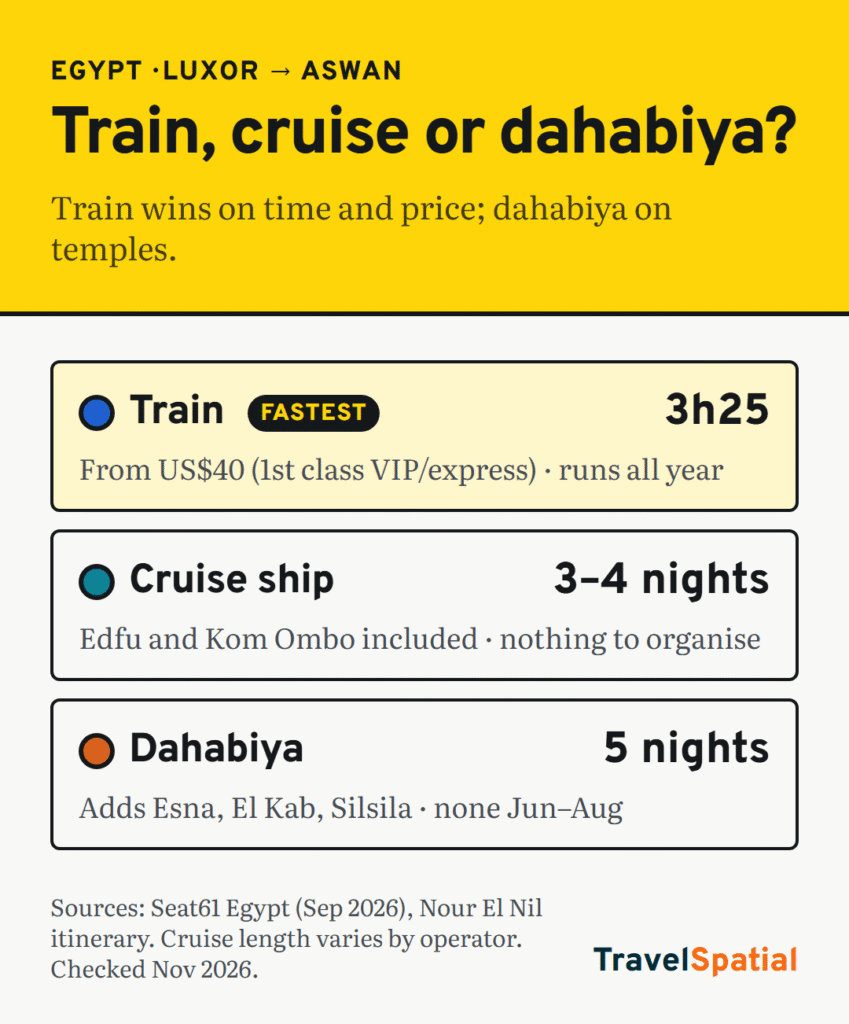
Luxor and Aswan are about 220 km apart on the Nile, and there are three good ways to cover that stretch. The train takes about 3½ hours and costs from US$40 in first class. A big Nile cruise ship turns the trip into a few nights afloat, with the temples at Edfu and Kom Ombo included. A dahabiya, a small sailing boat, takes five nights and stops at places the big ships pass.
Which wins depends on what you’re short of: time, money, or patience with crowds. So we’ve scored them head to head over five rounds. Each round has a winner, and the scorecard is at the end.
The contenders
| Train | Nile cruise ship | Dahabiya | |
|---|---|---|---|
| Time Luxor → Aswan | About 3h25 (VIP express) | Usually 3–4 nights (check the itinerary) | 5 nights / 6 days (Nour El Nil) |
| Price signal | From US$40 (1st class, VIP/express) | Package price, meals and guided visits often included | Highest per night; full board |
| Temples on the way | None, unless you stop off | Edfu and Kom Ombo on most itineraries | Esna, El Kab, Edfu, Gebel el-Silsila, Kom Ombo |
| Boat size | — | Large, many cabins | Small; Nour El Nil limits cabins to 2 guests (suites up to 4) |
| Season | All year | All year | Nour El Nil doesn’t sail June–August |
Train fares and times are from Seat61’s Egypt guide (updated September 2026), and the dahabiya details from Nour El Nil’s itinerary (both checked November 2026).
Round 1: Speed
Winner: train. The evening VIP express leaves Luxor at 19:30 and reaches Aswan at 22:55 (Seat61). If you’re also coming from Cairo, the Abela sleeper (train 86, the old Watania service) reaches Luxor at 06:10 and continues to Aswan by 09:25, calling at Esna, Edfu and Kom Ombo on the way (Seat61 sleeper guide).
A cruise ship spends days on a journey a train covers in an afternoon. That’s fine if the boat is the holiday, but it’s a poor deal if you only have a week in Egypt.
Round 2: Price
Winner: train, by a mile. Foreigners pay fixed dollar fares: on the VIP/express trains, US$40 in first class and US$35 in second, or US$77/US$62 on the newer Talgo trains (Seat61). One catch: Egyptian National Railways’ own website sells only to Egyptian nationals, so foreigners buy through agencies such as 12go or Bookaway, or at the station.
Cruise and dahabiya prices vary too widely to give a fair average. They change with the boat, the season and what’s included. Compare them by price per night with sightseeing included, then subtract what the same nights would cost in hotels plus the temple tickets and transport you’d otherwise pay for yourself. A cruise often looks less expensive once you count those.
Round 3: Temples seen on the way
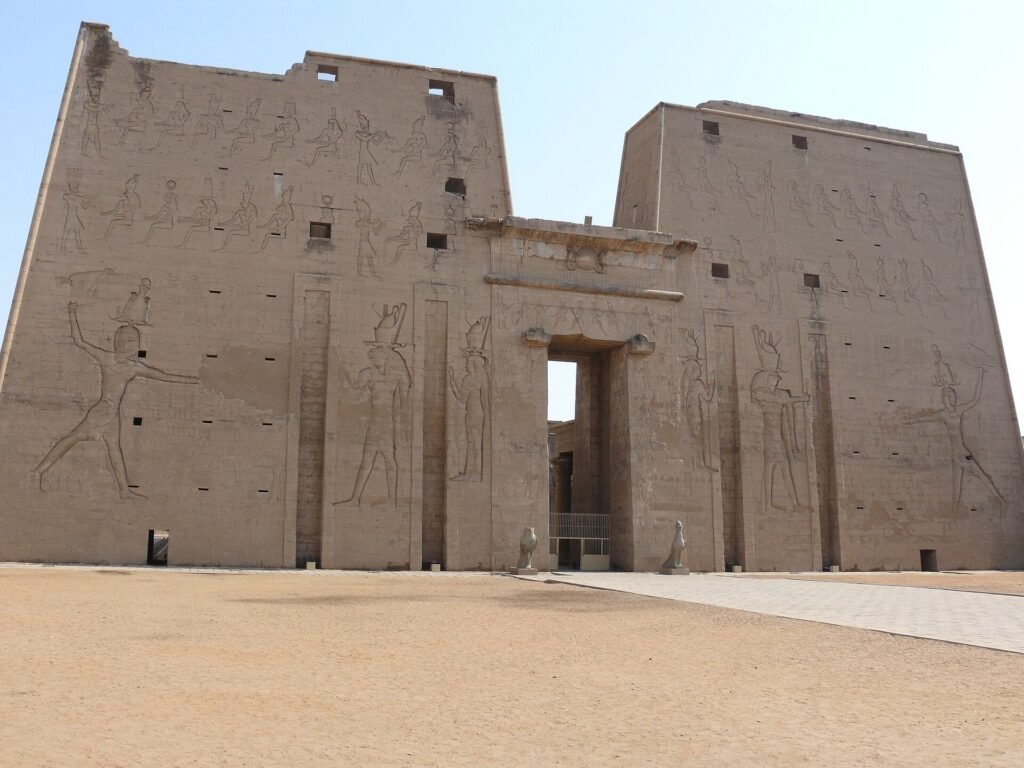
Winner: dahabiya. Both boats stop at the big two, Edfu and Kom Ombo. But a dahabiya is small enough to moor where large ships can’t. Nour El Nil’s five-night route also stops at Esna, El Kab and Gebel el-Silsila, the ancient sandstone quarries (itinerary).
The train can see the same temples if you break the journey yourself. Stop at Edfu or Kom Ombo, visit, and catch a later train. It’s cheap, but you handle the logistics and your luggage.
Round 4: Crowds and atmosphere
Winner: dahabiya. Edfu and Kom Ombo get busy when several cruise ships dock at the same time, and you visit on the boats’ schedule. A dahabiya carries a handful of cabins and moves under sail where the wind allows. That’s the reason to pay the premium: a quiet river, small moorings and no buffet queue.
The train is efficient, but it’s a means of transport, not an experience. The big cruise ship sits in between: comfortable, social, and predictable.
Round 5: Flexibility and season
Winner: train. Trains run daily all year and you can change plans at short notice. Boats lock you into fixed departure days, and dahabiyas avoid the hottest months: Nour El Nil says it doesn’t operate June to August because of the heat (nourelnil.com). That’s a real constraint, not a sales line. Summer afternoons in Upper Egypt are very hot.
The scorecard
| Round | Train | Cruise ship | Dahabiya |
|---|---|---|---|
| Speed | ✔ | ||
| Price | ✔ | ||
| Temples on the way | ✔ | ||
| Crowds and atmosphere | ✔ | ||
| Flexibility and season | ✔ |
The cruise ship doesn’t win a round, but it doesn’t lose one badly either. It’s the safe all-rounder: you get the river, the two big temples and no logistics, for less than a dahabiya.
Our pick for each kind of trip
- One week in Egypt: take the train and use the days you save at Abu Simbel or the Valley of the Kings. That’s the approach in our 10-day Egypt itinerary.
- First visit, want the Nile without planning: cruise ship, 3–4 nights.
- Special trip, October to May: dahabiya. Book early, because the boats are small.
- Tight budget but you want Edfu and Kom Ombo: train, with a stop-off at each.
Our tip: whichever you choose, start your day at the temples early. Upper Egypt is hot by late morning for much of the year, even outside summer.
Before you go
Most nationalities can buy a visa on arrival for US$30, cash only, valid for 30 days. Since 1 August 2026, travellers arriving at Cairo airport can also buy a digital visa on arrival by card for US$36 (UK Foreign Office: Egypt entry requirements). Check your own passport on our visa map.
The short version
For Luxor to Aswan, the train wins on speed, price and flexibility: about 3½ hours, from US$40 in first class, daily all year. A dahabiya wins on temples and atmosphere: five nights, extra stops at Esna, El Kab and Gebel el-Silsila, but no summer sailings. The big cruise ship is the comfortable middle choice, with Edfu and Kom Ombo included and nothing to organise.
Want the next route in your inbox? Join the TravelSpatial newsletter for one mapped itinerary a week.
Sources
- Seat61: Train travel in Egypt (Luxor–Aswan times and foreigner fares, ticket rules), updated September 2026, checked November 2026
- Seat61: Cairo to Luxor and Aswan by sleeper train (train 86 timetable, Abela operator)
- Nour El Nil: Itinerary and homepage (dahabiya route, length, season, cabin occupancy)
- Wikipedia: Luxor (distance to Aswan)
- UK Foreign Office: Egypt entry requirements (visa on arrival)
Photo credits
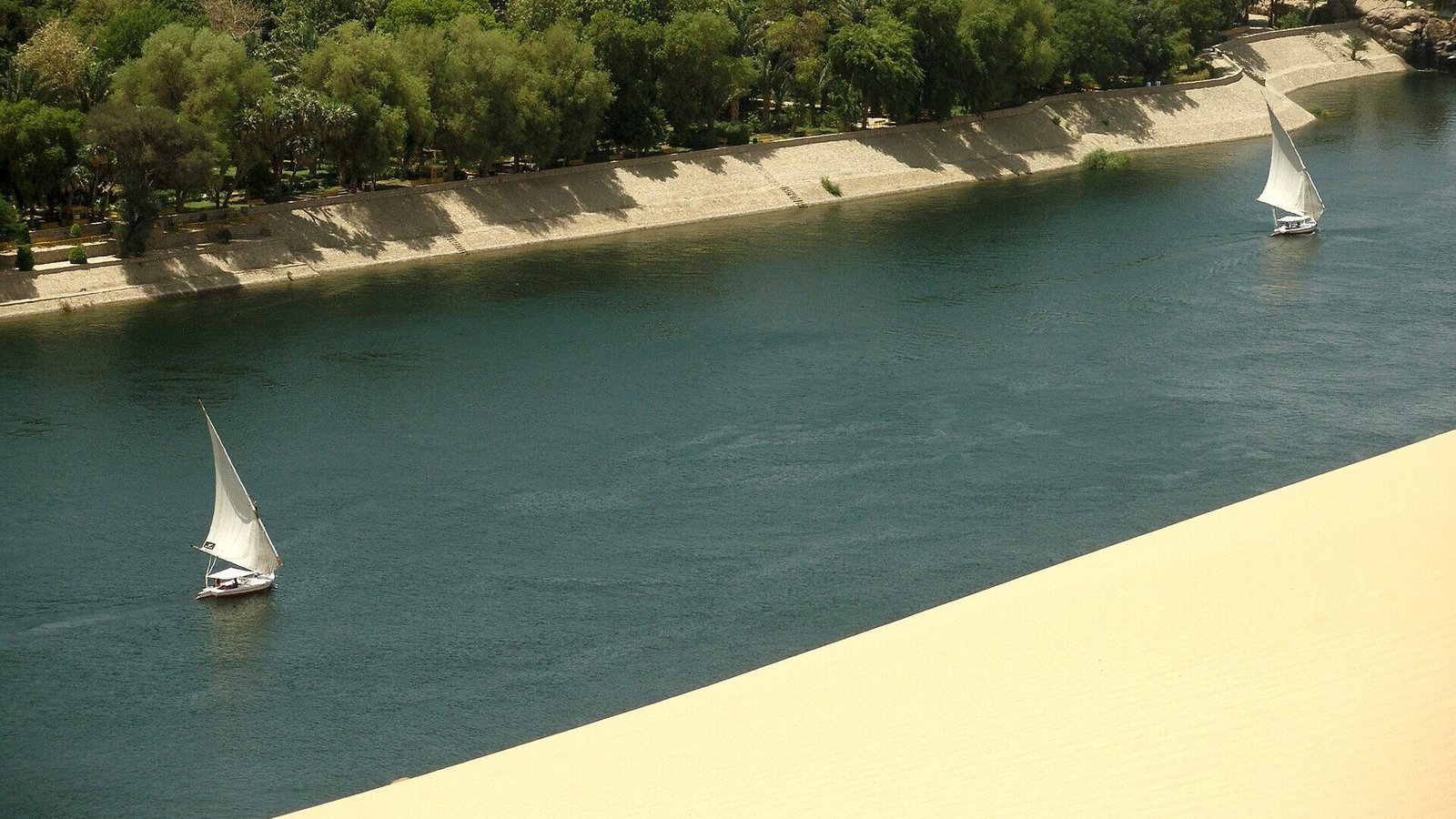
- Nile River, Felucca boats, Aswan, Egypt by Vyacheslav Argenberg, CC BY 4.0, via Wikimedia Commons
- Temple of Edfu 02 by Ad Meskens, CC BY-SA 3.0, via Wikimedia Commons
The infographic is original to TravelSpatial. Photos are used under the licences linked above.