


Choose by month, not by reputation. From late July to October, the wildebeest herds are usually in Kenya’s Maasai Mara or on the Tanzanian side of the Mara River. Kenya puts you closer to them, and Nairobi is a shorter drive away. From December to March, the herds are calving on Tanzania’s southern Serengeti plains, and Kenya has no equivalent.
Everything else is a tiebreaker: how many days you have, how much driving you’ll put up with, and what the park fees do to your budget. This guide works through those tiebreakers one decision at a time, and gives you a verdict for each.
Short on time? Read the verdict table below and skip to the month you’re travelling.
The verdict at a glance
| If this is you… | Pick | Why |
|---|---|---|
| Travelling August–October | Kenya (Maasai Mara) | Herds usually in the Mara; short hop from Nairobi |
| Travelling January–March | Tanzania (southern Serengeti, Ngorongoro) | Calving season on the short-grass plains |
| Travelling April–May | Either, cautiously | Long rains in both countries; cheaper, muddier |
| Only 3–4 days | Kenya | Nairobi–Mara is the tightest bush trip in East Africa |
| Want a classic “big circuit” with a crater | Tanzania | Tarangire, Ngorongoro and Serengeti in one loop |
| Climbing Kilimanjaro first | Tanzania | Same airport (Kilimanjaro/Arusha) as the northern circuit |
| Want to add elephants under a famous mountain | Kenya (Amboseli) | Amboseli faces Kilimanjaro from the Kenyan side |
Our tip: don’t book a “migration safari” before you’ve checked the month. The herds go round in a loop, and nobody controls where they are on a given date.
Decision 1: What month are you going?
The migration is a clockwise loop. According to the Serengeti overview on Wikipedia, which summarises the long-term pattern, it goes like this:
- January–March: wildebeest graze the short-grass plains in the southeast of the ecosystem (Tanzania). Most calves are born in a 2–3 week window around February.
- May–June: the rains end and the herds move northwest towards the Grumeti River (Tanzania).
- July: the Grumeti and Mara river crossings begin.
- Late July/August–October: the herds are in Kenya’s Maasai Mara for the rest of the dry season.
- Early November: the short rains start and the herds turn south, back into Tanzania.

The same pattern as a list you can scan:
| Month | Where the herds usually are | Verdict |
|---|---|---|
| Jan–Mar | Southern Serengeti and Ngorongoro area, calving | Tanzania |
| Apr–May | Moving through central Serengeti; long rains | Tanzania, if you accept rain |
| Jun | Western corridor, Grumeti | Tanzania |
| Jul | Northern Serengeti, first Mara crossings | Toss-up (river crossings on both sides) |
| Aug–Oct | Maasai Mara and northern Serengeti | Kenya for access, Tanzania for fewer vehicles |
| Nov–Dec | Heading south through the Serengeti | Tanzania |
Both countries have two rainy seasons: a long one around March to May and a short one around October to November. Lodges cut prices in the long rains, but some seasonal camps close and some roads turn to mud.
Decision 2: How many days do you have?
3–4 days: Kenya. The Maasai Mara is close enough to Nairobi to make a short safari work. Fly in and out of a Mara airstrip and you can get two full days of game drives into a long weekend.
6–8 days: Tanzania’s northern circuit, or Kenya’s Mara + Amboseli. Tanzania’s classic loop runs from Arusha through Tarangire, the Ngorongoro Crater and the Serengeti. In Kenya, adding Amboseli gives you a second, very different landscape: open swamp grassland with elephant herds and Kilimanjaro on the skyline.
10+ days: either, or both. The Serengeti and the Mara are one ecosystem split by a border. On a long trip you can follow the season rather than the country, but plan the border crossing separately. There’s no simple drive across from one reserve into the other, so most travellers fly between Kenya and Tanzania.
Decision 3: What will the park fees do to your budget?
Park fees are where the two countries differ most, and they apply per person, per day, on top of your lodge or tour price. These are the figures for non-resident adults:
| Park | Fee per adult per day | Notes |
|---|---|---|
| Maasai Mara (Kenya) | US$100 Jan–Jun 2026; US$200 from 1 Jul 2026 | 12-hour ticket validity |
| Amboseli (Kenya) | US$90 | 24-hour validity |
| Serengeti (Tanzania) | US$82.60 peak / US$70.80 low (with 18% VAT) | Peak 16 May–14 Mar |
| Ngorongoro Conservation Area | US$70.80 per 24 hours | Plus US$295 per vehicle to drive into the crater |
| Tarangire (Tanzania) | US$59 peak / US$53.10 low (with VAT) |
Sources: the Mara rates are Narok County’s 2026 schedule as reported by masaimara.travel. Narok County hasn’t published a gazette notice online, so ask your operator to confirm. Amboseli comes from the KWS conservation fee schedule, Ngorongoro from the NCAA tariffs page, and Serengeti and Tarangire from the TANAPA 2023–2026 tariff, which lists fees before VAT. That tariff ran to 30 June 2026, so check whether a 2026/27 schedule has replaced it. All checked November 2026.
What this means in practice: a Mara day in high season now costs more in fees than a Serengeti day. The Mara’s 12-hour ticket also means that if you stay outside the reserve, every re-entry is a new day’s fee. Two nights at a lodge inside the reserve can work out cheaper than two nights just outside it with daily re-entry. Ask your operator to show you the fee line, not just the package total.
Verdict on cost: Tanzania’s northern circuit isn’t cheap either. The crater vehicle fee and longer drives add up. But for an August–October trip that’s mostly about the Mara, Kenya’s fee jump from July 2026 narrows the old price gap.
Decision 4: Entry paperwork
Both countries now ask for something before you land.
- Kenya: most visitors need an Electronic Travel Authorisation, from US$30, usually processed within 72 hours. The eTA site advises applying at least two weeks before travel. East African Community citizens and a list of other nationalities are exempt (eTA general information). Since 5 October 2026, most visitors staying less than 12 months also need the Kenyan government’s travel health insurance. You buy it during the eTA application, or through the eCitizen insurance portal if you already hold an eTA. It’s valid for 90 days and multiple entries, and your own travel policy doesn’t count instead (FCDO Kenya entry requirements, updated 6 November 2026).
- Tanzania: check visa rules for your passport. Since 1 October 2026, visitors to mainland Tanzania also need the government’s mandatory inbound travel insurance (US$44, covers up to 92 days), bought through the NIC portal. One policy covers both the mainland and Zanzibar, and EAC and SADC residents are exempt (Norwegian Embassy notice, September 2026). It doesn’t replace your own travel insurance.
Our visa map explains how to check your own passport, and Travel Insurance, Explained Simply covers what your own policy should include on a safari.
Decision 5: What kind of safari do you want?
Some differences don’t fit in a fee table:
- Crowds: in August and September, the busiest Mara crossing points can have a line of vehicles. The northern Serengeti in the same months is more remote and harder to reach, so it’s quieter. Kenya’s private conservancies beside the Mara limit vehicle numbers. They charge their own fees, so ask your operator for the price.
- Landscape variety: Tanzania’s northern circuit packs in three very different places: Tarangire’s baobabs, Ngorongoro’s crater floor and the Serengeti’s plains. Kenya’s variety comes from combining parks: the Mara, Amboseli, Lake Nakuru and Samburu.
- Add-ons: Tanzania pairs with Kilimanjaro and Zanzibar. Kenya pairs with the coast at Mombasa and Diani, and the Nairobi–Mombasa train is an easy add.
Climbing first? Our Kilimanjaro guide covers routes and costs. Kilimanjaro International Airport also serves Arusha, the usual starting point for Tanzania’s northern circuit, so the two combine easily.
The short version
Pick by month. Go August–October and Kenya’s Maasai Mara is usually the easiest place to see the herds. Budget for its US$200 high-season fee from July 2026. Go January–March and Tanzania’s southern Serengeti calving season has no Kenyan equivalent. If you have only three or four days, Kenya wins on logistics. If you want a crater, a classic loop and a Kilimanjaro climb in one trip, Tanzania wins. Then sort the paperwork: Kenya’s eTA, and Tanzania’s mandatory US$44 insurance since October 2026.
If South Africa is also on your list, our 14-day South Africa route shows how a self-drive Kruger safari compares.
Want the next route in your inbox? Join the TravelSpatial newsletter for one mapped itinerary a week.
Sources
- Wikipedia: Serengeti (migration pattern and rainy seasons), checked November 2026
- masaimara.travel: Reserve entry fees 2026 & 2027 (Maasai Mara fees, reporting Narok County’s schedule)
- Kenya Wildlife Service: Conservation fees 2025 (Amboseli)
- Ngorongoro Conservation Area Authority: Tariffs (entry and crater service fee)
- Tanzania National Parks tariffs 2023–2026 (Serengeti, Tarangire; VAT exclusive)
- Kenya eTA: FAQs and general information
- FCDO Kenya entry requirements (mandatory Kenyan government travel health insurance from 5 October 2026, 90 days, bought with the eTA, foreign policies not accepted), checked November 2026
- Royal Norwegian Embassy in Tanzania: Mandatory travel insurance
Photo credits
- Wildebeest herd on hillside, Maasai Mara, Kenya by Daniel Case, CC BY-SA 4.0, via Wikimedia Commons
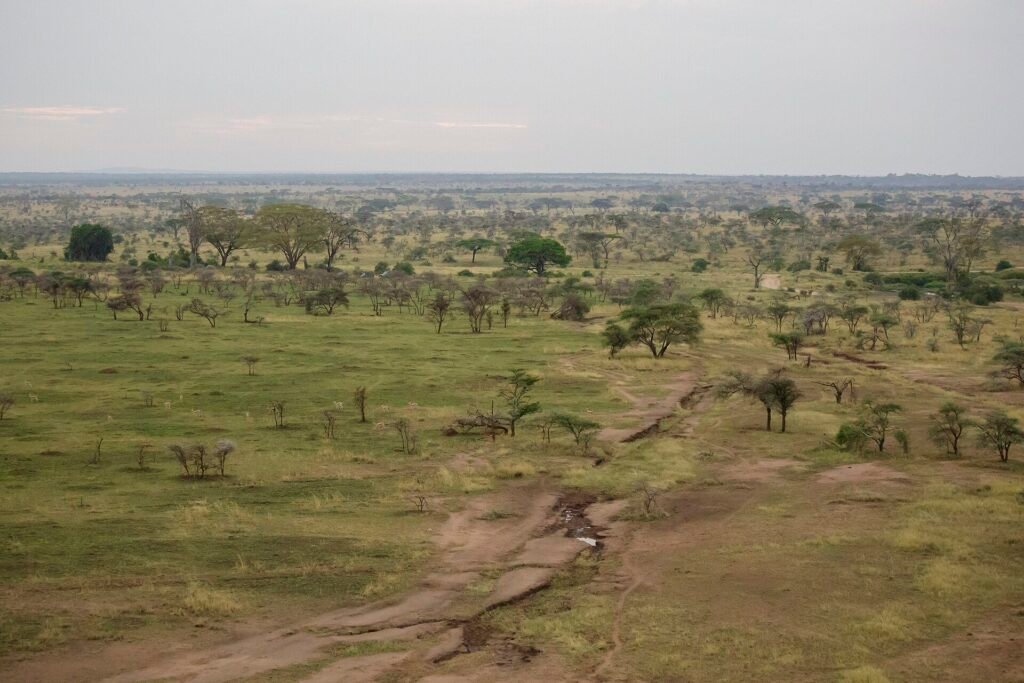
- Serengeti National Park 15 – landscape by Thomas Fuhrmann, CC BY-SA 4.0, via Wikimedia Commons
The infographic is original to TravelSpatial. Photos are used under the licences linked above.

1 comment on “Kenya or Tanzania for Your First Safari? A Month-by-Month Map”