


The door slides open, a bell chimes, and someone behind the counter calls out a greeting. There’s one free stool between two office workers, both bent over their bowls. Nobody looks up. In Tokyo, a person eating alone isn’t something anyone notices.
If you’ve ever hovered outside a restaurant abroad, wondering whether a table for one will feel awkward, Tokyo is the cure. A large share of the city’s restaurants are designed around one person: counters, booths, ticket machines and set meals on a single tray. This guide explains the main formats, how to order in each, and the small pieces of etiquette that make solo eating here easy.
Why Tokyo works so well for one
Three things come together. Counter seating is everywhere, from ramen shops to high-end sushi. Ordering is often done by machine, touch screen or a form, so there’s little to say out loud. And eating alone is ordinary: plenty of people eat lunch alone between meetings or stop for a bowl on the way home.
The practical result: you’ll rarely need a reservation for casual food, a single seat is often easier to get than a table for four, and a menu you can’t read is less of a barrier than you’d think.
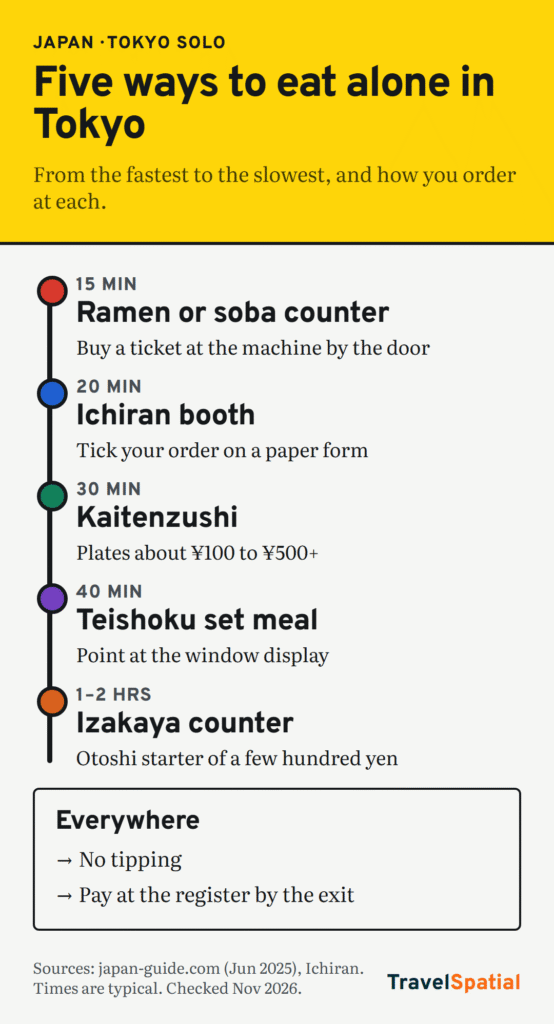
The formats, from fastest to slowest
Ticket-machine shops: ramen, gyudon, soba
In many ramen and gyudon (beef bowl) restaurants, you buy a meal ticket from a vending machine near the entrance and hand it to the staff (japan-guide.com, updated June 2025). Station-side soba shops often work the same way, and some are standing-only. You’re in and out in fifteen minutes.
How to use the machine:
- Put your money in first. Many machines still take only cash, although cards and IC cards such as Suica are accepted at a growing number of restaurants.
- Press the button for your dish. Many machines have pictures; if yours doesn’t, a translation app’s camera mode reads the buttons.
- Take the ticket (and your change), sit down wherever there’s a free stool, and put the ticket on the counter.
- If staff ask you something you don’t understand, it’s usually a choice about your order. “Futsū” (regular) is a safe answer.

Ichiran: the booth built for one
Ichiran is the city’s best-known solo format. Each seat has partition boards on both sides, and the kitchen is hidden behind a curtain. Ichiran calls it a “flavor concentration booth”. You order on a paper form, available in English, choosing seven settings: noodle firmness, richness, garlic, spice and so on. For an extra portion of noodles (kae-dama), you put the plate on the call button. Several branches, including Shibuya and Shinjuku Central East Exit, are listed as open 24 hours (Ichiran store hours, checked November 2026; check holiday notices). Use the official ichiran.com site, since the company warns about counterfeit ones.
It’s touristy, and there’s often a queue. It’s also the gentlest possible start if you’re nervous.
Kaitenzushi: conveyor-belt sushi
Sushi passes on a belt, or arrives by a little train after you order on a touch screen. Plates are colour-coded by price, from about ¥100 to ¥500 or more. Stack your empty plates as you go, and staff count them when you leave. Two rules: don’t touch a plate unless you’re taking it, and never put one back on the belt (japan-guide.com). For a solo diner it’s ideal: eat two plates or twelve, and leave whenever you like.
Teishoku: the set meal
A teishoku is a set meal on one tray: grilled fish or a fried cutlet, rice, miso soup and pickles. Look for plastic food models or photos in the window. You point, you eat, you pay at the register by the door. It’s the everyday lunch of the city, and it’s built for one person.
Izakaya: the solo-friendly pub, if you sit at the bar
Izakaya are Japanese pubs, and they’re more social. Dishes are meant for sharing, and on busy weekends some set a two-hour limit. Sit at the counter if there is one: you’ll be served directly and you can order small plates one at a time.
Expect an otoshi when you sit down: a small appetiser you didn’t order, which usually costs a few hundred yen and works as a seating charge (japan-guide.com izakaya guide). It isn’t a scam, so don’t send it back.
Counter omakase: the splurge
At the top end, solo diners have an advantage: counter-only sushi bars, kaiseki kitchens and yakitori grills often have just eight or nine seats, and a single free seat is easier to book than a pair. Time Out Tokyo’s solo dining list (August 2023) included a sushi counter in Shibuya with a weekday lunch omakase at ¥4,400. Prices will have moved since, but lunch is generally the cheaper way into this world.
The small etiquette that matters
- No tipping. It isn’t customary, and staff may chase you to return money you leave behind. A quiet “gochisōsama deshita” (“thank you for the meal”) as you leave is the polite equivalent.
- Pay at the register near the exit at most casual places. Bring your bill or ticket.
- Don’t linger at a busy counter once you’ve finished, especially at lunchtime.
- Slurping noodles is fine.
- Carry some cash. Card acceptance is widespread, but plenty of small places still prefer cash.
A one-day eating plan for one
| Time | Where | Format |
|---|---|---|
| 8:00 | Station soba shop | Ticket machine, standing counter |
| 12:30 | Neighbourhood set-meal restaurant | Teishoku |
| 15:00 | Convenience store or depachika (department-store food hall) | Grab and go |
| 19:00 | Kaitenzushi or a ramen counter | Belt or ticket machine |
| 21:00 | Izakaya counter | Small plates and a drink |
Getting around between meals
Tokyo’s rail network makes it easy to eat across the city in a day. If you’re continuing to Kyoto and Osaka, read whether the Japan Rail Pass is still worth it before you buy one. For many itineraries, single tickets now cost less. And if this is your first solo trip, Tokyo appears in our first solo trip comparison as the city where getting lost is least scary.
The short version
Eating alone in Tokyo is normal, easy and often the best way to do it. Start with a ticket-machine ramen shop or Ichiran’s booths. Try kaitenzushi for flexibility and a teishoku for a proper lunch, and sit at the counter when you go to an izakaya. Carry some cash, don’t tip, and say gochisōsama deshita on the way out.
More guides for travelling alone are in our Solo Travel section, and the weekly newsletter sends them as they go up.
Sources
- How to dine out in Japan, japan-guide.com (updated 1 June 2025): meal tickets, payment, tipping
- Kaitenzushi and Izakaya, japan-guide.com (updated 1 June 2025)
- Ichiran and its store hours (checked November 2026)
- Best restaurants in Tokyo for solo diners, Time Out Tokyo (3 August 2023)
Photo credits
- Ramenrestaurant „Hakata-Fūryū Akihabara” in Sotokanda 3-chōme, -26 mei 2015 by Rob Faulkner, CC BY 2.0, via Wikimedia Commons
- Vending Machine Restaurant in Tokyo, Japan (14377933671) by Steven-L-Johnson, CC BY 2.0, via Wikimedia Commons
The infographic is original to TravelSpatial. Photos are used under the licences linked above.
4 comments on “Eating Alone in Tokyo: Counters, Ticket Machines and Where Solo Diners Fit In”