

Hanoi by Its Lakes: How to Read Vietnam’s Capital
At six in the morning on the east shore of Hoan Kiem Lake, the water is the color of weak tea and the far bank is already busy with people stretching, jogging and doing slow tai chi under the trees. The red Huc Bridge arcs out to the temple on its little island, and behind you the first motorbikes are filtering into the Old Quarter. Stand here for five minutes and you’ve found the one fixed point Hanoi gives you; everything else is measured from this lake.
How Hanoi Is Laid Out
Hanoi isn’t a grid and it isn’t a river city in the obvious sense, even though the Red River curves along its whole northeastern edge. It’s a city of lakes. Learn three of them and the map falls into place.
- Hoan Kiem Lake is the center. The Old Quarter spreads north of it in a dense triangle of narrow streets, many still named for the goods once sold there (Hàng means merchandise, so Hang Bac is silver, Hang Duong is sugar).
- South and southeast of the lake is the French Quarter: wider boulevards, the Opera House, colonial villas and embassies. It’s a noticeably calmer grid.
- West of the Old Quarter is Ba Dinh, the political district, with the Imperial Citadel, the Ho Chi Minh Mausoleum and, a bit further south, the Temple of Literature.
- West Lake (Ho Tay), much bigger, sits northwest of all of this, with smaller Truc Bach Lake tucked against its southern shore.
East of the Old Quarter, a raised dike road separates the city from the Red River floodplain, and the century-old Long Bien Bridge crosses from just above the Old Quarter’s northern edge.
The ground is flat everywhere, so distances are the only thing to plan around. The real obstacle is that sidewalks double as motorbike parking and kitchen space, so you’ll often walk along the edge of the road.
The city now has two metro lines, but neither reaches the center you’ll spend most of your time in. Line 2A runs elevated from Cat Linh, just west of the Temple of Literature, southwest to Ha Dong. Line 3 runs from Nhon in the west to Cau Giay. Line 3’s underground extension east to Hanoi Station, with stops at Kim Ma, Cat Linh and Van Mieu by the Temple of Literature, is targeted for the end of 2027. For now, central Hanoi is a walking city, with ride-hailing apps and buses filling the gaps.
Where to base yourself
I’d stay at the southern edge of the Old Quarter, within a few blocks of the lake’s north shore, around Hang Bac or Hang Be. You’re on the seam between the Old Quarter’s tangle and the lake’s open loop, so every walk in this post starts within 15 minutes of your door. The French Quarter is a 10-minute stroll south, and the weekend walking street starts at your corner.
Routes
Route 1: The Lake Loop and the Old Quarter, North to Dong Xuan
Start on the lake’s east shore and walk the full loop counterclockwise. It’s about 1.7–1.8 km (around 1.1 mi) of flat, tree-shaded path and takes 25–40 minutes at an easy pace. Partway around, cross the red Huc Bridge to Ngoc Son Temple; the ticket is about 30,000 VND, and the temple is open roughly 7 a.m. to 6 p.m.
Finish at the lake’s north end and head straight into the Old Quarter along Hang Dao, which runs north and changes its name block by block to Hang Ngang and then Hang Duong. This one street is the quarter’s spine. Side streets peel off to either side, each with its own trade: shoe sellers, tin workers, shops full of paper offerings for altars.
After about 1.3 km (0.8 mi), the street runs into Dong Xuan Market, the big covered market at the quarter’s northern edge. The building is mostly wholesale and a little overwhelming; the food stalls around its sides are the better reason to come. Round trip including the lake loop is about 4.5 km (2.8 mi), 2–3 hours with stops.
Route 2: Across Long Bien Bridge
From Dong Xuan, it’s a short walk east to Tran Nhat Duat street, where the Hanoi-side approach to Long Bien Bridge begins. The French built it between 1899 and 1902, and its steel trusses still carry a single rail line down the middle, with motorbikes and pedestrians squeezed into lanes on either side.
There’s no separate footpath. You share the outer lane with bicycles and motorbikes, the surface is uneven, and most of the edge has no proper railing. Keep left, walk steadily, and use the small bays between the trusses in the middle section to step aside for photos. The bridge is about 1.7 km (1.1 mi) long. Walking to the midpoint and back takes about 45 minutes; a full crossing to the Long Bien side and back is closer to 90.
The view is the reason to go: the Red River opening up wide and brown below, banana groves and vegetable plots on the sandbanks, and the Old Quarter’s rooftops behind you. In the dry season, roughly November to April, a path from the far end leads down onto the river islands. Skip it after rain. Go at the end of the afternoon and you’ll walk back toward the city as the light goes orange.
Route 3: West to the Temple of Literature and a Ride on Line 2A
Leave the lake heading west along Trang Thi and work your way southwest through the blocks to Quoc Tu Giam street, about 2.5 km (1.6 mi) and 30–40 minutes on foot. The Temple of Literature, founded in 1070, later housed Vietnam’s first national university, and the main gate faces Quoc Tu Giam.
Inside, the layout is a straight line of five walled courtyards, each opening onto the next. You pass the Khue Van Pavilion, built in 1805 and now a symbol of the city, then the Well of Heavenly Clarity, lined with 82 stone stelae mounted on turtles that record the doctoral graduates from 1442 to 1779. Tickets are 70,000 VND, cash only, and it’s open daily 8 a.m. to 5 p.m., last entry 4:30. Cover your shoulders and knees; staff turn away tank tops and short shorts, and there’s nowhere at the gate to borrow a cover-up.
From the temple, walk west about 15–20 minutes to Cat Linh station, the city-end terminus of Line 2A. The trains run elevated the whole way, so this is the cheapest viewpoint in Hanoi: the city’s low, narrow “tube houses” packed shoulder to shoulder, rooftop water tanks and gardens, and the new towers of the southwest rising ahead. Ride a few stops and back, or go the full 13.1 km to Yen Nghia in Ha Dong. Fares run 9,000–19,000 VND by distance, and you can tap a contactless Visa card at the gate or buy a single-use QR ticket with cash at the counter. Trains run 5:30 a.m. to 10 p.m.
Map Notes
- From Noi Bai Airport, take Bus 86 from Terminal 1 or 2. It runs via Long Bien and the Opera House to Hanoi Station, about every 45 minutes, in 50–60 minutes, for 45,000 VND; pay cash on board or tap a contactless card. Get off at the Opera House stop for the lake and the southern Old Quarter.
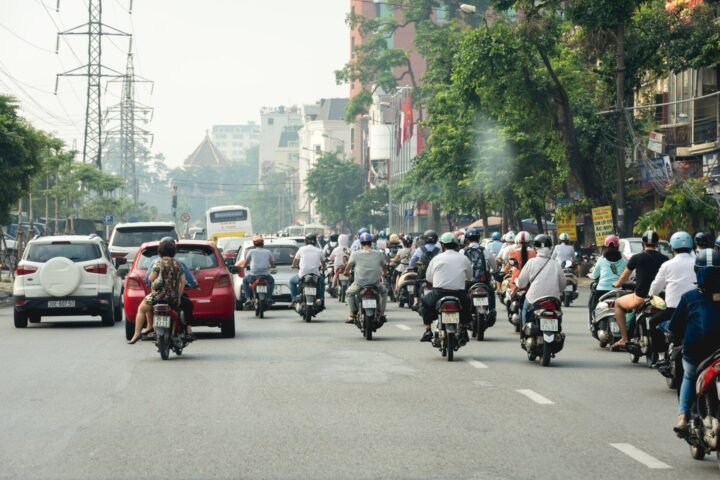
- To cross a street, walk at a slow, steady pace and don’t stop or step backward. The motorbikes are reading your speed and will flow around you; a sudden move is what causes trouble.
- From Friday evening through Sunday night, the streets around Hoan Kiem Lake close to traffic for the weekend walking street. Plan the lake loop for a weekend evening and the Long Bien walk for a weekday.
- Neither metro line reaches the Old Quarter yet. Use them as an elevated ride out of the center, not to get around it; for short hops, a ride-hailing app is faster than any bus.
- When the sidewalk disappears under parked motorbikes, walk in the road along the curb, with the traffic, not against it.
The Honest Take
The Old Quarter is wonderful for two or three hours and tiring after a full day; the noise and the stop-start walking add up. What surprised me was how quickly the city opened up once I stepped outside it. My first evening, I stood on the corner of Dinh Tien Hoang for what felt like five minutes, waiting for a gap in the motorbikes that was never going to come. A woman selling bánh mì from a basket watched me for a while, then took my elbow without a word and walked me across at a perfectly even pace, never once looking at the traffic. On the far side she let go, nodded, and went back to her corner. That’s the lesson Hanoi teaches: there’s no gap to wait for, just a rhythm to step into. Once you have it, the lakes, the bridge and the long walk west all feel close.
1 comment on “Hanoi Travel Guide: Lakes, Old Quarter and Metro”