A two-week holiday is something you book. A three-to-six-month solo trip is something you run, like a small project with a budget, a timeline and a plan for what happens after. People who plan long trips well don’t plan every day. They plan the five things that are hard to fix once you’ve left: money, route shape, paperwork, insurance and the return.
This guide sets out how to plan a long-term solo trip in that order, with a timeline that starts six months before you go. Rules and prices were checked in November 2026.
The project plan
| Months before you leave | Workstream | Done when… |
|---|---|---|
| 6+ | Money | You know your monthly cost and have a savings target with a date |
| 5 | Route shape | You have a rough order of regions and know which visa clocks apply |
| 3–4 | Paperwork and health | Passport, visas and vaccines are sorted or booked |
| 2 | Insurance, banking, phone | You have long-stay cover, two cards and a plan for your number |
| 1 | Home and the return | Your home, post and job (or job search) are handled while you’re away |
Workstream 1: Money
Start here, because the budget sets everything else: how long you can go, and where.
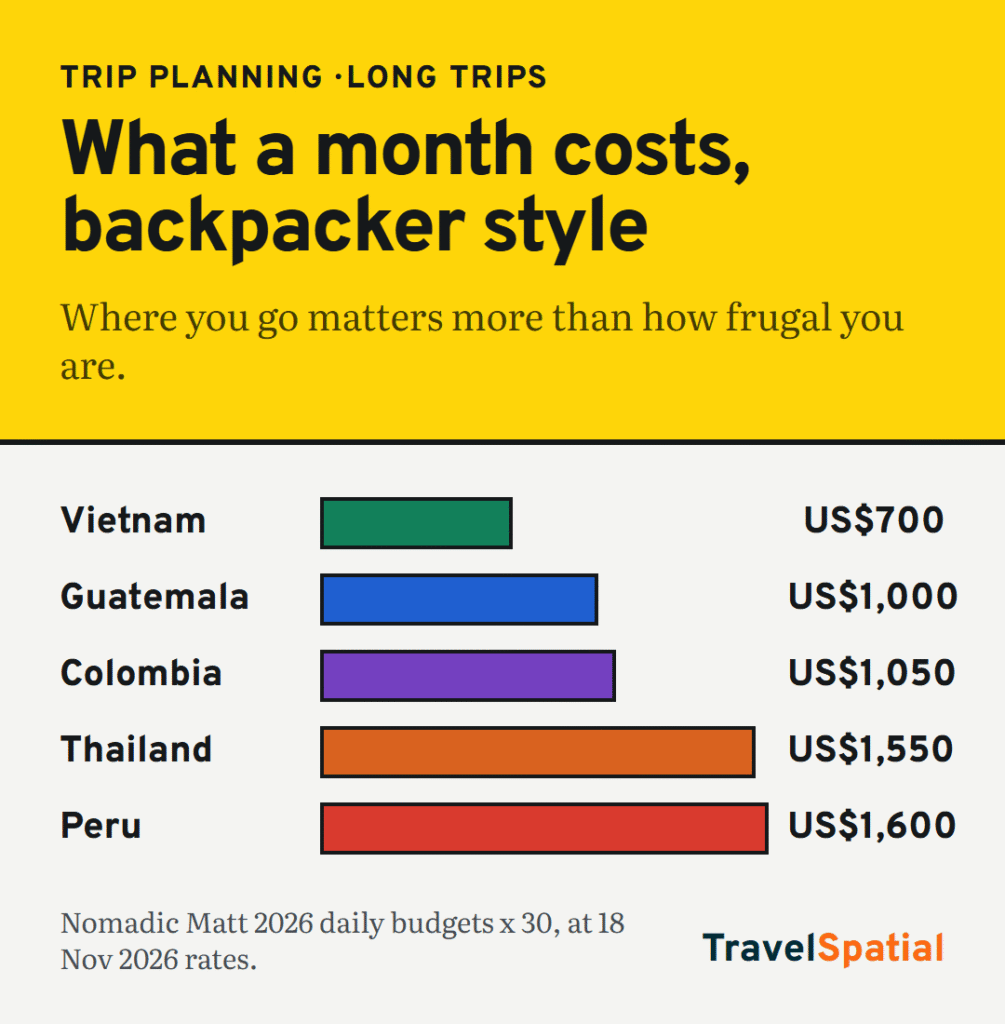
Step 1: estimate your monthly cost by region. The biggest variable isn’t how frugal you are. It’s where you go. These are backpacker daily budgets published by Nomadic Matt in 2026, converted at mid-November 2026 exchange rates and multiplied out to a month:
| Country | Backpacker budget per day | Per month (approx.) |
|---|---|---|
| Vietnam | 600,000 VND (about US$23) | About US$700 |
| Guatemala | 250 GTQ (about US$33) | About US$1,000 |
| Colombia | 115,000 COP (about US$35) | About US$1,050 |
| Costa Rica | US$50 | About US$1,500 |
| Thailand | 1,750 THB (about US$52) | About US$1,550 |
| Peru | 185 PEN (about US$54) | About US$1,600 |
These are lean, hostel-based budgets. Solo travellers pay for whole rooms and whole taxis, so if you want private rooms, add 30–50% (our estimate). For country-by-country detail, see our guides to Southeast Asia solo on a budget and backpacking South America on a budget.
Step 2: build the total. Trip cost = (monthly cost × months) + flights + insurance + gear + a 10–15% buffer. Then add the part most people forget: money to live on when you come home, until your income restarts. A trip that leaves you with nothing on arrival is a trip you’ll spend the last month worrying about.
Step 3: set a date and a monthly savings amount. Divide the total by the months until departure. If the number is impossible, change the route (cheaper regions, slower travel) before you change the date.
Workstream 2: Route shape
You don’t need an itinerary. You need a shape: a rough order of regions that makes sense for weather, visas and flights.
Follow the weather in one direction. Long trips often go wrong by zig-zagging: back and forth across oceans to catch dry seasons. Pick a direction and flow with the seasons. Our shoulder season guide helps with the timing.
Know your visa clocks. The one that catches most long-term travellers is Europe’s Schengen area: 90 days in any 180-day period, counted across all Schengen countries together (UK FCDO, Greece entry requirements). Six months in Europe means planning time outside Schengen, for example in the UK, the Balkans or Turkey. Many countries in Southeast Asia and Latin America have their own limits too. Our visa guide explains how they work.
One-ways or a round-the-world ticket? A round-the-world (RTW) fare bundles your long flights into one ticket. On oneworld’s continent-based Explorer fare, for example, you must start and finish in the same city, cross both the Atlantic and the Pacific, travel in one direction between zones, and take 3 to 16 flights over 10 days to a year (oneworld). It suits a trip that’s genuinely global with a fixed shape. For a trip that stays in one or two regions, or might change, one-way tickets are usually simpler. Budget airlines and overland routes do most of the work, and you’re free to stay longer where you like it.
Plan the first month, leave the rest loose. Book the first flight, the first few nights and a rough plan for weeks one to four. After that, decide on the road. Long trips almost always slow down after the first few weeks, and that’s when they get good.
Workstream 3: Paperwork and health
- Passport: check its validity against the date you’ll come home, not the date you leave. Many countries want six months left on arrival, and on a six-month trip a passport that looks fine today won’t be by the last border.
- Blank pages: some countries need a full blank page for a visa or stamps. Count them.
- Visas you need in advance: apply in the right order, as some need you to be in your home country.
- Vaccines: book a travel health appointment early, as some courses take weeks. The CDC’s destination pages list recommendations by country.
- Prescriptions: ask your doctor how to get a supply for the whole trip, and check the rules for carrying your medicines into each country.
Workstream 4: Insurance, banking and phone
Insurance. Many single-trip and annual policies limit how long each trip can last. You need cover for the whole trip: a long-stay or backpacker policy. Check medical limits, repatriation, the activities you’ll do (trekking altitude, diving, scooters), and whether you can extend from abroad. Our guides to what travel insurance covers and to trekking altitude limits go into detail. If you’ll work remotely, see digital nomad insurance vs travel insurance.
Banking. Take two cards from two different banks, at least one with no foreign transaction fees. Keep them in different places. Tell your banks you’ll be abroad, and make sure you can receive security codes abroad (a banking app is often more reliable than text messages). Our travel money fees guide explains which fees to avoid.
Phone. Decide whether to keep your home number. Many banks still send codes to it. A cheap plan that keeps it active, plus local SIMs or eSIMs on the road, is the usual answer.
Workstream 5: Home and the return
This is the workstream that makes the difference between a trip and a gap in your life.
- Home: sublet, rent out, end the lease or store your things. Redirect your post, or have someone you trust open it.
- Work: if you’re employed, ask about a sabbatical or unpaid leave before you resign. If you’re leaving, update your CV and references before you go, while it’s easy.
- The return: decide now roughly where you’ll live and how you’ll earn when you’re back, and keep that “landing money” in a separate account you don’t touch.
Coming home after months alone is its own adjustment, and people who’ve done it say it’s easier with a plan.
What to pack for months, not weeks
The same as for three weeks. Long trips aren’t packed for their length. They’re packed for a week, with laundry. Our backpack size guide explains why about 40 litres, give or take five, is enough for most warm-weather trips of any length.
Summary
To plan a three-to-six-month solo trip, work through five things in order. Money: monthly cost by region, plus a buffer and money for coming home. Route shape: follow the weather, know your visa clocks, and choose between one-ways and a round-the-world ticket. Paperwork: check your passport against your return date. Cover: long-stay insurance, two cards and your home number. Home: sort the place, the job and the return. Plan the first month in detail and leave the rest open.
Get our long-trip planning guides in the TravelSpatial newsletter.
Sources
- Nomadic Matt, travel guides by country (2026 budgets, checked November 2026)
- oneworld, Round the World tickets (checked November 2026)
- UK FCDO, Greece entry requirements (Schengen 90/180 rule) (updated 3 November 2026)
- CDC Travelers’ Health, destinations
Exchange rates used: open.er-api.com, 18 November 2026.
Photo credits
- Lanterns in Hoi An 4 by Christophe95, CC BY-SA 4.0, via Wikimedia Commons
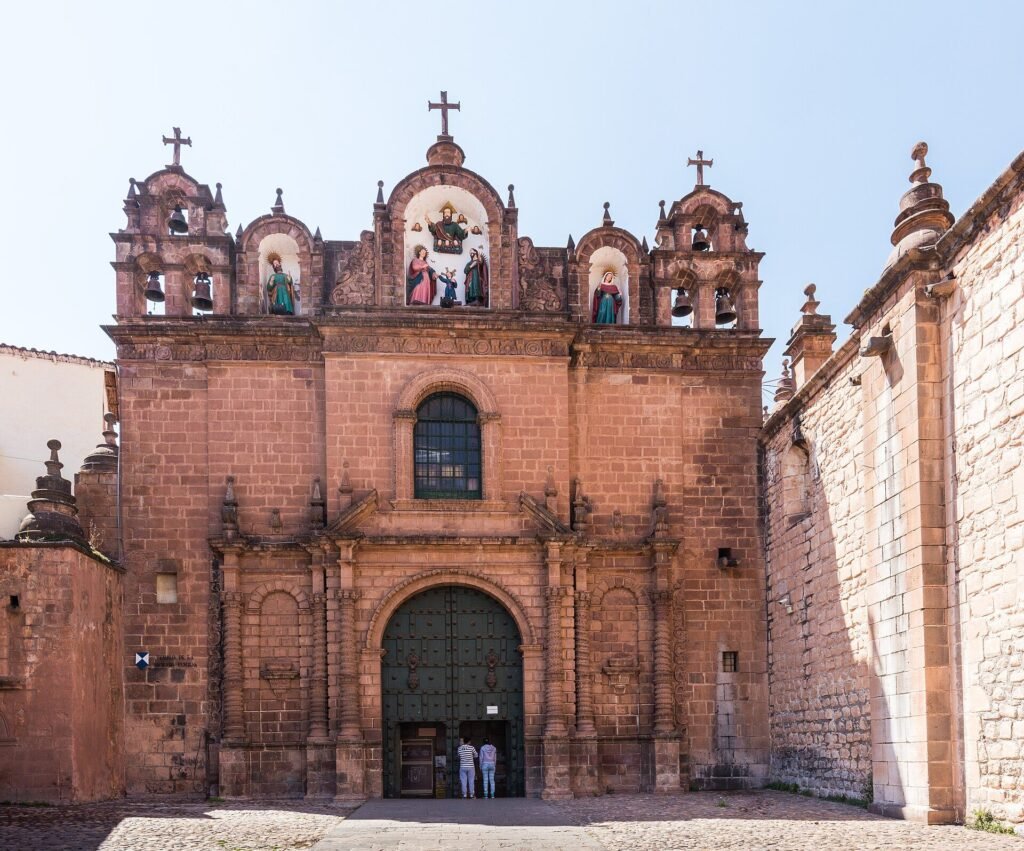
- Catedral, Plaza de Armas, Cusco, Perú, 2015-07-31, DD 57 by Diego Delso, CC BY-SA 4.0, via Wikimedia Commons
The infographic is original to TravelSpatial. Photos are used under the licences linked above.