Door stop alarms are one of the most recommended solo travel gadgets. They’re also one of the least explained. The short answer: a wedge door alarm for a hotel room is a cheap, light way to wake you if a door you’ve closed starts to open. It won’t keep out someone with a key. It only works on doors that open into the room. And whatever you put on a door, you have to be able to remove it in seconds in a fire.
Is that worth the space in your bag? It depends on the kind of room you’re sleeping in. Below are the five questions to ask before you buy one, with straight answers to each.
Question 1: What does each device actually do?
Four kinds of product get sold as “travel door security”. They do quite different jobs.
| Device | How it works | What it does | What it doesn’t do |
|---|---|---|---|
| Rubber door wedge | Jammed under a door that opens inward | Makes the door harder to push open | Make a sound. And it slips on smooth floors |
| Wedge door alarm | A wedge with a pressure switch and a siren | Sounds an alarm when the door presses down on it | Stop anyone who keeps pushing |
| Portable door lock | A metal plate fits into the strike plate and a bar holds the door closed | Stops the door opening, even with a key | Fit every door. It’s also slowest to remove |
| Contact or motion alarm | Two magnets on the door and the frame, or a hanging sensor | Sounds when the door or the handle moves | Hold the door shut |
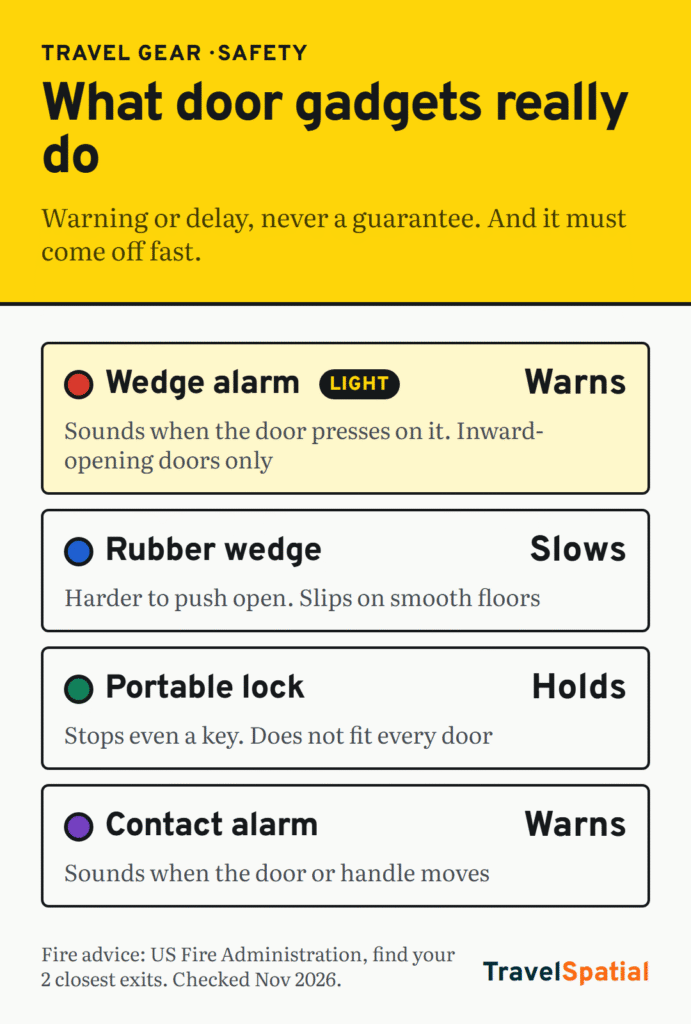
The gadgets that go viral are the wedge alarm and the portable lock. Neither makes a room safe. What they add is warning (the alarm) or delay (the lock), on top of the room’s own deadbolt and latch.
Question 2: Will it fit your door?
This is where many of these gadgets fail. Check three things.
- Which way the door opens. A wedge, alarmed or not, only works on a door that opens into the room, towards you. If it opens outward, a wedge does nothing.
- What the floor is like. Wedges grip on carpet and slip on polished tile or wood. Many wedge alarms come with a rubber base for this reason, but test it on the first night.
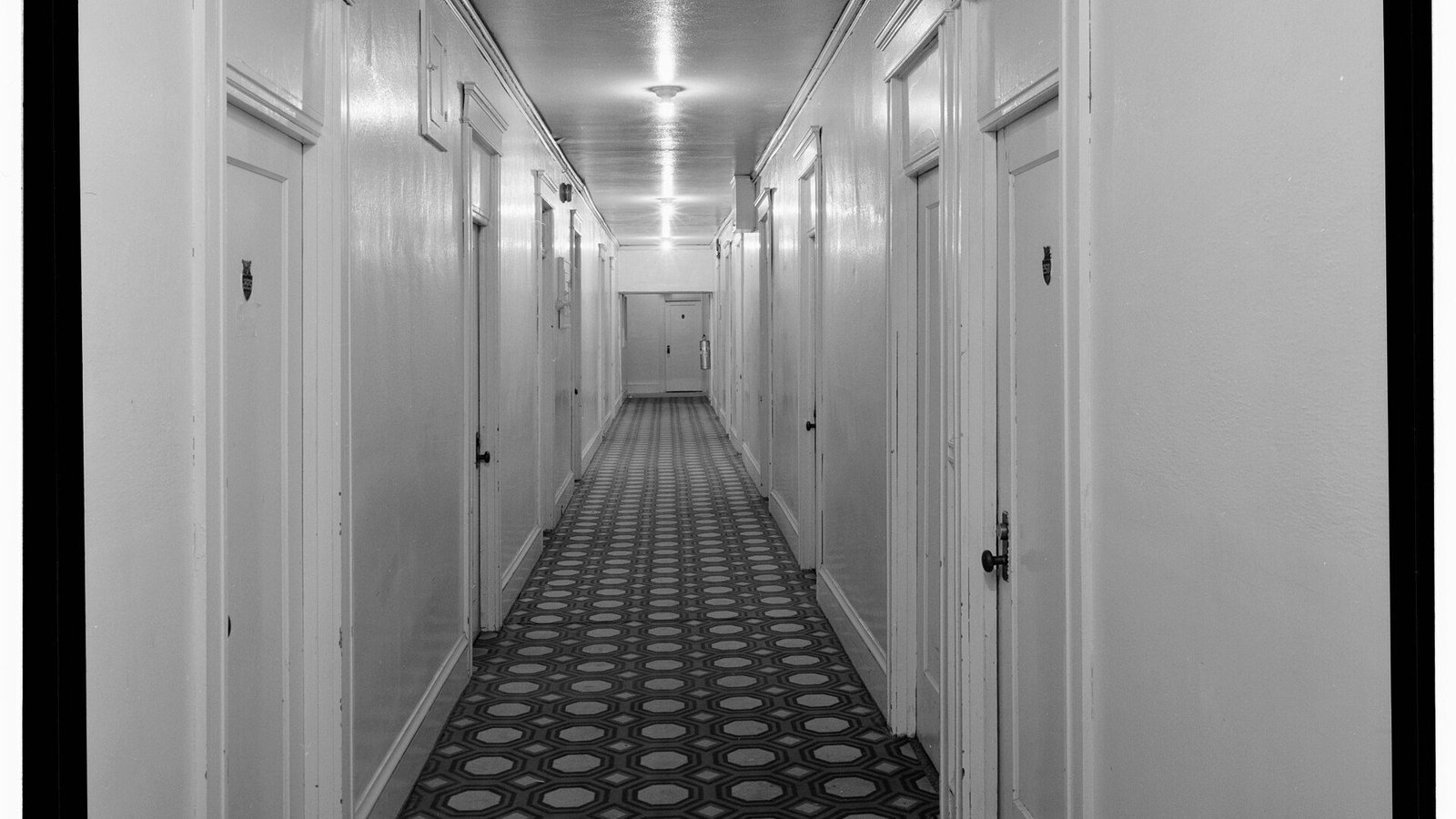
- The gap and the strike plate. Portable locks need a strike plate they can hook into, and a gap between the door and the frame. Some modern hotel doors are too tight for them, and some guesthouse doors don’t have a standard strike plate.
Our tip: pack a small piece of anti-slip drawer liner under the wedge. It weighs almost nothing and helps on hard floors.
Question 3: What can’t it protect you from?
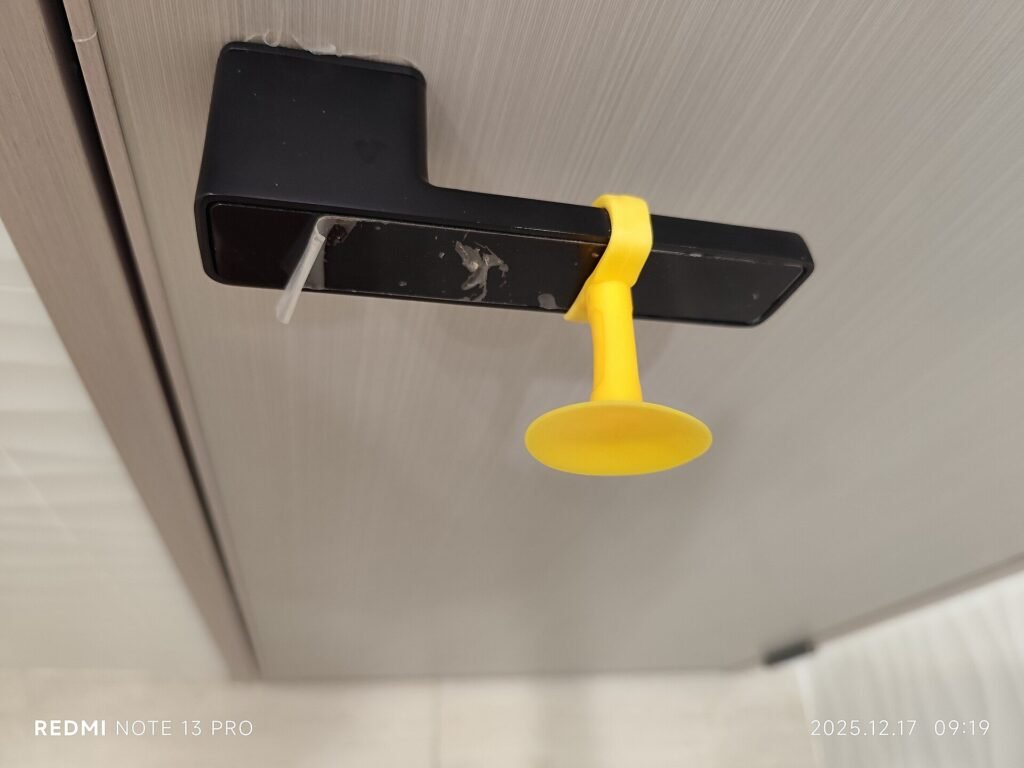
Be honest about what you’re buying. A wedge alarm tells you that a door is opening. It doesn’t tell you who’s opening it, and it won’t stop them. Housekeeping, maintenance or anyone else with a key card can still open the room’s lock. The wedge only adds a moment of resistance and a lot of noise.
The room’s own fittings already do most of the work:
- The deadbolt (the thumb-turn lock on the inside), which you should turn every time you’re in the room
- The swing bar or chain latch, which stops the door opening more than a few centimetres
- The peephole, for checking before you open the door
- The front desk phone, for checking that an unexpected “staff” knock is real
If a room has a working deadbolt and a latch, a wedge alarm adds an early warning and little else. If a room has neither, which is more common in budget guesthouses and some private rentals than in hotels, a wedge or portable lock fills a real gap.
Question 4: What happens if there’s a fire?
This is the question the viral videos skip. In an emergency you need to get out fast, and emergency crews may need to get in.
The US Fire Administration’s hotel fire safety advice tells guests to “find the 2 closest exits from your room” and to count the doors between your room and those exits, “if you need to get out in the dark”. For short-term rentals, it adds that you should be able to open “all doors and windows that lead outside”.
We couldn’t find any official guidance specifically about portable door locks or wedges. The common-sense rule follows from the advice above. Use only devices you can remove in seconds, by feel, in the dark. Practise it once on the first night. Before you sleep, put the key card or room key and your phone in the same place every time.
Question 5: Is it worth packing for your trip?
It depends on where you’re sleeping.
| Where you’re sleeping | Room’s own security | Is a wedge alarm worth it? |
|---|---|---|
| Hotel with deadbolt and latch | Good | Optional. Mostly peace of mind |
| Budget guesthouse or homestay | Often a basic lock only | Yes, if the door opens inward |
| Private rental (Airbnb and similar) | Varies. Others may have had keys | Yes. Check the doors on arrival |
| Hostel private room | Varies | Yes. It’s a good fit |
| Hostel dorm | Shared door | No. You can’t block a door other guests use |
For many solo travellers the real value is sleep. A quiet back-up that wakes you if the door moves can make an unfamiliar room feel calmer, and a calm traveller makes better decisions. That’s a fair reason to carry a small, light device. Just don’t let it replace the basics.
The two-minute room check (no gadgets needed)
Do this every time you check in:
- Close the door and test the deadbolt and the latch.
- Check that any connecting door is locked from your side.
- Look through the peephole from the bed side of the door.
- Find your two closest exits and count the doors to each one.
- Put your key, phone and shoes in the same spot by the bed.
- Put your wedge or alarm in place only after you’re in for the night.
The verdict
A door stop alarm is a small, cheap warning device. It’s useful in rooms without a good deadbolt and latch (budget guesthouses, private rentals, hostel private rooms) and less useful in a well-kept hotel room. It doesn’t stop anyone with a key, it only works on doors that open inward, and anything you put on a door must come off in seconds in an emergency. Choosing the room well matters more than any gadget. Our guide to choosing where to stay as a solo traveller shows how, and our arrival checklist covers the first night. Deciding between a hostel private room and a budget hotel? See hostel private room or budget hotel.
Want a practical safety tip like this every week? Sign up for the TravelSpatial newsletter.
Sources
- US Fire Administration, Hotel and motel fire safety (page last reviewed 1 April 2023; checked November 2026)
Photo credits
- Hamilton Hotel – 3rd floor corridor – Portland Oregon by Historic American Buildings Survey, Public domain, via Wikimedia Commons
- GD 廣東省 Guangdong DG 東莞市 DongGuan 粵龍酒店 Yue Long Hotel room door handle n yellow rubber doorstops December 2025 N13P 01 by HSOMWEI mATIWM Uatnm LUNGA, CC0, via Wikimedia Commons
The infographic is original to TravelSpatial. Photos are used under the licences linked above.