A country most people only fly through
Every year, millions of travelers see Panama only through the window of a departure gate. That is changing fast. Panama welcomed 1.76 million international visitors in the first half of 2026, up 17.4% on the year before, and a growing share are layover passengers who stepped out of the airport and stayed.
They are onto something. Panama is the narrow land bridge that joined two continents about three million years ago. On a clear day you can see both the Pacific and the Caribbean from a single summit. In one week you can watch a cargo ship rise 26 meters through a lock, sleep in a hut on a Guna island, and drink some of the world’s most expensive coffee in the cloud forest.
This Panama travel guide covers the Canal, Panama City, the islands, the highlands, the culture, and the practical details that make planning easy.
The Panama Canal: see it, then look past it
The Canal is the reason most people know Panama’s name, and it deserves at least half a day. It opened in 1914, runs about 80 km between the oceans, and passed to full Panamanian control on 31 December 1999. The 2016 expansion added the larger Neopanamax locks for today’s giant ships.
What surprises first-time visitors is that the Canal runs on rain. Every ship is lifted into Gatun Lake, an artificial reservoir, and each lockage drains fresh water to the sea. That lake also supplies drinking water to more than half the country.
This makes 2026 an interesting year to visit. After a very wet start to the year, rainfall across the watershed fell about 34% below normal from May through August as El Niño strengthened. In September the Canal Authority cut daily transits from 34 to 32, with a further reduction at the Panamax locks. Guides at the locks now talk about water management as much as engineering.
How to visit:
- Miraflores Locks Visitor Center, 20 minutes from downtown: viewing decks, a museum and a film. Ask about ship schedules, because transits cluster in the morning and afternoon.
- Agua Clara Visitor Center on the Caribbean side: the best view of the Neopanamax locks.
- A partial transit by tour boat (about 5 hours) is the most memorable way to experience a lock from the water.
Panama City: three cities in one
Panama City is really three cities from three centuries, and you can see all of them in a day.
Panamá Viejo (1519)
The original Spanish city was the first European settlement on the Pacific coast of the Americas. The pirate Henry Morgan sacked it in 1671. Today its stone cathedral tower stands in a quiet ruins park with the modern skyline behind it.
Casco Viejo (1673)
The rebuilt colonial quarter, a UNESCO World Heritage Site, is the city’s heart. Restored balconies sit next to crumbling facades, and the plazas fill with musicians at night. Walk the seawall at Paseo Esteban Huertas at sunset, then find a rooftop bar overlooking the bay.
The modern skyline
Across the bay, glass towers rise along Avenida Balboa and the Cinta Costera waterfront park. At the Amador Causeway, the Frank Gehry-designed Biomuseo tells how Panama’s rise from the sea reshaped life on two continents. Its bright, folded roof is hard to miss.
What to eat: start with sancocho, the national chicken soup, then try ceviche at the Mercado de Mariscos fish market and patacones (twice-fried plantains) with everything.
Two oceans of islands
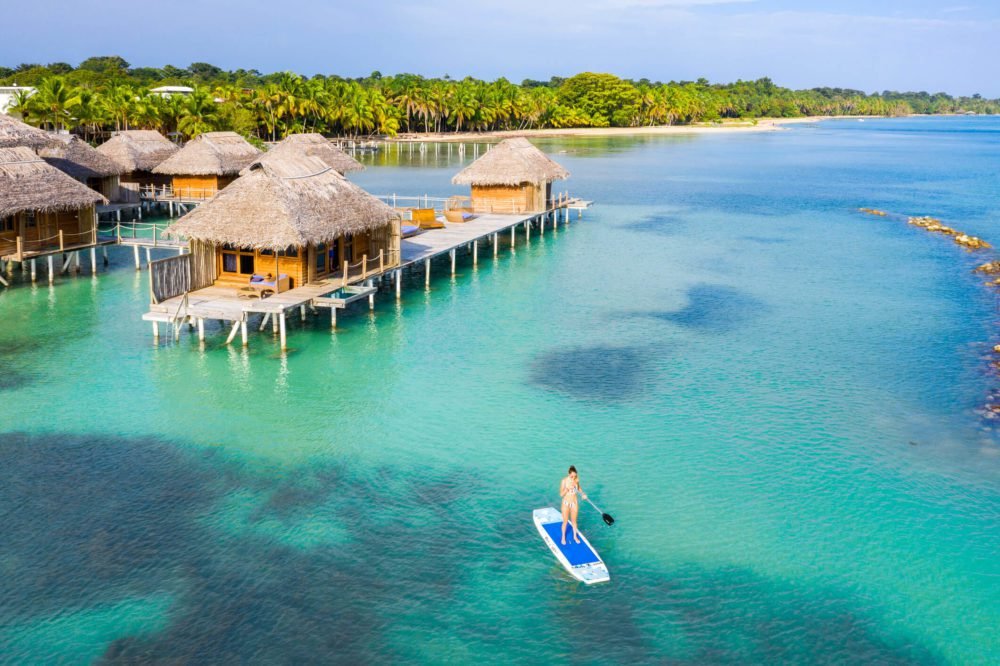
Panama has coastline on two oceans and more than 1,500 islands, and each group has a very different feel. Use this table to pick yours.
| Destination | Coast | Best for | Getting there | Vibe |
|---|---|---|---|---|
| Guna Yala (San Blas) | Caribbean | Postcard islands, Indigenous culture | 4×4 then boat (about 3 hours from the city) | Rustic, no-frills, unforgettable |
| Bocas del Toro | Caribbean | Snorkeling, surf, nightlife | 1-hour flight | Laid-back and social |
| Pearl Islands | Pacific | Easy beach escape, whale watching (Jul–Oct) | 2-hour ferry | Relaxed, resort-friendly |
| Coiba National Park | Pacific | Diving with sharks and rays | Boat from Santa Catalina | Wild and remote |
| Pedasí and Playa Venao | Pacific | Surfing, fishing, small-town life | 5-hour drive | Quiet, up-and-coming |
Guna Yala deserves special mention. The archipelago of about 365 islands is an autonomous territory run by the Guna people, who set their own rules for visitors. Expect simple cabins, fresh fish and a small community fee. Bring cash and respect local photo customs; some families ask a small fee for portraits.
Coiba, a former penal colony, is now a UNESCO World Heritage Site. Its waters are often compared with the Galápagos for marine life.
Cloud forests, coffee and a thousand birds
Panama is small, about the size of South Carolina, but it holds more bird species than the US and Canada combined: roughly 1,000. That richness comes from its role as a bridge between two continents.
Boquete and Volcán Barú
In the western highlands, the mountain town of Boquete is cool, green and full of coffee farms. This is the home of Panama Geisha, a floral coffee that regularly sets world auction records. Book a farm tour to taste it where it grows.
Above town rises Volcán Barú, Panama’s highest point at 3,474 m. Hikers start around midnight to reach the summit at dawn, when, on a clear morning, both oceans are visible at once.
Rainforest near the city
You don’t need to go far for jungle. Soberanía National Park, 40 minutes from the capital, is home to Pipeline Road, one of the world’s most famous birding trails. Look for toucans, trogons and, with luck, a sloth overhead.
A note on the Darién
The vast Darién rainforest on the Colombian border is the only break in the Pan-American Highway. It is beautiful but remote and dangerous. Visit only with licensed operators who run trips to Emberá communities, and never attempt to cross the border overland.
A crossroads culture
Centuries of trade have made Panama a mix of Indigenous, Spanish, Afro-Caribbean, Chinese and many other influences. That blend shows up in the music, the food and the festivals.
- Seven Indigenous peoples live in Panama, including the Ngäbe, Guna and Emberá. Guna women’s molas, layered hand-stitched textile panels, make the best souvenir you can buy, ideally from the maker.
- Afro-Caribbean heritage is strongest in Colón, Bocas del Toro and Portobelo. Coconut rice, rondón stew and calypso rhythms tell the story of workers who came to build the railroad and the Canal.
- Carnival, in the four days before Ash Wednesday, is the biggest party of the year. Las Tablas hosts the most famous celebration, with water trucks soaking the crowds.
- The pollera, Panama’s elaborate national dress, takes months to embroider by hand. Look for it at festivals and parades.
A fun myth to bust: the Panama hat is actually made in Ecuador. It got its name because Canal workers and gold-rush travelers bought them in Panama. For a truly Panamanian hat, look for the black-and-white sombrero pintao.
Practical tips before you go
| Topic | What to know |
|---|---|
| Best time to visit | Dry season, mid-December to April. The rainy season (May–November) brings afternoon showers, greener landscapes and lower prices. Bocas del Toro follows its own pattern; September and October are often its sunniest months. |
| Currency | The US dollar is used everywhere. Panama’s own balboa coins circulate alongside US coins at the same value. |
| Entry | Citizens of the US and Canada need no tourist visa and can stay up to 180 days; many European citizens get 90 days. Carry a passport valid for at least 3 months and proof of onward travel. Check rules for your nationality before booking. |
| Getting around | Panama City has a clean, cheap Metro and ride-hailing apps. Domestic flights reach Bocas and David; long-distance buses are cheap and reliable. |
| Long layover? | Copa Airlines’ Panama Stopover program lets you break a connection at Tocumen airport and spend a few days in the country at no extra airfare. |
| Water and health | Tap water is safe in Panama City and most towns. Bring strong sunscreen and insect repellent, and get travel insurance that covers evacuation from islands and jungle. |
Don’t just pass through
Panama rewards the traveler who slows down. In a single week you can watch the engineering marvel that links two oceans, wander a colonial quarter, sleep on a Caribbean island and wake up above the clouds in coffee country. Few places pack that much variety into such a small, easy-to-reach country.
So next time your flight connects through Panama City, don’t stay in the terminal. Step outside and stay a while.
Planning your trip? Subscribe for our weekly Central America guides, and tell us in the comments which part of Panama you’d visit first.