

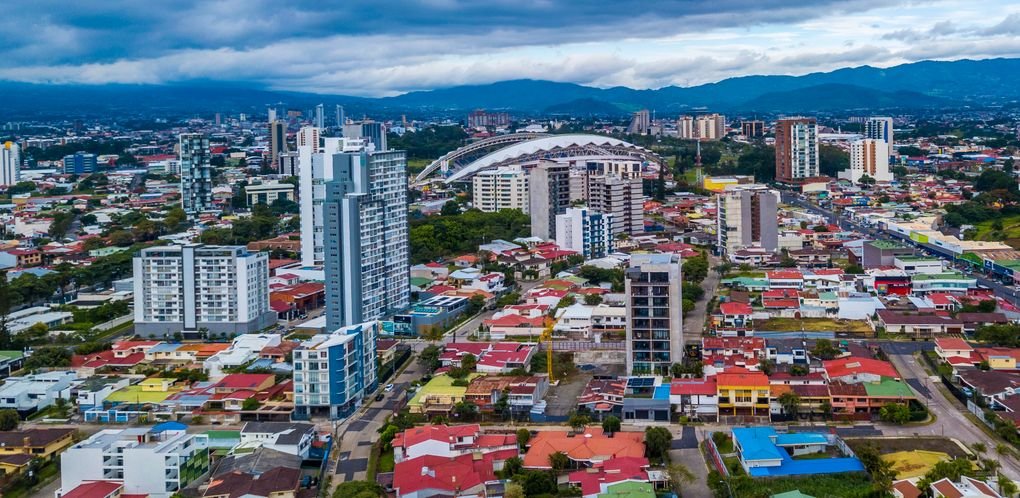
What if one small country could give you misty cloud forests, smoking volcanoes and two different oceans in a single week? That is Costa Rica. Wedged between Nicaragua and Panama, it covers about 51,000 km² — roughly the size of West Virginia — yet it holds a staggering share of the planet’s life.
Travelers have noticed. Costa Rica logged its best first half on record in 2026, with 1,605,360 air arrivals from January to June, up 7.8% on 2025 (La Nación). By July the year’s total had passed 2 million.
Locals sum up the country’s spirit in two words: pura vida — “pure life.” It works as hello, goodbye, thanks and a whole philosophy. In this guide you will learn why Costa Rica stands out in Central America, where to go, and how to plan your trip.
A Biodiversity Hotspot Like No Other
Costa Rica covers just 0.03% of Earth’s surface yet holds nearly 6% of its biodiversity, according to the Embassy of Costa Rica. The reason is geography: the country is a land bridge where North and South American species have mixed for millions of years.
About a quarter of the country is protected across more than 185 national parks, wildlife refuges and biological reserves, run by the national conservation system SINAC (Rough Guides). Forest now covers roughly half the land.
What you might spot on a single trip:
- Sloths hanging motionless in cecropia trees
- Resplendent quetzals flashing emerald in the Monteverde cloud forest
- Scarlet macaws squawking overhead on the Osa Peninsula
- Sea turtles nesting on Tortuguero’s Caribbean beaches
- Humpback whales calving off Marino Ballena on the Pacific
For the wildest experience, head to Corcovado National Park on the Osa Peninsula. It is remote, humid and, for many naturalists, the crown jewel of the country.
Two Coasts, a Ring of Volcanoes and Everything Between
Costa Rica is one of the few countries where you can watch sunrise over the Caribbean and sunset over the Pacific on the same day. Between the coasts runs a spine of mountains and volcanoes. Here is where to aim, depending on your style:
| Region | Best for | Don’t miss |
|---|---|---|
| Arenal / La Fortuna | Volcano views, hot springs, ziplining | Hiking the old lava flows below the cone |
| Monteverde | Cloud forest, hanging bridges | A guided night walk for frogs and tarantulas |
| Guanacaste (North Pacific) | Dry-season sunshine, resorts, surf | Sunset at Playa Tamarindo or Nosara |
| Manuel Antonio (Central Pacific) | Beaches inside a national park | Monkeys and sloths steps from the sand |
| Osa Peninsula (South Pacific) | Raw rainforest, wildlife | A guided trek into Corcovado |
| Caribbean coast | Afro-Caribbean culture, turtles | Rice-and-beans in Puerto Viejo; Tortuguero’s canals |
First-timers often pair Arenal, Monteverde and one Pacific beach in 7–10 days. With two weeks, add the Caribbean or the Osa for a completely different flavor.
Central America’s Green Leader
Costa Rica generated 98.6% of its electricity from renewable sources in 2025 — water, geothermal, wind, biomass and sun — according to the state utility ICE (El Mundo CR). That was a rebound from 2024, when an El Niño drought pushed the share down to about 86% (Observador CR).
The forest story is just as striking. Around 1940, three-quarters of the country was forest. By the late 1980s, cattle ranching and logging had cut that to roughly a fifth. Then Costa Rica started paying landowners to protect and replant trees, and cover has climbed back to about 57% (ScienceBlog).
It all traces back to an unusual choice. In 1948, after a brief civil war, Costa Rica abolished its army and steered that money into schools, health care and later conservation. More than 75 years on, it still has no military.
For travelers, this means ecotourism here is not a marketing slogan. Look for lodges with the national CST sustainability certification, hire local guides, and you will be part of the model that keeps the forests standing.
Plan Your Trip: Practical Tips
Most travelers need little more than a passport and a return ticket. Here is the essentials checklist, based on the U.S. State Department’s Costa Rica page:
| Topic | What to know |
|---|---|
| Entry (U.S. citizens) | No visa for tourist stays; officials may grant up to 180 days. Passport valid for your whole stay, plus proof of onward travel |
| Other nationalities | Rules vary by country — check with Costa Rica’s immigration service before booking |
| When to go | Dry season runs roughly December–April; the “green season” (about May–November) brings afternoon rain, lush scenery and lower prices |
| Getting in | Two main airports: San José (SJO) for the Central Valley and Caribbean, Liberia (LIR) for Guanacaste |
| Getting around | Shuttles and domestic flights are easy; if you drive, rent a 4×4 for rural roads and avoid driving at night |
| Money | The currency is the colón; U.S. dollars and cards are widely accepted in tourist areas |
| Safety | The State Department rates Costa Rica Level 2 (increased caution) for petty crime. Never leave valuables in a car or on the beach |
One warning matters more than any other: respect the ocean. Rip currents drown visitors every year, and most beaches have no lifeguards. Swim only where lifeguards are posted — Manuel Antonio, Tamarindo and Playa Guiones are among them — and never swim alone or after drinking.
Also pack insect repellent (dengue and chikungunya circulate), drink bottled or filtered water where you are unsure, and buy travel insurance that covers adventure sports.
Pura Vida Is Waiting
Costa Rica packs more into a small space than almost anywhere in Central America: two coasts, active volcanoes, cloud forests and about 6% of Earth’s species. It also shows that a country can protect nature and still welcome millions of visitors — powered almost entirely by clean electricity.
Whether you come for sloths, surf or a soak in volcanic hot springs, you will leave understanding why pura vida is more than a slogan.
Ready to start planning? Save this guide, pick your first two regions from the table above, and book during the green season for the best value. Have you been to Costa Rica? Share your favorite spot in the comments.

1 comment on “Costa Rica: Why Central America’s Green Jewel Belongs on Your List”