


Cooking in a hostel kitchen is one of the simplest ways to make a backpacking budget last. Lots of people have worked that out: in Hostelworld’s 2026 survey, 27.5% of solo travellers said they now cook instead of eating out to save money (Hostelworld, State of Solo Travel 2026). But hostel kitchens have their own rules. There’s one frying pan, a fridge shared by forty people and no spices. And in some countries, cooking doesn’t save anything at all.
This is a practical manual for cooking for one in a hostel: where it pays, a small kit that makes it work, a 7-day shopping list built around one bag of groceries, and the kitchen etiquette nobody writes on the wall.
Where cooking actually saves money
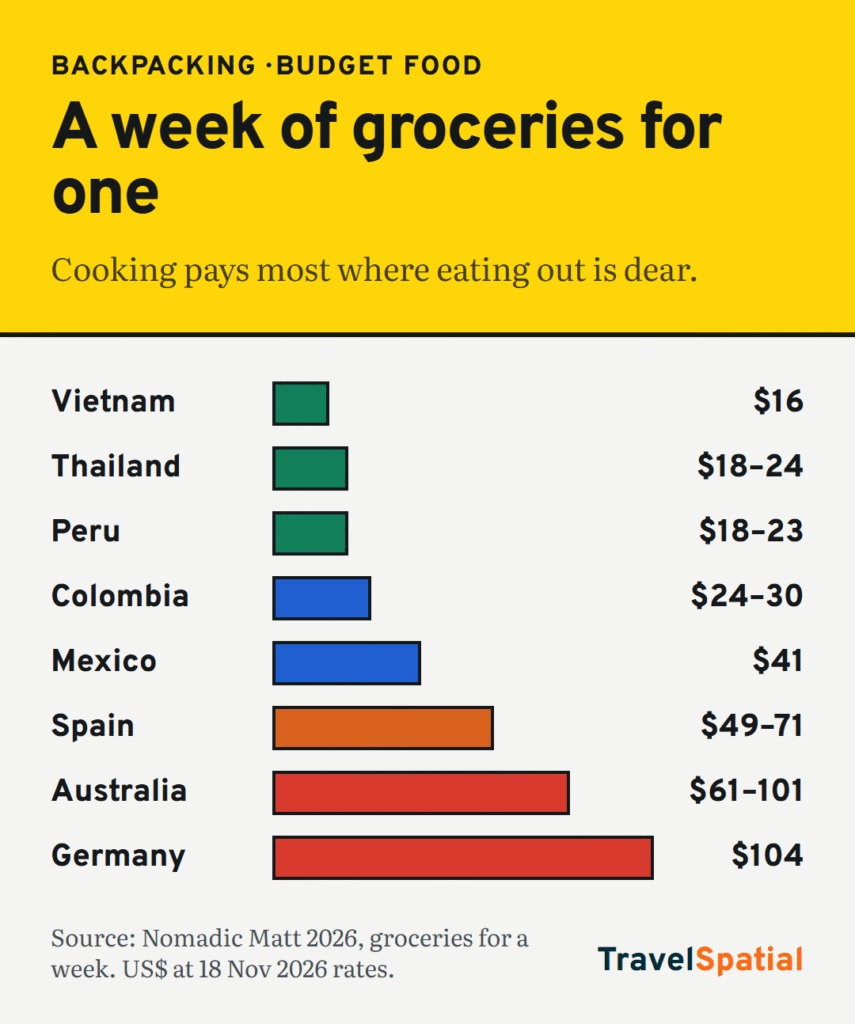
The table uses Nomadic Matt’s 2026 estimates for “groceries for a week” for one person, converted at exchange rates on 18 November 2026 and rounded.
| Country | A week of groceries | ≈ US$ | Is cooking worth it? |
|---|---|---|---|
| Vietnam | 400,000 VND | $16 | Rarely. Street food costs about the same |
| Thailand | 600–800 THB | $18–24 | Rarely. Street dishes are 30–100 THB |
| Peru | 60–80 PEN | $18–23 | Sometimes. Set lunches are cheap, dinners aren’t |
| Colombia | 80,000–100,000 COP | $24–30 | Sometimes, for breakfast and dinner |
| Guatemala | 200 GTQ | $26 | Sometimes |
| Mexico | 750 MXN | $41 | Sometimes. Street tacos compete well |
| Japan | ¥7,000 | $44 | Yes for breakfast. Convenience-store dinners compete |
| Spain | €45–65 | $49–71 | Yes. A set lunch averages about €14.70 |
| Costa Rica | 20,000–30,000 CRC | $45–67 | Yes. Eating out is expensive |
| Australia | AUD 90–150 | $61–101 | Yes, clearly |
| Germany | €95 | $104 | Yes, clearly |
Sources: Nomadic Matt’s 2026 country guides for Vietnam, Thailand, Peru, Colombia, Guatemala, Mexico, Japan, Spain, Costa Rica, Australia and Germany. The Spanish set-lunch average comes from a 2026 Hostelería de España and Edenred survey, as reported by Euro Weekly News.
The pattern: in Southeast Asia, cook breakfast at most and eat everything else out. In Europe, Australia and Costa Rica, cooking dinner is one of the biggest savings you can make. In Latin America, the smart mix is a cheap set lunch out and a simple dinner in. Our guide to eating alone on a budget lists the set lunches by country.
The travel kitchen kit
Hostel kitchens usually have pans, plates and cutlery. What they lack is everything small. This fits in a bag the size of a wash bag:
- A few zip-lock bags for open packets in the shared fridge
- A marker pen for labelling (see the etiquette rules below)
- A small tub of salt and a mixed dried herb or chilli blend, refilled from supermarkets on the way
- A small bottle of oil or soy sauce, bought locally and finished before you fly, since liquids rules apply in the cabin
- A lightweight container with a lid for leftovers and next-day lunch
- A spork or folding cutlery for eating out of the container on a bus
- A tea towel that doubles as a pan holder
Buy a cheap knife locally if you need one, and leave it behind when you fly. Blades aren’t allowed in cabin bags.
A 7-day shopping list for one
This is built around one shop, about 15 minutes in a supermarket, and dishes that need a single pan or pot. Quantities are for one person, cooking breakfast and dinner, with lunch out or from leftovers.
The base (lasts all week): – 1 kg rice or pasta – 500 g oats – 6–10 eggs – 1 tin of tomatoes and 1 tin of beans or chickpeas – 1 small bag of lentils – 1 jar of peanut butter – Bread or tortillas
The fresh part (buy twice a week if you can): – Onions, garlic, carrots, peppers, whatever greens are cheapest – Bananas and one other local fruit – Milk or yoghurt – A block of cheese
The week’s menu:
| Day | Breakfast | Dinner |
|---|---|---|
| 1 | Oats with banana | Pasta with tomato, onion and garlic (make double) |
| 2 | Eggs on toast | Leftover pasta, plus a fried egg |
| 3 | Oats with peanut butter | Lentil and tomato stew with rice (make double) |
| 4 | Yoghurt and fruit | Leftover stew in a wrap with cheese |
| 5 | Eggs and peppers in a tortilla | Fried rice with egg and whatever vegetables are left |
| 6 | Oats | Beans, rice and a local sauce |
| 7 | Whatever’s left | Eat out: you’ve earned it |
At the Spain-to-Germany end of the grocery table, that week replaces about 14 meals out with one bag of shopping. That’s where the 27.5% are saving their money.
Kitchen etiquette: the unwritten rules

Every hostel kitchen has the same five unwritten rules. Follow them and you’ll be welcome. Break them and you’ll find a passive-aggressive note on the fridge.
- Label everything. Your name and the date you leave, on every bag in the fridge. Unlabelled food gets thrown out or eaten.
- Wash up immediately. Not after you eat, not tomorrow morning. There’s one big pan, and someone else is waiting for it.
- Check the free shelf before you shop. Departing guests leave oil, salt, pasta and half-used spices behind. Take what you’ll use, and leave yours when you go.
- Don’t take other people’s food, even “just a bit of milk”. Ask, and most people will say yes.
- Mind the peak times. Kitchens are busiest around 18:00–20:00. Cook a bit earlier or later and you’ll get the hob to yourself.
Our tip: the kitchen is also one of the easiest places to meet people. Offering a portion of a double batch to whoever’s waiting for the pan is a natural opener. Our guide to meeting people when you travel solo has more low-effort ways to start a conversation.
When not to cook
- When street food is cheaper. In Vietnam or Thailand, a hot dinner on the street often costs about the same as the ingredients, and it’s half the fun.
- When the kitchen is a microwave and a kettle. Check the photos before you book if you plan to cook. Our dorm guide lists what to look for.
- When you’re tired. A set lunch is still cheap, and a skipped meal costs more in the long run.
Summary
Cooking in a hostel kitchen saves the most in Europe, Australia and Costa Rica, where a week of groceries costs about US$45–104, much less than eating out. In Southeast Asia, street food is usually as cheap as cooking. Pack a tiny kit (zip bags, a marker, salt and herbs, a container), shop once for a week of one-pan meals, and follow the five rules: label, wash up, use the free shelf, don’t take, avoid the 18:00 rush.
Get one cheap-eats guide a month in the TravelSpatial newsletter.
Sources
- Hostelworld, State of Solo Travel 2026 (checked November 2026)
- Nomadic Matt 2026 country guides, “groceries for a week”: see the links under the table above (checked November 2026)
- Euro Weekly News, Spain menú del día prices (24 October 2026)
- Exchange rates: ExchangeRate-API (18 November 2026)
Photo credits
- Kitchen at Destino26 hostel in Montevideo by Mx. Granger, CC0, via Wikimedia Commons
- Hostel Warszawa w Warszawie by Аимаина хикари, CC0, via Wikimedia Commons
The infographic is original to TravelSpatial. Photos are used under the licences linked above.

2 comments on “Hostel Kitchen Cooking for One: Where It Pays, a 7-Day Shopping List and the Unwritten Rules”