
“Which site is cheaper for hostels, Hostelworld or Booking.com?” The honest answer is it depends on the bed, and usually by about the price of a coffee. One comparison site checked 8,218 hostels listed on both platforms and found the dorm price differed by around 15% in a typical month, about US$2 a night (Hostelz). Small, but over a month of dorms that adds up. And headline prices aren’t the only thing that differs. What you pay up front, what you get back if you cancel, and which fees are quietly non-refundable all vary too.
We read the terms, the help pages and the comparisons so you don’t have to. Here’s what we found, translated into plain English, plus a ten-minute test you can run on any hostel before you book.
A note on sources: several of the comparisons that rank for this question are published by sites that earn commission from one or both platforms, including the one quoted above. We’ve used their data where it’s specific, and the platforms’ own terms where it matters.
The verdict first
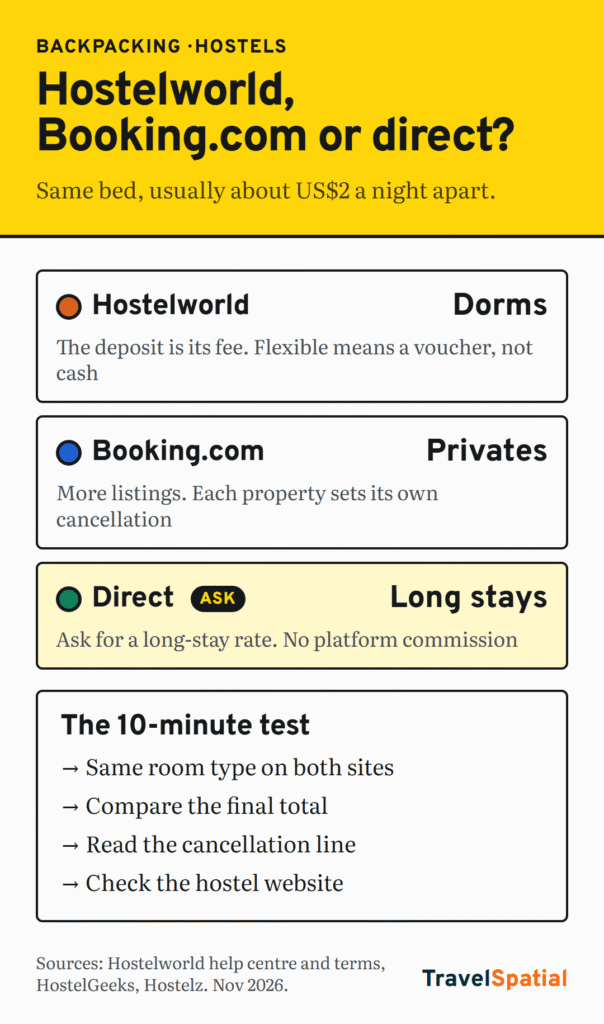
| If you’re booking… | Usually best | Why |
|---|---|---|
| A dorm bed | Hostelworld, after a quick comparison | Dorms are often cheapest there, and its social features help solo travellers |
| A private room in a hostel | Booking.com, after a quick comparison | Private rooms are often cheaper there, with more flexible cancellation options |
| A stay of a week or more | The hostel directly | Ask for a long-stay rate. A direct booking saves the hostel the platform’s commission |
| Peak dates in a popular city | Whichever has the bed | Availability matters more than US$2 |
The dorm-vs-private split comes from HostelGeeks, which notes that dorms can be cheapest on Hostelworld while private rooms are cheaper on Booking.com (HostelGeeks). It’s a pattern, not a rule, which is why the test below matters.
The fine print, translated
Hostelworld
- You pay a deposit when you book, and that deposit is Hostelworld’s fee. The help centre says the guest pays a percentage to secure the booking, and this payment “is retained by Hostelworld as a service fee/commission”. The rest is paid to the hostel, usually at check-in (Hostelworld help centre).
- Some hostels take the balance before you arrive. Properties can ask for up to 100% of the total in advance, by a deadline, and cancel the booking if you don’t pay.
- There may be a booking fee too. Hostelworld’s terms say you “may also be required to pay a flat booking fee”, and that where one is charged “it is non-refundable in all circumstances” (Hostelworld terms). Check the price breakdown at checkout.
- Cancellation depends on the rate type. Here’s how they work:
| Hostelworld rate | If you cancel in time | If you cancel late or don’t show |
|---|---|---|
| Free Cancellation | Deposit refunded | Deposit lost, and the hostel may charge a fee |
| Standard Flexible (deposit + a small protection fee) | Deposit becomes a voucher, not cash | Deposit lost |
| Standard Non-Flexible | Deposit lost | Deposit lost |
| Non-Refundable / Pay Now | Nothing back | Nothing back |
Source: Hostelworld, rate types explained. The voucher point catches people out: “flexible” here means credit for a future Hostelworld booking, which expires, not money back.
Booking.com
Booking.com lists more hostels than Hostelworld, according to Hostelz’s counts, and lets each property set its own cancellation terms, from fully flexible to non-refundable. Taxes and extras such as city tax or linen fees are set by the hostel on either platform, so the “total” you see may not include everything. Read the line items before you pay.
Booking direct
Every booking through a platform costs the hostel a commission. On Hostelworld, that’s your deposit. That’s why some hostels offer a better rate, a free breakfast or a longer cancellation window when you book on their own website, by email or at the desk. It’s never guaranteed, and you lose the platform’s customer service if something goes wrong, so it works best with hostels you’ve already checked or stayed in.

The 10-minute test
Use this before any booking longer than two nights:
- Search the same hostel, same dates, same bed type on both platforms. Make sure it’s exactly the same room (“6-bed mixed dorm”, not “6-bed female dorm”).
- Go all the way to the final screen on each, where the total, taxes and any fees are shown. Compare those, not the headline prices.
- Note what you’d pay today and what you’d pay on arrival. A lower deposit is better for your cash flow but doesn’t change the total.
- Read the cancellation line for that specific rate. Free cancellation, a voucher or nothing?
- Check the hostel’s own website. If it has a booking engine, compare its price too. If it doesn’t, send a short email for stays of a week or more.
- If Hostelworld turns out more expensive after you’ve booked, HostelGeeks notes you can contact Hostelworld about its price guarantee, within its conditions.
That’s it. On a two-night stay, US$2 a night probably isn’t worth the effort. On a two-month trip, the test pays for a few nights.
What the price doesn’t show: the social side
For solo travellers, the platform can matter beyond price. In Hostelworld’s 2026 solo travel survey of 3,309 people, 45.8% said they meet people through the Hostelworld app, almost as many as the 46.6% who meet people only in person (Hostelworld, State of Solo Travel 2026). It’s Hostelworld’s own survey, so read it with that in mind. Still, if meeting people is half the point of your trip, its chat features are a factor Booking.com doesn’t compete on.
The survey also found that reviews from other solo travellers are the top factor in booking decisions, cited by 58.8%. Whichever site you book on, reading the right reviews matters more than the US$2. Our guide to choosing a hostel dorm explains how to filter reviews to people like you.
Red flags on any platform
- A dorm price far below every neighbour’s. Check recent reviews for “bed bugs”, “noise” or “not as pictured”.
- A non-refundable rate with no real discount. If flexible costs only slightly more, pay it.
- Advance-payment demands sent outside the platform, such as a payment link by message. Check that the request appears in your booking’s own messages first.
- A “hostel” that’s really a private room in someone’s flat. Fine if that’s what you want, but different from a staffed building with lockers and key cards.
Still deciding whether you want a dorm at all? Compare the options in hostel private room or budget hotel.
Summary
Hostelworld and Booking.com usually differ by about US$2 a night on the same bed. Dorms are often cheaper on Hostelworld, private rooms on Booking.com. The bigger differences are in the terms. Hostelworld’s deposit is its commission, a booking fee may apply on top, and “flexible” cancellation gives you a voucher, not cash. Run the 10-minute test on anything longer than two nights, ask hostels directly about long stays, and read the cancellation line for the exact rate you’re booking.
Get our solo travel checklists in the TravelSpatial newsletter.
Sources
- Hostelworld help centre, understanding how payments work and rate types explained (checked November 2026)
- Hostelworld, terms and conditions (checked November 2026)
- Hostelworld, State of Solo Travel 2026 (checked November 2026)
- HostelGeeks, Hostelworld review (checked November 2026)
- Hostelz, why hostel prices differ between sites (checked November 2026)
Photo credits
- Hualien WOW Youth Hostel reception and check-in area, as taken on 30 October 2021 by Kai3952, CC BY-SA 4.0, via Wikimedia Commons
- Hostel 6-bed dorm room, Kuching, Malaysia by Sgroey, CC BY 4.0, via Wikimedia Commons
The infographic is original to TravelSpatial. Photos are used under the licences linked above.