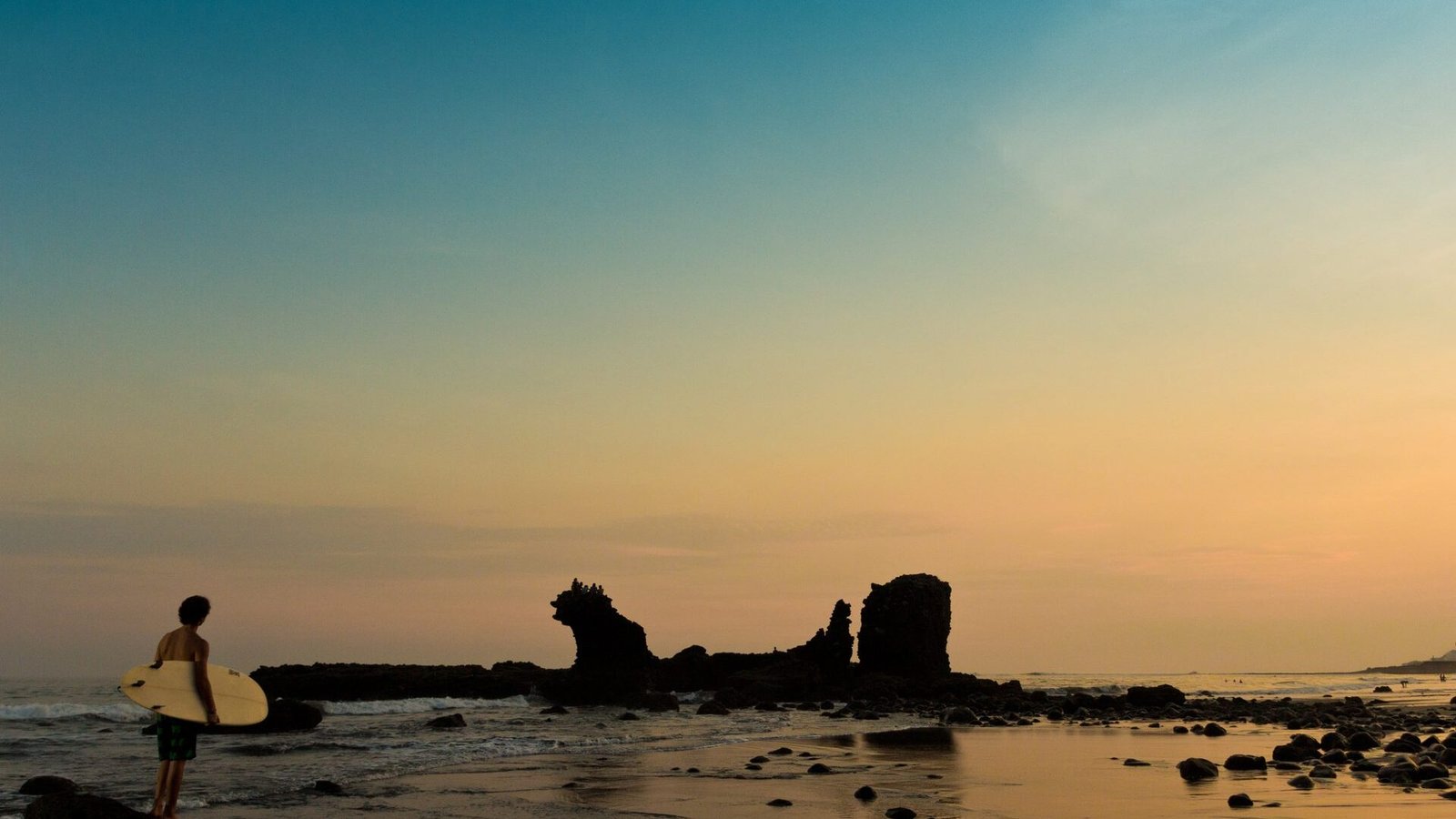
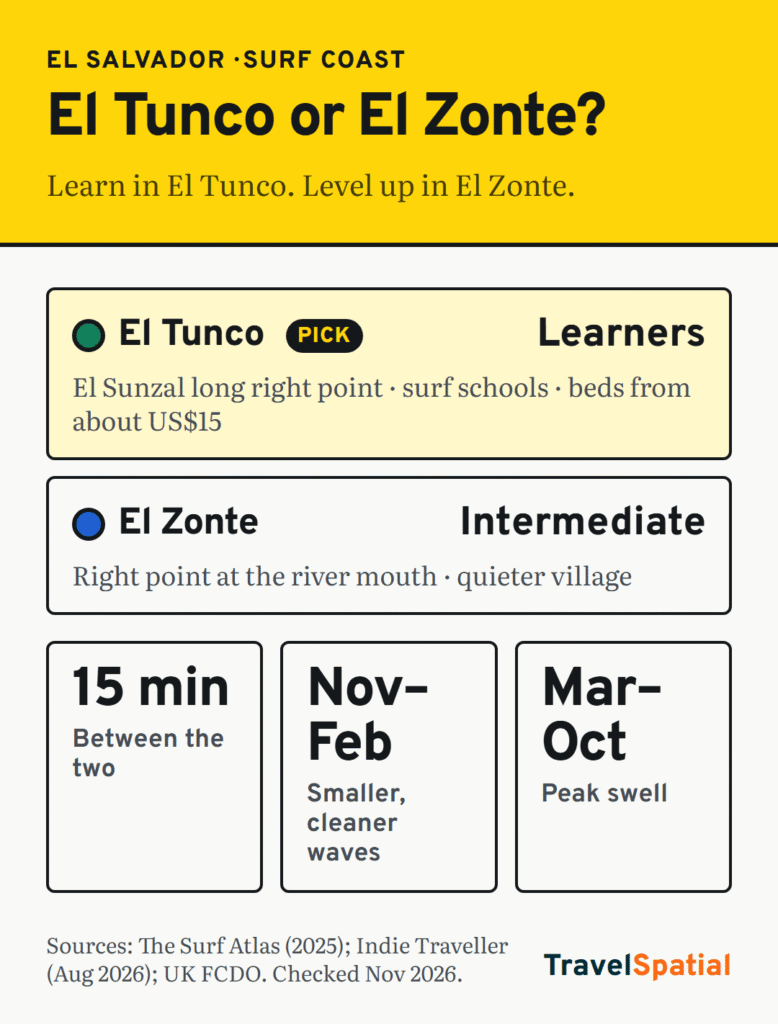
Here’s the short answer. El Tunco if you’re learning: it has the surf schools, the beginner-friendly point at El Sunzal, the widest choice of beds and the nightlife. El Zonte if you can already catch a wave and want a quieter village with a right-hand point break at the river mouth. They’re only about 15 minutes apart by car, so many people stay in one and surf both.
Surf conditions below are from The Surf Atlas, and prices are from recent travel guides, checked November 2026. The ocean decides on the day, so check the forecast and ask a local school before you paddle out.
The two towns at a glance
| El Tunco | El Zonte | |
|---|---|---|
| Main waves | El Sunzal (long right point, beginner to intermediate); La Bocana (fast left A-frame, advanced) | El Zonte Point (right point at the river mouth, soft inside, punchier outside) |
| Nearby | Punta Roca, about 10 min, advanced | K59, about 10 min west, experienced surfers |
| Best for | First lessons, longboarders, a social scene | Intermediate surfers, a quieter stay |
| Beds | Budget about US$15–30; mid-range about US$50–80; luxury about US$100–250 | Fewer options; mostly small hotels and guesthouses |
| Nights | Bars and live music | Early nights |
| Distance between them | About 15 min drive |
The waves, explained without the jargon
El Sunzal (El Tunco). A right-hand point break means the wave peels to the right, from the surfer’s point of view, along a rocky point. The Surf Atlas calls Sunzal the longest right-hand point in the area and rates it for beginners through intermediates and longboarders. It’s the wave most surf schools take students to.
La Bocana (El Tunco). A left-hand A-frame at the river mouth, meaning the peak breaks both ways. The Surf Atlas describes it as fast and sometimes heavy, so it’s for advanced surfers only. If you’re learning, watch it from the sand.
El Zonte Point. A right-hand point at the river mouth that works on small-to-mid swells. The Surf Atlas describes a soft inside section suited to intermediates and a punchier outside for stronger surfers. The ten-minute drive west to K59 is for experienced surfers.
Punta Roca. About ten minutes from El Tunco, and often described as the best wave in the country. Advanced surfers only, when it’s working.
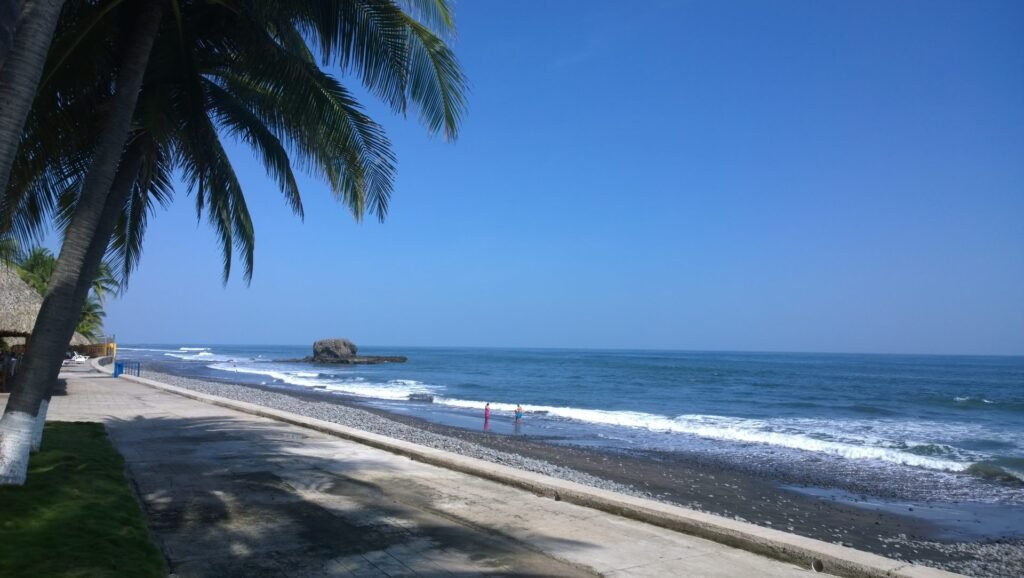
When to go
The Surf Atlas splits the year in two:
| Months | What it’s like | Who it suits |
|---|---|---|
| March–October | Peak swell season, bigger and more powerful waves | Intermediate and advanced; May–August are the best months for wave quality at El Zonte |
| November–February | Smaller, cleaner waves | Beginners and intermediates; a good time to learn |
Water temperature sits at around 26–29°C, so no wetsuit. Winds tend to be offshore in the morning and onshore by midday, so surf early.
Where to sleep
El Tunco has the most choice. Indie Traveller (updated August 2026) groups it roughly like this:
- Budget, about US$15–30 a night: hostels and simple rooms close to the beach.
- Mid-range, about US$50–80: small hotels with pools.
- Luxury, about US$100–250: cliffside hotels and villas.
El Zonte is smaller and quieter, with fewer and more spread-out places to stay. Book ahead in peak months, and choose somewhere walkable to the point.
Getting there
- From the airport (SAL): about 45 minutes by private taxi to El Tunco, around US$30–40, according to The Surf Atlas.
- From San Salvador by bus: route 102A runs about every 20 minutes and takes about an hour, usually for under US$2 (Indie Traveller).
- Between the towns: a 15-minute drive. Hiring a scooter costs about US$25–40 a day if you want to try different breaks.
Safety in the water and out of it
- Currents. The UK Foreign Office warns of strong undertows along the Pacific coast. It says currents at La Bocana de San Diego are especially treacherous, and that several people have drowned there in recent years. There are very few lifeguards. If you’re new, surf with a school, not alone.
- Entry: El Salvador abolished its US$12 tourist entry card in 2025 reforms. Your stay still counts towards the 90-day allowance shared with Guatemala, Honduras and Nicaragua.
- Travel advice: El Salvador has been under a state of exception since 2022. The UK Foreign Office says arrests can be made on weak evidence and consular access may be limited. Keep a copy of your passport photo page with you, and stay away from political demonstrations.
Pick one in ten seconds
- First time on a board → El Tunco, in November–February, with lessons at Sunzal.
- Intermediate, wants a quiet village → El Zonte, in March–October.
- Travelling with a non-surfer who wants a social scene → El Tunco.
- Can’t decide → stay in El Tunco, take a taxi to El Zonte for a dawn session, and be back for lunch.
The short version
El Tunco is the learner’s base: Sunzal’s long right point, surf schools, beds from about US$15 and bars at night. El Zonte, 15 minutes west, has a quieter right point at the river mouth for intermediates. Learn in November–February, when the waves are smaller and cleaner, and come back in March–October for the bigger swells. Planning the wider trip? Our Isthmus Run backpacking route explains why El Salvador’s coast is worth a detour, and our insurance explainer covers what to check before you surf.
Want the next route in your inbox? Join the TravelSpatial newsletter for one mapped itinerary a week.
Sources
- The Surf Atlas: El Tunco and El Zonte (breaks, seasons, distances, airport transfer; updated March 2025)
- Indie Traveller: El Tunco guide (accommodation price bands, bus 102A; updated 25 August 2026)
- El Salvador in English: US$12 entry fee abolished (1 May 2025)
- UK FCDO: El Salvador safety and security, checked November 2026
Photo credits
- El-Tunco-La-Libertad-3 by Pablo J Gonzalez 7, CC BY-SA 4.0, via Wikimedia Commons
- El Salvador – La Libertad, El Sunzal – panoramio by randreu, CC BY 3.0, via Wikimedia Commons
The infographic is original to TravelSpatial. Photos are used under the licences linked above.