

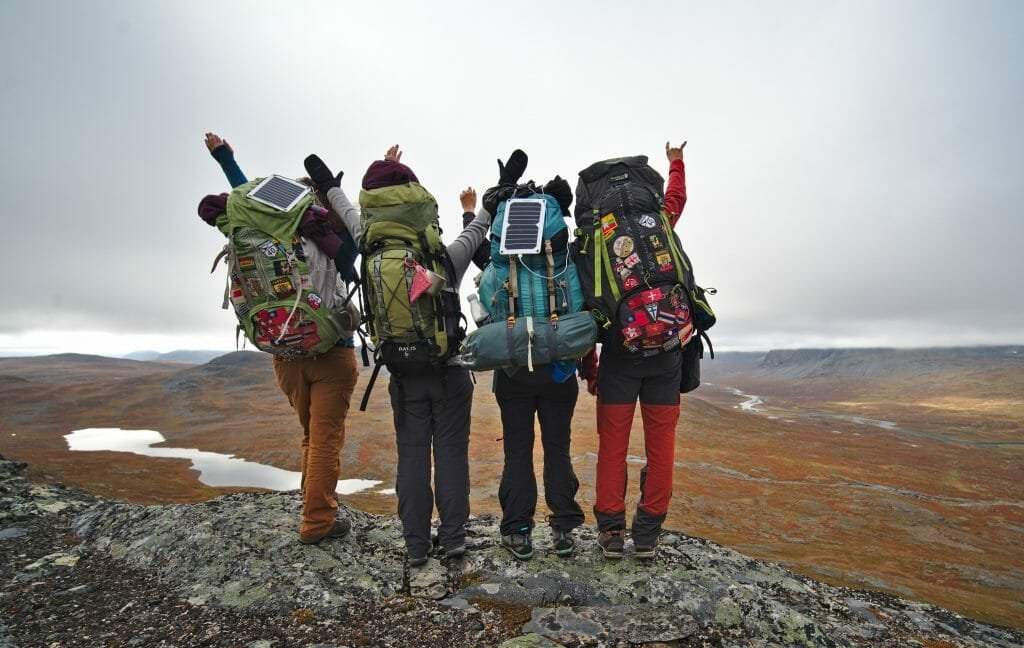
Backpacking routes aren’t lists of places. They’re lines.
Every classic trail has a spine you ride most days, a few bends where people peel off, and one spot where the line breaks: a border, a gap with no road, a ticket that sells out. Get those three right and the rest of the trip takes care of itself. Get them wrong and you lose a week at a bus station.
So this guide does it the TravelSpatial way. For five of the world’s classic backpacking routes, it drops a pin at each end, measures the line between them, and checks what a day on it costs in 2026. Then it shows where the route bends, where it breaks, and which entry rules changed this year.
The list starts on the Mekong and ends in the Atlas Mountains. If you’re still deciding when to go, read our Shoulder Season Travel Guide first, then come back.
The Route Test
A trail made this list only if it passed four checks.
- It works overland. Buses, trains, boats or shared vans can carry you pin to pin. At most one short flight or sailing fills a real gap.
- A dorm-and-street-food budget holds. A day on the route, with a hostel bed, local food and ground transport, lands somewhere between about US$25 and US$60.
- The hostel chain is unbroken. Every overnight stop has dorms and other travellers, so you’re never stuck planning alone.
- It bends. There’s at least one detour off the main line that’s quieter and cheaper, so the famous stops aren’t your only option.
Daily budgets below are 2026 backpacker estimates for one person in dorms, before flights and insurance. Treat them as a starting range, not a quote. Moving slower almost always lands lower.
The Five Routes at a Glance
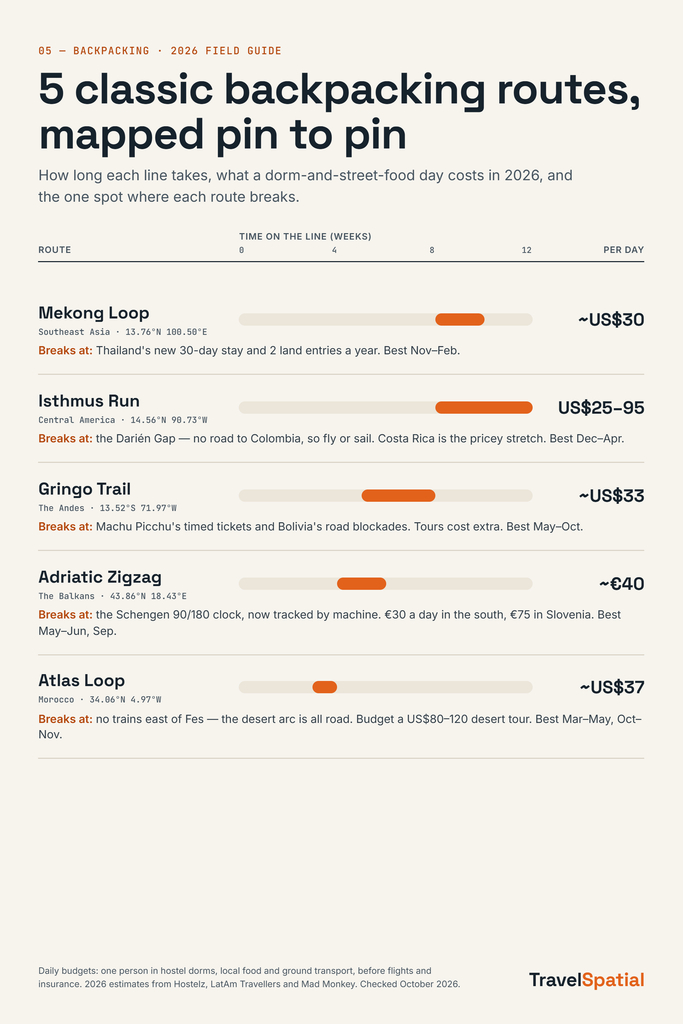
| Route | Start → end pin | Time on the line | Backpacker day, 2026 | Where it breaks | Best months |
|---|---|---|---|---|---|
| Mekong Loop (SE Asia) | Bangkok → Siem Reap, then fly back | 8–10 weeks | ~US$30 (more on Thai islands) | Thai–Cambodian land border closed; Thailand’s 30-day stay | Nov–Feb |
| Isthmus Run (Central America) | Antigua → Panama City | 8–12 weeks | US$25–45; US$60–95 in Costa Rica | Darién Gap: fly or sail to Colombia | Dec–Apr |
| Gringo Trail (Andes) | Lima → San Pedro de Atacama | 5–8 weeks | ~US$32–33 plus tours | Machu Picchu tickets; Bolivian road blockades | May–Oct |
| Adriatic Zigzag (Balkans) | Ljubljana → Ohrid | 4–6 weeks | ~€40 average (€30–75 by country) | Schengen 90/180, now tracked by EES | May–Jun, Sep |
| Atlas Loop (Morocco) | Tangier → Essaouira | 3–4 weeks | ~US$37 plus desert tour | No rail east of Fes | Mar–May, Oct–Nov |
The cheapest day on paper is Southeast Asia or the Andes. The cheapest trip is often Morocco, because it’s short and close to Europe’s budget airlines.
1. Southeast Asia: The Mekong Loop
13.76°N 100.50°E (Khao San Road) → 13.36°N 103.86°E (Siem Reap) → fly back to Bangkok
The line. Bangkok north to Chiang Mai, across the river at Chiang Khong, two days down the Mekong by slow boat to Luang Prabang, then Hanoi and the length of Vietnam by train before cutting west through Phnom Penh and Siem Reap. It’s roughly 4,700 km overland and fits comfortably in 8 to 10 weeks. The old final leg, a bus from Siem Reap back to Bangkok, no longer exists: the land border is closed, so the loop now ends with a one-hour flight.
The spine. Night trains in Thailand and Vietnam, and the public slow boat in Laos. The boat runs Huay Xai to Luang Prabang over two days with a night in Pakbeng, and costs about 500,000 kip (around US$23) without the room (Backpackers Wanderlust).
What it costs. Mainland Southeast Asia is still the cheapest backpacking on the planet. About US$30 a day holds in Vietnam, Cambodia, Laos and northern Thailand, while the Thai islands push past it (Mad Monkey). Two lumpy lines to add: Vietnam’s e-visa is US$25 single or US$50 multiple entry, and Angkor passes are US$37 for one day, US$62 for three and US$72 for seven (Travel Arbitrage).
Where it breaks. At the Thai–Cambodian border, and on Thailand’s clock. Every land crossing between Thailand and Cambodia has been suspended since June 2025, and they were still closed on 18 November 2026. The FCDO also advises against all but essential travel within 20 km of that border (UK FCDO). So reach Cambodia overland from Vietnam (Moc Bai–Bavet) or Laos (Nong Nok Khiene), and fly from Siem Reap or Phnom Penh back to Bangkok. Thailand’s rules matter on the way back. Since 15 September 2026, most passports get 30 visa-free days, not 60 (TTG Asia), and visa-free entries over land or sea are capped at two per calendar year. Air arrivals don’t count towards that cap, so the flight back saves one of your land entries. Keep Thai time short at each end.
The bend. The 3-day Angkor pass is valid across seven days. Base in Siem Reap, do temples on days one, three and five, and spend the rest on Kampot’s river and pepper farms on the way down from Phnom Penh.
Entry check. Laos’s eVisa is accepted only at nine named ports, and Friendship Bridge IV at Huay Xai is one of them. Arrive anywhere else and you’ll need a visa on arrival instead.
Timing. November to February is dry and cooler across the whole loop. Avoid northern Thailand from February to April, when field-burning smoke settles over Chiang Mai.
2. Central America: The Isthmus Run
14.56°N 90.73°W (Antigua, Guatemala) → 8.98°N 79.52°W (Casco Viejo, Panama City)
The line. Antigua to Lake Atitlán, down through El Salvador’s surf coast and Honduras, into León and Granada in Nicaragua, across Costa Rica and on to Panama City. Plan on 8 to 12 weeks. Coming from the north? Our Mexico City layout guide is the natural first pin.
The spine. Chicken buses and tourist shuttles. Shuttles cost more but clear borders in hours, not a day.
What it costs. This is the route where the budget swings hardest. Nicaragua, Honduras and Guatemala run about US$25–45 a day for a backpacker; Costa Rica jumps to roughly US$60–95 (LatAm Travellers). Antigua is Guatemala’s pricey exception, so sleep at the lake and day-trip in.
Where it breaks. At the bottom. There’s no road through the Darién Gap between Panama and Colombia, so the line ends at the water. Most backpackers fly, or take a multi-day sailboat through the San Blas islands to Cartagena, which runs about US$680–780 with one established operator (Lonely Planet). Book a captain with reviews, not the cheapest berth.
The border trap. Guatemala, El Salvador, Honduras and Nicaragua share one 90-day clock under the CA-4 agreement. Crossing between them doesn’t reset it; only leaving the zone does (Living in Guatemala). Linger too long at the lake and you’ll be rushing Nicaragua.
The bend. El Salvador’s coast and western Honduras around Copán get a fraction of the traffic, at Guatemala-level prices.
Check before you go. Nicaragua is visa-free for most Western passports, but its advisories run high and entry decisions can be unpredictable. Read your own government’s advisory the week you travel.
Timing. December to April is dry along most of the line. September and October bring the heaviest rain.
3. The Andes: The Gringo Trail
12.05°S 77.03°W (Lima) → 13.52°S 71.97°W (Cusco) → 20.46°S 66.83°W (Uyuni) → 22.91°S 68.20°W (San Pedro de Atacama)
The line. Lima down the desert coast to Huacachina and Arequipa, up to Cusco and Machu Picchu, across Lake Titicaca to La Paz, south to the Uyuni salt flat, then a jeep over the border into Chile’s Atacama. Budget 5 to 8 weeks, and most of it above 3,000 m. Spending a day in Lima first? Our Lima Metropolitano guide covers it in one bus line.
The spine. Overnight buses between cities, then 4×4 jeeps for the last stretch. A 3-day budget jeep tour across the salt flat and lagoons typically runs US$150–180 (Bolivia Hop).
What it costs. Day to day, this is one of the cheapest lines on the list: about US$32 a day in Peru and US$33 in Bolivia for a hostel traveller (Hostelz). The tours are what push it up, so price Machu Picchu, Colca Canyon and Uyuni as separate lines.
Where it breaks. Two places. At Machu Picchu, entry is by timed circuit, high-season capacity is 5,600 a day, and only 1,000 tickets a day are held for walk-up sale in Aguas Calientes (Peru Hop). Book online the day your month opens. In Bolivia, road blockades over fuel prices cut La Paz off for weeks in May and June 2026, and Canada still advises a high degree of caution on roads to Titicaca and Uyuni (Government of Canada). Build two buffer days into the Bolivian leg.
The good news. US citizens no longer pay for a Bolivian visa. Since 1 December 2025 they can enter visa-free for up to 90 days (Condé Nast Traveler via Yahoo).
The bend. Arequipa and the Colca Canyon. It’s lower than Cusco, so it doubles as altitude training, and the canyon trek costs a fraction of the Inca Trail.
Timing. May to October is the dry season in the highlands. Visit Uyuni from January to March instead if you want the mirror effect, and accept some washed-out roads.
4. The Balkans: The Adriatic Zigzag
46.05°N 14.51°E (Ljubljana) → 43.86°N 18.43°E (Sarajevo) → 41.12°N 20.80°E (Ohrid)
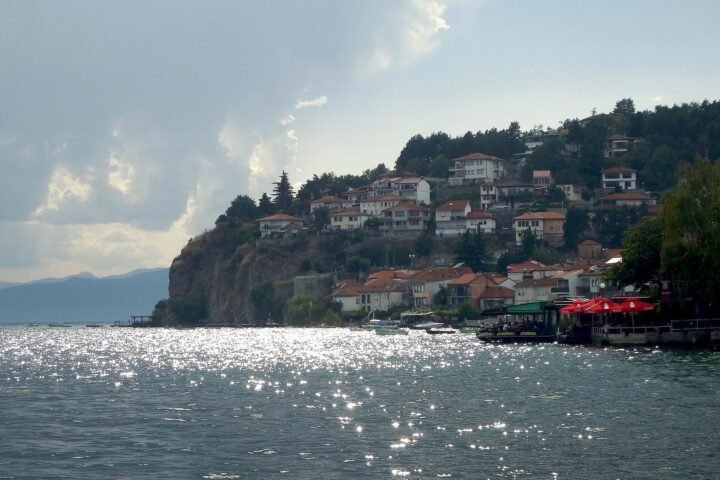
The line. Ljubljana to Zagreb and the Plitvice lakes, down the coast to Split, inland to Mostar and Sarajevo, back to the sea at Kotor, then through Albania to Lake Ohrid. Four to six weeks covers it without rushing.
The spine. Buses, almost entirely. Rail is patchy across the western Balkans, but intercity coaches link every stop, and the inland legs through Bosnia are some of the best bus rides in Europe.
What it costs. Prices fall as the line runs south. A backpacker day runs about €75 in Slovenia and €62 in Croatia, but €33 in Bosnia, €31 in Albania and €30 in North Macedonia. The full loop averages roughly €40 a day (Hostelz). Front-load the expensive north, then let the south stretch your money.
Where it breaks. At every border, on paper. Slovenia, Croatia and Greece are in Schengen; Bosnia, Montenegro, Albania and North Macedonia are not. That matters more now because the EU’s Entry/Exit System became fully operational on 10 April 2026, so your 90-in-180-day count is tracked by machine, not by a stamp an officer might miss (Schengen Visa Info).
The upside. Days in the non-Schengen Balkans don’t touch that clock. US passport holders can even stay in Albania for up to a year visa-free (Schengen Traveler). A slow Balkan middle section lets you save Schengen days for later.
The bend. Albania’s south: Berat, Gjirokastër and the Riviera. A two-week Albanian loop averages about €28.50 a day, around €12 cheaper than the full Balkan route.
Timing. May, June and September are the sweet spot. July and August pack the coast and push Croatian dorm prices toward Western European levels.
5. Morocco: The Atlas Loop
35.78°N 5.81°W (Tangier) → 31.10°N 4.01°W (Merzouga) → 31.51°N 9.77°W (Essaouira)
The line. Off the ferry in Tangier, up to blue-washed Chefchaouen, into the Fes medina, over the Middle Atlas to the Erg Chebbi dunes at Merzouga, back west through the Dades and Todra gorges to Marrakech, and out to the coast at Essaouira. Three to four weeks is right; it’s the shortest line on this list and the easiest add-on to a Spain trip.
The spine. CTM and Supratours buses, plus ONCF trains in the north. Fares are low: Fes to Chefchaouen is about 110 dirhams by CTM, and Chefchaouen to Tangier about 65 (eTravelSIM).
What it costs. About US$37 a day in dorms, with the bed as your biggest line (Hostelz). Treat the Sahara as a separate splurge: shared 3-day desert tours typically run US$80–120 with transport, camp and meals (Social Life Magazine).
Where it breaks. East of Fes. The rail network stops well short of the desert, so the Fes–Merzouga–Marrakech arc is all road. A shared tour that starts in Fes and drops you in Marrakech turns that gap into the highlight instead of two lost bus days. Don’t wait for faster trains either: Al Boraq’s high-speed extension to Marrakech isn’t due until 2029 (Railway Gazette).
The bend. Essaouira and the surf coast south of it. Cooler, calmer and cheaper than Marrakech, with hostels a short walk from the beach.
Timing. March to May and October to November. Summer in the desert is brutal, and the Atlas passes can snow over in winter.
Map Notes: What Changed in 2026
Map Notes
- Thailand halved its visa-free stay. From 15 September, 60 eligible nationalities get 30 days, not 60, and visa-free land or sea entries are capped at two per calendar year (TTG Asia). Loops that cross back into Thailand by bus need replanning.
- The Thailand–Cambodia land border closed. All crossings have been suspended since June 2025 after fighting along the frontier, and remained closed on 18 November 2026 (UK FCDO). Fly between the two countries, or enter Cambodia from Vietnam or Laos.
- Bolivia opened up, then shut its roads. US citizens have entered visa-free since December 2025. But blockades over fuel prices ran for weeks this spring, and Bolivia has told the IMF it will end fuel subsidies from January 2027, which unions have protested before (Latin Times).
- Europe’s border clock went digital. The Entry/Exit System has been fully operational since 10 April 2026, so Schengen overstays are now flagged automatically.
- ETIAS lost its date again. The EU’s travel authorisation is not running, isn’t taking applications, and has no launch date as of 19 October 2026. The EU says it will give several months’ notice (Schengen Visa Info). Ignore any site asking you to pay for one now.
- Machu Picchu capped its crowds. High-season capacity is 5,600 a day, 4,500 the rest of the year, and the timed circuits introduced in 2024 are unchanged.
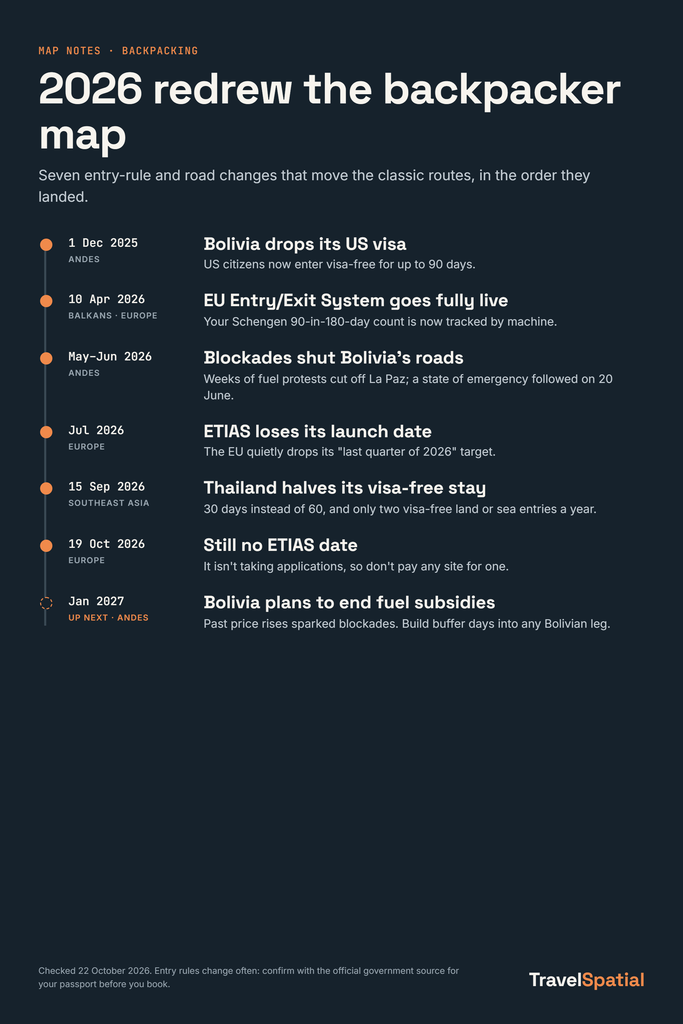
Entry rules here are checked as of October 2026 and change often. Confirm with the official government source for your passport before you book.
The Honest Take
The best backpacking route isn’t the cheapest or the most famous. It’s the one whose break you’ve planned for. Every line on this list has one: a border clock, a sold-out ticket, a road that closes, a gap with no road at all. Know where yours is before you leave and the rest of the trip can stay loose.
Then bend the line. Kampot instead of another Bangkok night. Copán instead of a fourth week at the lake. Arequipa before Cusco, Albania’s south after Dubrovnik, Essaouira after Marrakech. The detours are where the dorms get quieter and the money stretches.
Next step: pick one route from the table, set it against a calendar with our Travel Budget Template, and mark its break in red. Then sort cover with Travel Insurance, Explained Simply before you book anything non-refundable. Subscribe below for one honest guide a week.
Sources
- Slow boat Laos, 2026 (Backpackers Wanderlust)
- Southeast Asia on $30 a day in 2026 (Mad Monkey)
- Southeast Asia backpacking budget 2026, official fees (Travel Arbitrage)
- Thailand cuts visa-free stay to 30 days (TTG Asia)
- UK FCDO, Cambodia travel advice: Thailand land border (updated 18 November 2026)
- Cheapest Central American country, 2026 (LatAm Travellers)
- Sailing Panama to Colombia (Lonely Planet)
- Guatemala visa guide and the CA-4 rule (Living in Guatemala)
- Uyuni salt flats cost, 2026 (Bolivia Hop)
- Backpacker budgets, Central and South America (Hostelz)
- Machu Picchu tickets in 2026 (Peru Hop)
- Bolivia travel advice (Government of Canada)
- Bolivia drops visa requirement for Americans (Condé Nast Traveler via Yahoo)
- Bolivia blockade truce and fuel subsidies (Latin Times)
- How long to backpack the Balkans, 2026 costs (Hostelz)
- ETIAS has no launch date (Schengen Visa Info)
- Albania entry rules and Schengen (Schengen Traveler)
- Morocco travel budget, 2026 (eTravelSIM)
- Morocco backpacking budget (Hostelz)
- Budget travel in Morocco, 2026 (Social Life Magazine)
- Kénitra–Marrakech high-speed line (Railway Gazette)
11 comments on “5 Classic Backpacking Routes, Mapped (2026 Costs)”