Here’s the formula this whole article rests on:
Full days of sightseeing = nights − number of bases.
Every time you change base, you lose roughly a day: half of one packing and checking out, half of the next getting there and checking in. A stop of two nights gives you one full day. Three nights give you two. That’s why the most common rule of thumb for how long to stay in each city is three nights. The travel-costs site Price of Travel calls three days and nights “the magic number” for a European city (Price of Travel), and the formula shows why.
Below we put the formula to work: what it means for 7, 14 and 21 days, how to adjust it by city size, and why travelling solo shifts the answer a little further towards fewer, longer stops.
Why each move costs a day
A typical transfer day, door to door:
| Step | Typical time |
|---|---|
| Pack and check out (often by 10:00–11:00) | 1 hour |
| Get to the station or airport | 30–60 minutes |
| Wait, board, travel | 2–5 hours for most regional hops |
| Get from arrival to your room, check in (often from 14:00–15:00) | 30–60 minutes |
| Find food, get your bearings | 1 hour |
Add it up and a “short” two-hour train ride still takes five to eight hours of your day. You can see something on a travel day, such as an evening walk or a late dinner, but rarely a museum, a hike or a day trip. So the honest way to plan is to count travel days as gone, and treat anything you squeeze in as a bonus.
The formula at three trip lengths
Here’s the same trip length split across different numbers of bases. “Full days” are days with no transfer.
| Trip | Bases | Nights each (avg.) | Full days | Share of trip spent sightseeing |
|---|---|---|---|---|
| 7 nights | 4 | 1.75 | 3 | 43% |
| 7 nights | 3 | 2.3 | 4 | 57% |
| 7 nights | 2 | 3.5 | 5 | 71% |
| 14 nights | 7 | 2 | 7 | 50% |
| 14 nights | 5 | 2.8 | 9 | 64% |
| 14 nights | 4 | 3.5 | 10 | 71% |
| 21 nights | 9 | 2.3 | 12 | 57% |
| 21 nights | 6 | 3.5 | 15 | 71% |
| 21 nights | 5 | 4.2 | 16 | 76% |
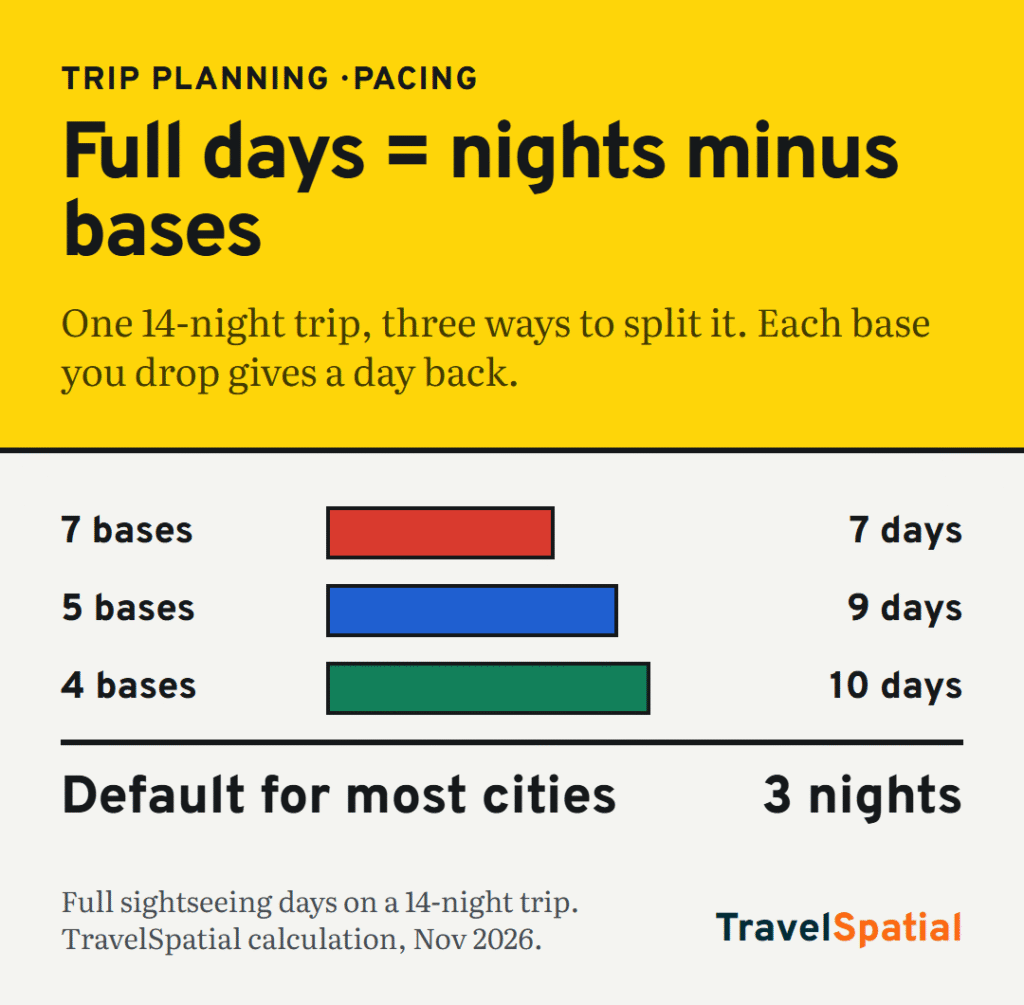
The pattern is plain: each base you drop gives you a whole day back. Going from seven bases to four in a fortnight is like adding three days to your holiday for free.
So how many nights should you spend in each city?

Start with three nights as the default, then adjust by what the place is:
- Big capital with a lot to see (Paris, Rome, Tokyo, Mexico City): 4–5 nights. Two full days barely covers the headline sights, never mind a neighbourhood or a day trip.
- Mid-sized city (Porto, Kraków, Kyoto, Oaxaca): 3 nights. Two full days is usually right.
- Small town or a single sight (Hallstatt, Český Krumlov, a ruin site): 1–2 nights, or a day trip. Often you don’t need to move base at all. Our guides to Vienna to Hallstatt, Prague to Český Krumlov and Rome to Pompeii by train do the day-trip-or-overnight sums.
- Beach or rest stop: at least 3 nights. One night by the sea isn’t rest. It’s a transfer with a view.
A useful check: list what you want to do in each place, one “big thing” per full day. If a stop has four big things and two full days, either add a night or cut two things.
The solo adjustment
The formula applies to everyone, but three things make moving cost more when you travel alone.
You do every part of the move yourself. There’s no one to watch the bags while you buy tickets, read the map while you drag the case, or decide on dinner when you’re tired. Each transfer takes more energy alone.
Planning is all yours. Every new base means researching a new neighbourhood, transport system and set of restaurants. Fewer bases means fewer evenings spent on your phone planning tomorrow.
Longer stays are how you meet people. On a second or third night you recognise the hostel crowd, the café owner says hello, you join the walking tour someone mentioned. Two-night stops reset all of that.
So for solo trips we’d shift the default up slightly: 3 nights as the minimum for anywhere you actually want to see, and a “zero day” every 7–10 days. That’s a day with no plan: laundry, a long lunch, a nap, a call home. It feels like a waste when you plan it, and like a lifesaver when you get there.
Three ways to see more without moving more
- Hub and spoke. Stay four or five nights in a well-connected city and do day trips. You unpack once.
- Use night trains or buses for long hops. Done right, they replace a night’s accommodation and a lost day. Our night train break-even test shows when that’s worth it.
- Book an open-jaw flight into one city and home from another. You save a whole day of backtracking.
A worked example: 14 nights in Europe
Say you want Paris, Amsterdam, Berlin, Prague, Vienna and Budapest in two weeks. Six bases in 14 nights gives you 8 full days, with six transfer days. That’s possible, but you’d spend nearly half the trip moving.
Drop to four: Paris (4), Berlin (3), Prague (3), Vienna (4). Now you have 10 full days, every stop has at least two of them, and Vienna gives you a spare day for Hallstatt or Bratislava. Amsterdam and Budapest become their own trip.
For a route that already follows these rules, see our Europe by train route: 6 cities in 18 days. For the wider planning process, from picking a route to booking, read how we plan a trip from scratch.
Summary
Full days = nights − bases. A two-night stop gives you one full day, which is why three nights is the sensible default. Spend four or five nights in big capitals, two or a day trip for small towns, and at least three anywhere you want to rest. Travelling solo, make three nights your minimum and plan a free day every week or so. When in doubt, drop a city: you’ll see more, not less.
Get more trip-planning tools in the TravelSpatial newsletter.
Sources
- Price of Travel, how long should you stay in each European city? 3 nights (checked November 2026)
- Price of Travel, how long to stay in each city: itinerary tips (checked November 2026)
Photo credits
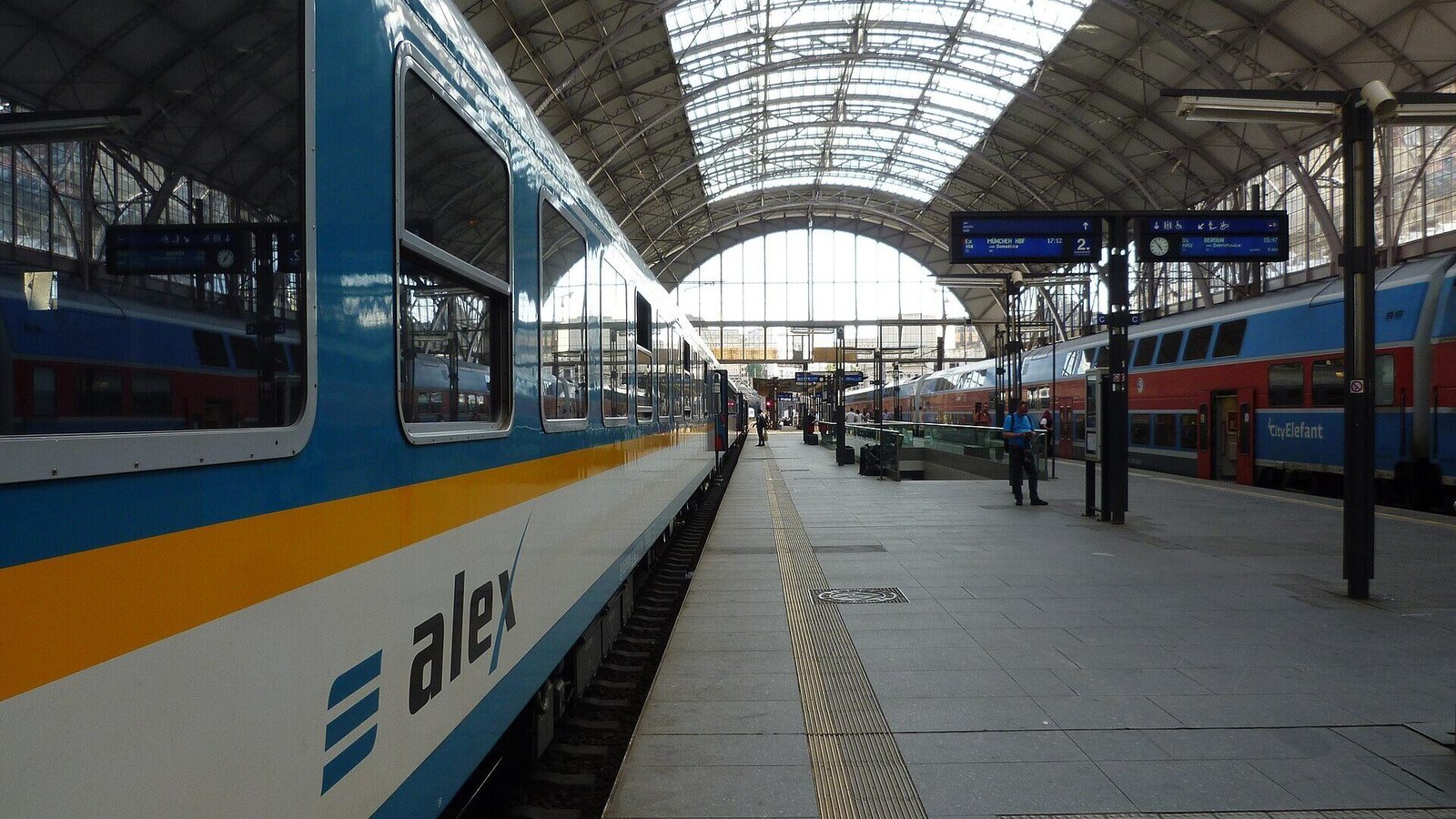
- Bahnsteig, "Praha hlavni nadrazi" by Rosa-Maria Rinkl, CC BY-SA 4.0, via Wikimedia Commons
- Hallstatt – Zentrum by C.Stadler/Bwag, CC BY-SA 4.0, via Wikimedia Commons
The infographic is original to TravelSpatial. Photos are used under the licences linked above.