Hostel volunteering is one of the best things that can happen to a solo trip. You get a bed, a crew of instant friends and a reason to stay somewhere longer than two nights. It’s also where a lot of travellers break immigration law without realising it.
The honest answer to “can I volunteer on a tourist visa?” is often no, and it depends on the country, not the platform. Several governments say outright that tourists can’t do unpaid work. Others allow narrow exceptions. Workaway, Worldpackers and similar sites leave the visa question entirely to you.
Below are the five things backpackers tell each other about volunteering visas, checked against what governments actually say.
Myth 1: “It’s unpaid, so it isn’t work”
This is the big one, and official guidance contradicts it again and again. Immigration rules tend to care about what you’re doing, not whether money changes hands.
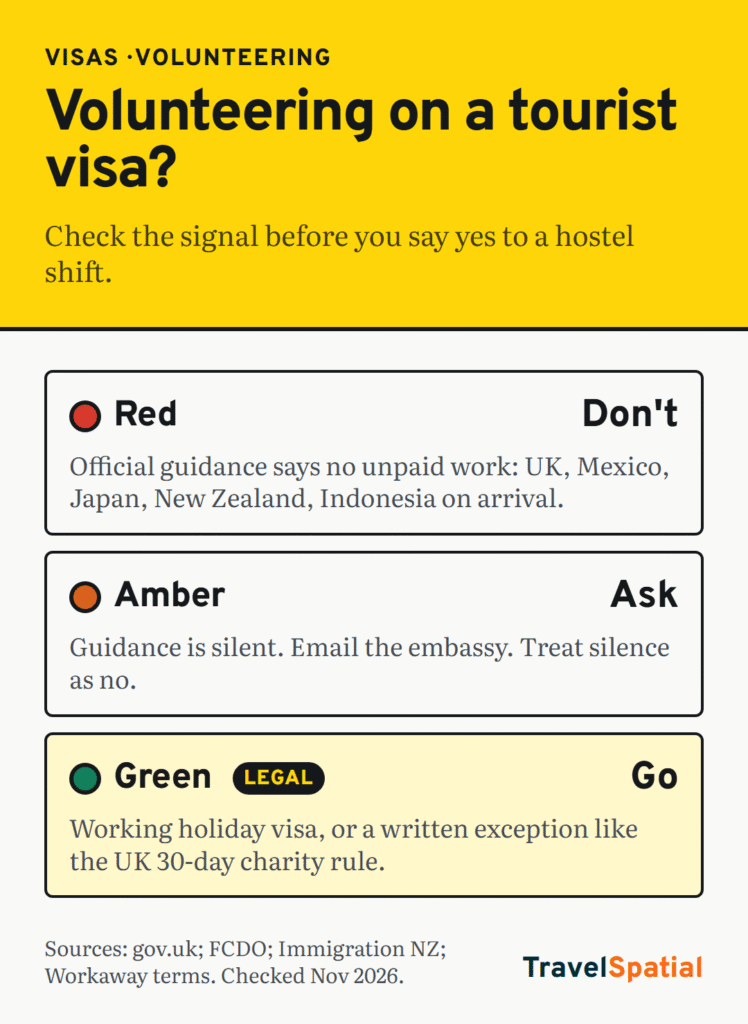
- United Kingdom: visitors need a work visa “if you want to do any other paid or unpaid work in the UK” (gov.uk, Standard Visitor).
- Mexico: “Tourists cannot do any type of voluntary or paid work or activity,” according to the UK government’s advice for Mexico. To volunteer, you need the correct visa from a Mexican embassy before you travel (FCDO, Mexico).
- Japan: the FCDO says it is illegal to work without the correct visa “no matter how informal or temporary the work” (FCDO, Japan).
- Indonesia: the 30-day visa on arrival “is not suitable for all business activities, volunteering, influencer work, or creating commercial online content” (FCDO, Indonesia).
Reception shifts, bar work, cleaning, building, teaching English: if it’s a job someone could be paid to do, assume an immigration officer will see it as work.
Myth 2: “Free room and board doesn’t count as payment”
Most exchanges trade your hours for a bed and meals. That’s exactly the arrangement many immigration systems treat as a reward for work.
New Zealand’s visitor visa page says plainly that “you cannot work” on it, beyond working remotely for an employer or client based overseas (Immigration New Zealand, Visitor visa). The French working-holiday network PVTistes, in its country-by-country guide to volunteering, says New Zealand treats accommodation and food as a reward, so volunteering for them on a tourist visa would break the rules (PVTistes, February 2026). It also says the US doesn’t allow visitors to do any work, even unpaid.
Even Workaway draws the line. Its terms tell hosts that if they need “more than volunteer help and cultural exchange”, they must pay at least the country’s minimum wage (Workaway terms, December 2025). If your four hours a day look like a staff rota, that’s a warning sign.
Myth 3: “The platform has checked the visa side”
It hasn’t. Workaway’s terms make you “solely responsible for complying with the relevant rules, laws and entry requirements in your home or visiting jurisdiction especially concerning applicable visas or work permissions”. Hosts carry the same responsibility in their country. PVTistes adds that WWOOF, HelpX and Workaway don’t provide visa information.
A listing being live on a big platform tells you nothing about whether you can legally take it. For how the two biggest platforms compare on price, vetting and support, see our Workaway vs Worldpackers guide.
Myth 4: “Nobody ever checks”
Maybe nobody checks this time. But the cost of being caught is out of all proportion to a free bed.
- At the border. Tell an officer you’re coming to “volunteer at a hostel” and you’ve told them you’re coming to work. That’s an easy refusal. Some countries also ask for an onward ticket, an accommodation address and funds, so the questions come naturally.
- In the country. Indonesia’s guidance warns that using the wrong type of visa is taken very seriously and can lead to prosecution, detention and deportation at your own cost.
- Afterwards. A refusal or deportation stays on your record, and future visa and ETA forms ask about it.
Myth 5: “A working holiday visa is overkill for a few weeks”
For anyone who qualifies, it’s the cleanest way to do this. Working holiday visas exist precisely so young travellers can work, and PVTistes notes that with one, “volunteering won’t be a problem either”. They’re usually for travellers in their twenties and early thirties, and age limits and eligible nationalities vary by country, so check the programme for your passport.
If you’re past the age limit, you’re not out of options. Our guide to hostels for travellers over 35 covers other ways to meet people without a dorm, and none of them need a work permit.
The exceptions that do exist
Some countries carve out narrow room for genuine volunteering. The UK is a good example of how narrow:
A Visitor may undertake volunteering provided it lasts no more than 30 days in total and is for a charity that is registered with either the Charity Commission for England and Wales; the Charity Commission for Northern Ireland; or the Office of the Scottish Charity Regulator.
That’s the UK’s Appendix Visitor, rule PA 3 (updated 8 October 2026). It covers a month helping a registered charity. It doesn’t cover a hostel, a farm or a surf camp, because those are businesses.
The pattern holds elsewhere: exceptions are usually for registered charities, for a limited time, and incidental to a holiday. A commercial hostel exchange rarely fits.
A traffic-light check before you say yes
| Signal | What it looks like | What to do |
|---|---|---|
| Red | The country’s official guidance says tourists can’t do unpaid work (UK beyond the charity rule, Mexico, Japan, New Zealand, Indonesia on a visa on arrival) | Don’t do it on a tourist entry. Get the right visa or skip it |
| Amber | Official guidance is silent or unclear | Email the country’s embassy and keep the reply. Treat silence as no |
| Green | You hold a working holiday visa, or the role fits a written exception (like the UK’s 30-day registered-charity rule) | Keep the visa or the charity’s registration details with your passport |
What to do instead
You can still get most of what volunteering offers, legally:
- Stay longer as a paying guest. Many hostels offer weekly rates that cost less than you’d think. Our hostel dorm guide helps you pick a sociable one.
- Join the hostel’s events, not its rota. Family dinners, walking tours and pub nights are where the friendships happen anyway. Our introvert’s guide to making friends in a hostel has an hour-by-hour plan.
- Plan a working holiday properly if you’re eligible, and fit it into a longer trip with our long-term solo trip planner.
The bottom line
Unpaid isn’t the same as legal. The UK, Mexico, Japan, New Zealand and Indonesia all say, in official guidance, that tourists can’t do this kind of work on a visitor entry, apart from narrow exceptions. Platforms leave it to you. If you want to volunteer, get a working holiday visa or another visa that allows it, or choose a role that fits a written exception. Otherwise, pay for the bed and keep the friends.
Travelling long term on a budget? Get our hostel and backpacking guides in your inbox. Sign up for the TravelSpatial newsletter.
Sources
- gov.uk, Standard Visitor: visit on business (“any other paid or unpaid work”; checked November 2026)
- gov.uk, Immigration Rules Appendix Visitor: Permitted Activities (PA 3 volunteering; updated 8 October 2026, checked November 2026)
- FCDO entry requirements: Mexico, Japan, Indonesia (volunteering and work on visitor entry; checked November 2026)
- Immigration New Zealand, Visitor visa (visitors cannot work; checked November 2026)
- Workaway, Terms and conditions (visa responsibility, minimum-wage line; last updated December 2025)
- PVTistes, Volunteering with WWOOF, Workaway or HelpX (country notes, working holiday visas; February 2026, checked November 2026)
Photo credits
- The Legacy by 2go4 City Center common area by Sdkb, CC BY-SA 4.0, via Wikimedia Commons
- Perth Youth Hostel Reception – geograph.org.uk – 4120019 by Rude Health, CC BY-SA 2.0, via Wikimedia Commons
The infographic is original to TravelSpatial. Photos are used under the licences linked above.