


Short answer: a standard single-trip travel policy is built for a holiday with a fixed return date. Digital nomad insurance is built for open-ended stays: it usually runs as a monthly subscription, can often be bought after you’ve left home, and limits how long it covers you back in your home country. If you’re away for more than a few weeks with no fixed end date, you probably need the second kind, or a long-stay or international health plan.
Below, the questions people actually ask about digital nomad insurance, answered from the providers’ own pages (checked November 2026). We’re not affiliated with any insurer, and this isn’t financial advice: read the policy wording before you buy.
What’s the difference between travel insurance and digital nomad insurance?
Travel insurance is bought per trip. You choose dates, you’re covered for medical emergencies and usually for things like cancellation, delays and lost luggage, and the policy ends when you get home. If you need a refresher on what a normal policy includes, our plain-English map of travel insurance goes through it section by section.
Digital nomad insurance is mostly travel medical insurance sold as a subscription. It keeps renewing until you stop it, and it’s designed around someone who moves between countries for months and sometimes goes home for a visit.
Can I buy it once I’m already abroad?
Often, yes, but there are conditions.
- SafetyWing: “Sign up before you depart or at any point during your travels or while living abroad.” Its Essential plan only starts “when you leave your home country” (SafetyWing).
- Genki Traveler: you can sign up “even if you’re already traveling abroad”, but if you had no cover before, “only medical emergencies are covered for the first 14 days” (Genki Traveler).
- World Nomads: you can “buy cover anytime, anywhere”, and there “may be a waiting period” if you buy while overseas (World Nomads).
That waiting period is the catch. Buy before you need it, not in the clinic waiting room.
Am I covered if I fly home for a visit?
This is the question most people forget, and the rules differ a lot.
- SafetyWing Essential: “For every 90 days, you are covered for up to 30 days in your home country” (15 days if your home country is the US). Complete has no home-country time limit (SafetyWing FAQ).
- Genki Traveler: home-country cover is “limited to emergencies only, during the first 6 weeks of each stay, after you have been abroad for at least 4 weeks” (Genki Traveler).
- Genki Native Basic covers up to 182 days per stay in your country of nationality after 91 days abroad. Native Premium has no day limit (Genki Native).
If you go home often, this line matters more than the price.
How much does it cost?
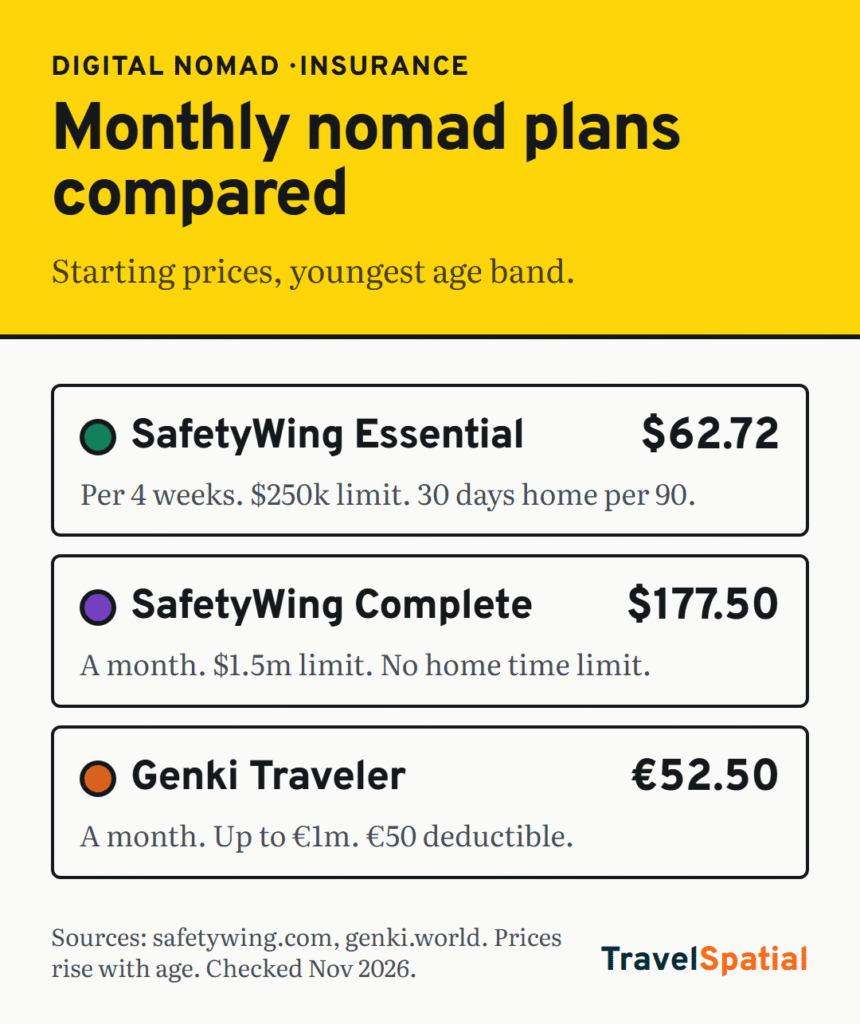
From the providers’ own pages, November 2026:
| Plan | From | Medical limit | Deductible |
|---|---|---|---|
| SafetyWing Essential | US$62.72 every 4 weeks (ages 10–39) | US$250,000 | None |
| SafetyWing Complete | US$177.50 a month (ages 18–39) | US$1,500,000 | None |
| Genki Traveler | €52.50 a month | Up to €1,000,000 | €50 (none for inpatient stays) |
| Genki Native Basic | €189 a month (ages 20–24, no deductible) | €1 million a year | €0, €500 or €1,000, your choice |
Prices rise with age, and US cover usually costs extra. SafetyWing’s FAQ says Nomad Insurance “does not have a deductible on either plan”.
What’s the fine print, in plain English?
| The policy says | What it means for you |
|---|---|
| “Pre-existing conditions excluded” | Anything you had before buying, such as asthma or a bad knee, may not be covered. SafetyWing excludes them on both plans. Genki Traveler excludes conditions with symptoms or treatment in the year before cover starts. |
| “Overall limit” | The most the insurer pays in total, not per claim. |
| “Home-country cover” | How many days you’re covered at home, and often only for emergencies. |
| “Waiting period” | Days after buying when some or all claims aren’t paid. |
| “Up to age 69” | The maximum age to buy. SafetyWing Essential and Genki Traveler both stop at 69. Genki Native sign-up stops at 55, and SafetyWing Complete at 64. |
| “Trips up to 12 months” | Genki Traveler’s limit per trip. Longer than that, look at a long-term plan. |

Do I need it for a visa?
Sometimes. Many digital nomad visas ask for health insurance valid in the country. Georgia now requires visitors to hold health and accident insurance for their whole stay, with at least 30,000 GEL of cover, from a Georgian or foreign insurer (FCDO Georgia entry requirements), which matters if you’re planning a month in Tbilisi. Check whether your policy’s certificate states the limits and dates a consulate or border officer will want to see. Some cheaper plans don’t meet visa requirements.
When is a subscription plan the wrong choice?
- You’re settling in one country for six months or more. International health insurance, or the local health system if you become a resident, may suit you better than travel medical cover.
- You have a pre-existing condition. Genki Native says it can cover declared conditions case by case. Most travel-style plans won’t.
- You need trip cancellation or valuables cover. Medical-first nomad plans may offer little or none of that.
- You’re over the age limit. Check before you plan around a policy.
What should I check before I buy?
- Can I buy it from where I am now, and is there a waiting period?
- How many days does it cover me in my home country?
- Is the medical limit high enough for the countries I’ll visit, especially the US?
- Are my existing conditions excluded?
- Does the certificate meet my visa or entry requirements?
- How do I claim, and how quickly? Our guide to making a travel insurance claim explains what paperwork to keep.
The one-paragraph answer
If your trip has a fixed end date, normal travel insurance is usually enough. If it doesn’t, digital nomad insurance gives you month-to-month medical cover you can often buy from abroad. Compare the home-country rule, the medical limit, pre-existing-condition exclusions and the waiting period, not only the monthly price. To see what insurance adds to a month’s costs, read what a digital nomad really spends per month.
For more practical guides, sign up for the TravelSpatial newsletter below.
Sources
- SafetyWing Nomad Insurance and FAQ, checked November 2026
- Genki Traveler and Genki Native, checked November 2026
- World Nomads travel insurance, checked November 2026
- FCDO Georgia entry requirements (minimum 30,000 GEL, whole stay), checked November 2026
- GPI Holding: mandatory insurance for tourists visiting Georgia, checked November 2026
Photo credits
- Thailand Bangkok Bumrungrad International Hospital Campus by Teesal (talk), Public domain, via Wikimedia Commons
- Thailand Bangkok Bumrungrad International Hospital interior by Pinaew (talk), CC BY-SA 3.0, via Wikimedia Commons
The infographic is original to TravelSpatial. Photos are used under the licences linked above.



4 comments on “Digital Nomad Insurance vs Travel Insurance: What a Monthly Policy Really Covers”